Something remarkable is happening in the global AI development community, signaling what many industry observers believe is the beginning of a profound shift in the software industry. Developers are no longer simply "vibe coding" basic websites, simple dashboards, and experimental applications. Instead, they are pushing the boundaries of what is possible by attempting to recreate entire, highly complex commercial software suites, including industry giants like Adobe Creative Cloud and Microsoft Office.
What makes this movement particularly fascinating is that many of these ambitious projects are not being engineered by massive enterprise teams with hundreds of employees and multimillion-dollar budgets. Rather, they are being built by individual developers leveraging the power of advanced AI coding agents. Two distinct projects have captured the attention of the tech world: an AI-powered reverse-engineering toolkit known as Reverse Engineer Anything, or REA, and a growing ecosystem of desktop software clones called ArtCraft.
For decades, the software market has wrestled with a stubborn and persistent hurdle: free alternatives to commercial software have always existed, yet they have struggled to capture mainstream enterprise and creative markets due to switching costs. Excellent open-source and free options are readily available today. GIMP has long served as an alternative to Adobe Photoshop, Inkscape offers robust vector graphics editing capabilities, and LibreOffice provides a comprehensive suite that rivals Microsoft Word, Excel, and PowerPoint.
However, a major barrier has consistently blocked widespread adoption. Most alternative applications feature their own unique interfaces, distinct keyboard shortcuts, and unfamiliar workflows. A professional who has spent a decade mastering the intricacies of Adobe Photoshop often finds that switching to GIMP feels less like transitioning to a new tool and more like learning an entirely different discipline from scratch.
This new generation of AI-built software clones is approaching the problem from a fundamentally different perspective. Instead of forcing users to adapt to a reinvented user experience, developers are attempting to painstakingly recreate familiar layouts, nested menus, standard shortcuts, and expected functionality. The theoretical promise is alluring: a user could open a free, independently built alternative to a major creative application and instantly know where every tool, panel, and setting is located. There would be no need for extensive tutorials, no disruption to established professional workflows, and, crucially, no expensive recurring subscription fees. While the actual stability, performance, and feature compatibility of these early clones still vary considerably, the concept has struck a powerful nerve across the developer and user communities.
REA Is Making Reverse Engineering More Accessible
One of the foundational projects propelling this broader movement forward is Reverse Engineer Anything, commonly known as REA. Created as an AI-powered reverse-engineering toolkit, REA has experienced an explosive rise in popularity, rapidly attracting more than 130,000 stars on GitHub in a remarkably short span of time.
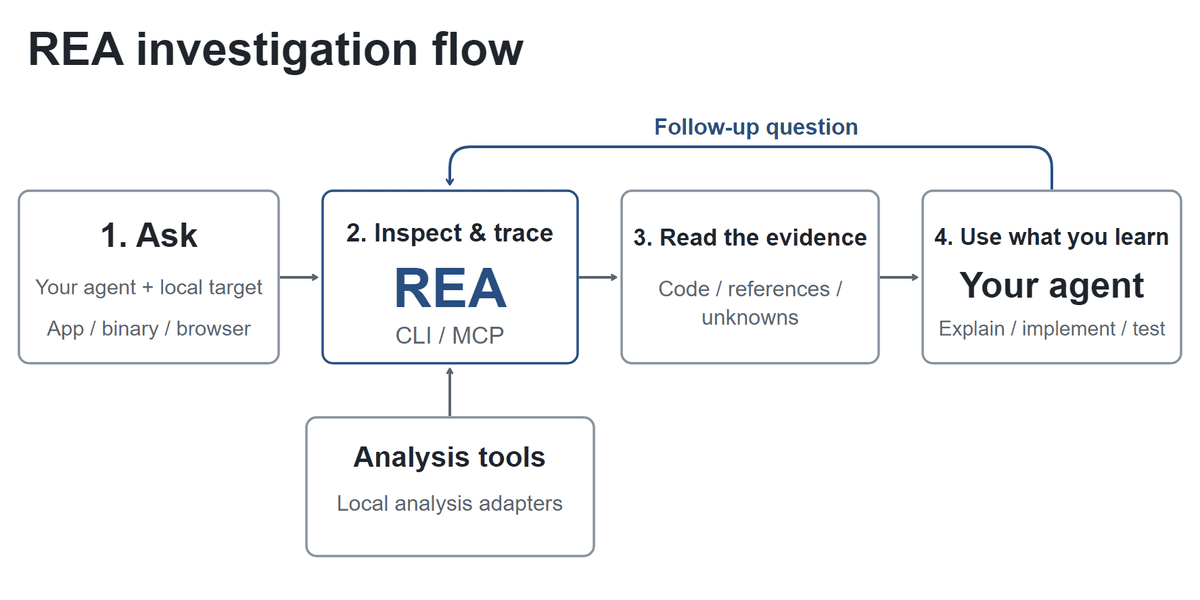
Traditionally, the process of reverse engineering commercial software has required highly specialized technical knowledge, mastery over complicated disassemblers and debuggers, and countless hours of tedious manual labor. REA attempts to democratize and accelerate this complex workflow by bridging the gap between modern AI coding agents—such as Claude Code, Codex, and Cursor—and established binary analysis tools like Ghidra, Hopper, and IDA Pro.
The core premise behind the toolkit is straightforward. A developer provides an application’s compiled binary file, and the integrated AI agent can systematically analyze its underlying functions, external dependencies, system architecture, and internal behavior without ever needing direct access to the original source code. Once the AI extracts these architectural insights and logic routines, developers can leverage those findings to accurately recreate specific features, understand proprietary file formats, or develop independent, clean-room software alternatives.
Developers across the open-source community are already experimenting creatively with this methodology. Prominent early showcases of REA in action include successfully reconstructing complex clipboard functionality inspired by Notion, recreating intricate sound calculation routines from classic titles like DX-Ball, and recovering foundational mathematical algorithms from older PC-98 software systems.
The implications of applying these techniques to broader commercial software suites are profound. While REA cannot magically conjure a flawless, production-ready clone of a multi-gigabyte application with a single click, it drastically lowers the barrier to understanding how legacy and proprietary software operates under the hood. By making internal software mechanics transparent, REA empowers independent developers to rebuild useful features and share their work openly.
ArtCraft Is Already Recreating Adobe and Microsoft Software
Alongside foundational toolkits like REA, individual developers are building complete end-user applications using conversational AI and modern systems programming languages. Developer Brandon Thomas has drawn widespread attention across social media and developer forums for constructing a coordinated family of Adobe-inspired creative applications built primarily using Claude and the Rust programming language.
The growing ArtCraft ecosystem features several ambitious applications designed to mirror industry standards. Among them are PhotoCraft, engineered for Photoshop-style raster image editing; VectorCraft, aimed at replicating Illustrator-style vector graphics manipulation; and FilmCraft, designed to offer Premiere-style video editing capabilities. When these projects first emerged, the developer set an exceptionally aggressive target of achieving comprehensive Adobe feature parity within a single month—an audacious goal that naturally invited a healthy degree of skepticism from veteran software engineers.
Yet, the ambition behind this movement extends far beyond creative suites into productivity and office software. The conceptual framework of ArtCraft and similar initiatives has begun touching upon territory traditionally dominated by Microsoft Office, with independent developers attempting to sketch out word processing, spreadsheet, and presentation tools that mimic established corporate standards.
What continually astonishes observers is not necessarily that these early-stage applications rival decades-old commercial giants on day one, but rather that a single independent developer can even conceive of building, testing, and iterating across multiple massive software categories in such a short window of time.
What Are People Saying About This?
The emergence of AI-generated software clones has sparked an intense global conversation characterized by a dynamic mix of unbridled enthusiasm and pragmatic skepticism. Within developer circles, many are genuinely astonished by the sheer velocity at which individuals can now scaffold, prototype, and refine complex software systems that previously demanded large, specialized engineering departments. Content creators, graphic designers, and administrative professionals have expressed excitement at the prospect of escaping escalating software licensing costs in favor of lightweight, familiar alternatives.
At the same time, industry veterans and software architects raise valid concerns regarding whether these rapidly assembled applications can truly match the long-term reliability, high-performance rendering, memory management, and exhaustive feature sets found in mature commercial products like Photoshop or Excel. Early testers evaluating these projects have frequently pointed out noticeable bugs, missing edge-case features, and occasional stability issues.
Despite these technical hurdles, the broader cultural and economic momentum is difficult to ignore. Technology users are increasingly questioning the sustainability of perpetual subscription models, wondering why they should continue paying steep monthly fees if AI-assisted development tools can eventually replicate core professional workflows at little to no cost.
Final Thoughts
The most striking aspect of this ongoing technological wave is its sheer speed. Projects like REA capturing over 134,000 GitHub stars within days of gaining widespread visibility demonstrates an immense, pent-up appetite within the global developer community for new ways to build and deconstruct software.
The convergence of advanced AI coding agents and reverse-engineering frameworks points toward a future where sophisticated software is no longer locked exclusively behind corporate paywalls. Instead, developers can investigate established tools, extract essential functionalities, and contribute modular alternatives back to the open-source ecosystem.
This phenomenon transcends any single repository or developer. ArtCraft and REA represent symptoms of a broader, structural transformation where individuals and small, agile teams can accomplish software development feats that once required years of dedicated corporate investment.
Ultimately, the most profound implication of this movement may not be the immediate displacement of industry giants, but the fundamental redefinition of software ownership. If independent developers can successfully deliver familiar interfaces, reliable performance, and essential features through AI-driven workflows, the traditional software market may soon face a future where users are no longer willing to pay for subscriptions out of habit alone. As the developer community continues to experiment and iterate, the boundaries of what a single programmer can achieve are being rewritten in real time.