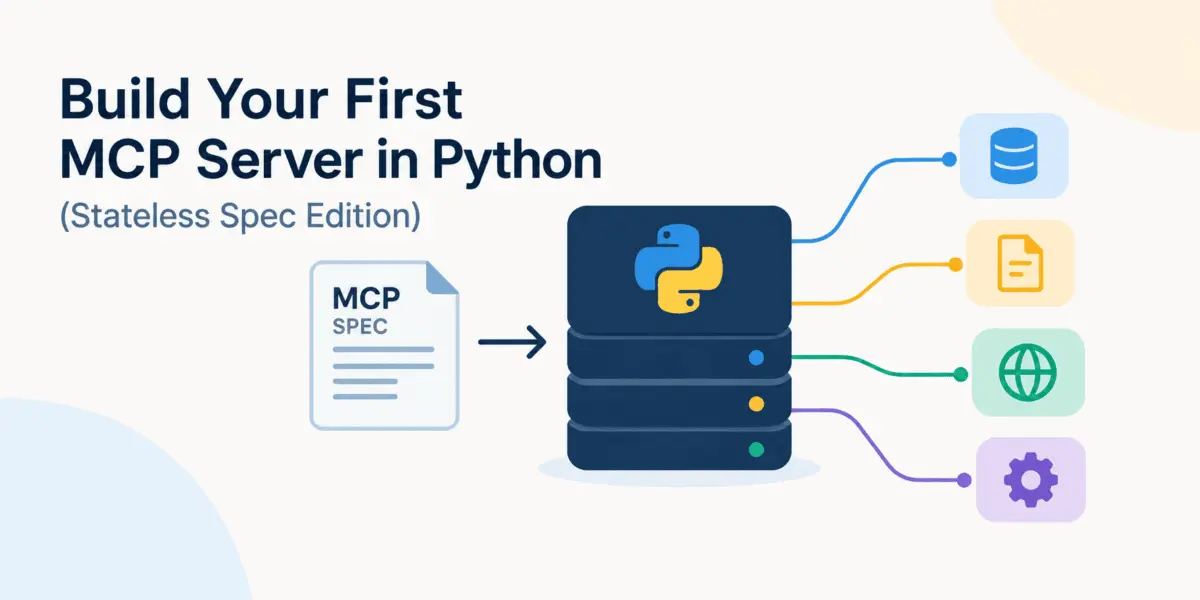
The Model Context Protocol (MCP) has undergone a fundamental architectural evolution following a critical update to its core specification. Introduced late this July, the 2026-07-28 MCP specification shifted the protocol’s core to a fully stateless model, eliminating the previous requirement for modern clients to establish a formal protocol session prior to dispatching requests. Concurrently, servers are no longer burdened with tracking state through Mcp-Session-Id parameters for ordinary operations. This architectural redesign drastically simplifies the deployment of MCP servers, allowing them to scale effortlessly behind standard HTTP infrastructure without requiring complex session-management or sticky routing configurations.
Alongside these protocol-level changes, the official Python SDK has advanced to version 2 as its primary stable line. This latest iteration introduces a high-level MCPServer application programming interface designed to streamline how developers define tools, resources, and prompts using standard Python functions. Rather than manually constructing JSON schemas or complex protocol metadata, developers can now leverage native Python type hints and decorators to expose functionality to large language models. This development brings the creation of network-accessible AI applications closer to conventional software engineering, removing unnecessary framework boilerplate.
To demonstrate the capabilities of the updated Python SDK under the stateless specification, developers have begun constructing streamlined server architectures, such as developer knowledge-base systems. These applications expose distinct MCP primitives—specifically tools for querying data, resources for loading static context, and prompts for guiding language model behavior—without retaining any user session state on the server. Every incoming request contains all the information necessary for processing, exemplifying the core philosophy of the stateless protocol model.
The foundation of this architecture relies on the high-level MCPServer class provided by the updated Python SDK. While the SDK retains a lower-level Server class for advanced scenarios requiring exact control over schemas and protocol metadata, the MCPServer interface handles the heavy lifting for typical implementations. By integrating standard Python data structures and simple lookup functions, developers can map search queries or data retrieval logic directly into the AI agent’s execution loop.
One of the most notable developer experience improvements in the version 2 Python SDK is the elimination of manual schema writing. In previous iterations, exposing a function to an AI model often required explicit schema definitions, argument parsers, or handwritten tool manifests. Under the current SDK, type hints and default argument values within standard function signatures are automatically translated into valid MCP input schemas. A function accepting a search query and a limit parameter directly informs the client regarding required fields and default behaviors, streamlining the interface definition process.
Beyond interactive tools, which function essentially as action-oriented operations callable by the model, the protocol distinguishes between actionable tasks and passive data access through resources and prompts. Resources expose read-only information via uniform resource identifiers, allowing host applications to inject relevant context directly into the model’s working memory without requiring explicit tool execution. This separation of concerns aligns read operations with standard retrieval patterns and action operations with execution logic. Meanwhile, reusable prompt templates provide structured guidance for specific interactions, ensuring consistent behavior across different deployment environments.
Development workflows have similarly benefited from the updated SDK ecosystem. The inclusion of dedicated development commands launches MCP servers alongside inspection interfaces, providing real-time visibility into available tools, resources, and prompts. This tooling allows developers to test interactions, verify argument schemas, and execute trial queries locally before moving applications to production environments.
When transitioning from local development to network deployment, the updated SDK supports Streamable HTTP configurations out of the box. By default, applications expose standard endpoints capable of handling incoming requests seamlessly. For more complex production environments, the server instance can export a standard ASGI-compatible application, allowing integration with high-performance web frameworks like Uvicorn, FastAPI, or Starlette. This compatibility ensures that MCP servers can operate as isolated microservices or run alongside larger web application architectures.
The shift toward a stateless protocol core carries significant implications for scalability. Under older protocol iterations, bidirectional, stateful interactions required clients to initialize sessions that tied subsequent requests to specific server instances. This often necessitated sticky routing or distributed session stores to maintain continuity across multi-worker deployments. The modern stateless model decouples requests entirely, meaning incoming calls can be routed to any available worker in a multi-instance pool without degrading functionality or losing context.
Despite the stateless nature of the protocol itself, application-level state remains entirely achievable. The architectural distinction lies in where that state is managed: rather than hiding session data within the protocol layer, the application manages state explicitly through identifiers passed directly between the client, the model, and the server. For instance, workflows requiring shopping baskets or multi-step transactions can generate unique identifiers and require the language model to pass those handles back in subsequent tool calls. This explicit-handle pattern ensures that distributed backends remain robust and horizontally scalable while still supporting complex, stateful user interactions.
The broader adoption of the 2026-07-28 specification and the version 2 Python SDK marks a maturing ecosystem for AI context integration. By removing the handshake requirements, session warming routines, and sticky routing dependencies of earlier versions, the updated protocol allows developers to focus on core application logic. As organizations increasingly deploy AI agents across distributed cloud environments, the combination of stateless request handling and native Python abstractions provides a scalable foundation for the next generation of intelligent tools.