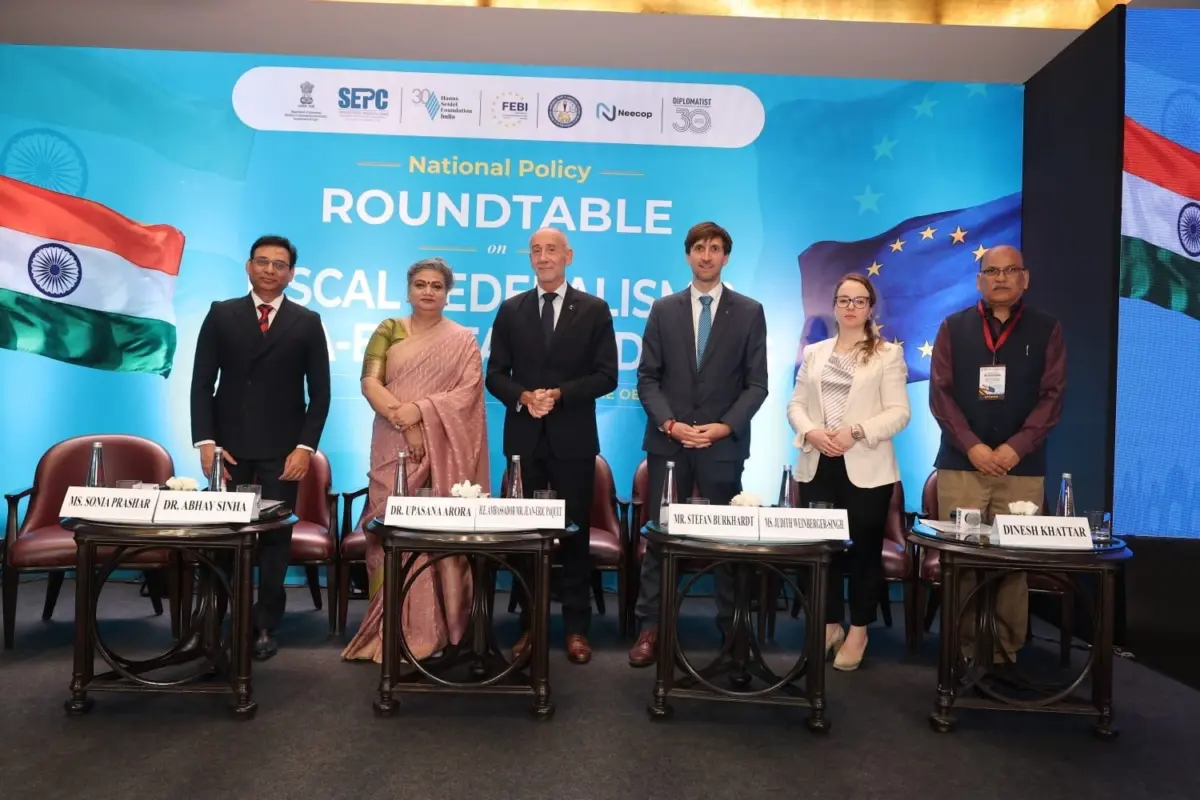
As India and the European Union step closer toward a transformative chapter in their bilateral economic relations, policymakers, diplomats, industry leaders, and academic experts gathered in the national capital to confront a critical reality: negotiating a historic free trade agreement is only the starting point. The true measure of success will rely heavily on India’s structural, institutional, and fiscal preparedness at the sub-national level to translate high-level market access into genuine economic opportunities on the ground.
This pressing implementation challenge took center stage at the National Policy Roundtable on Fiscal Federalism and India–EU FTA Readiness, held at The Oberoi in New Delhi. Organized by the Services Export Promotion Council (SEPC) in close collaboration with the Hanns Seidel Foundation (HSS) India, the Federation of European Business in India (FEBI), Diplomatist Magazine, and other key institutional partners, the full-day conference brought together a diverse ecosystem of stakeholders to examine whether India’s administrative and fiscal architecture is fully equipped to maximize the benefits of the impending trade pact.
Throughout the day-long discussions, a central theme resonated across panels and keynote addresses: while international trade agreements are fundamentally negotiated and signed at the national level, their practical, everyday impact is heavily dictated by state-level capabilities. From transportation infrastructure and specialized workforce skills to regulatory compliance, investment facilitation, and rigorous sustainability standards, the building blocks of export competitiveness fall largely within the functional domain of India’s state governments.
Beyond Tariffs: The Implementation Challenge
As deliberations unfolded, participants emphasized that successfully leveraging the India–EU Free Trade Agreement will require businesses to look far beyond simple tariff reductions and broad market access. To thrive in the demanding European marketplace, Indian enterprises will need to navigate intricate standards and certification requirements, strict sustainability norms, sophisticated digital infrastructure, localized skills availability, and increasingly resilient supply chains.
Because many of these critical components fall under the implementation purview of state administrations, the conference closely scrutinized India’s institutional and fiscal readiness. Discussions shed light on how state-level public investment, fiscal federal arrangements, and proactive administrative frameworks directly influence export competitiveness.
A focal point of the policy discussions was the introduction of the proposed EU–India FTA State Readiness Index. This novel framework seeks to establish measurable, objective indicators to assess how prepared individual Indian states are to embrace and leverage the opportunities presented by the trade agreement. Experts noted that strengthening Centre–State coordination, upgrading institutional capacity, and channeling public investment toward export-oriented sectors will be indispensable in ensuring that economic gains are widely distributed across different regions and business communities.
High-Level Inaugural Session Sets the Tone
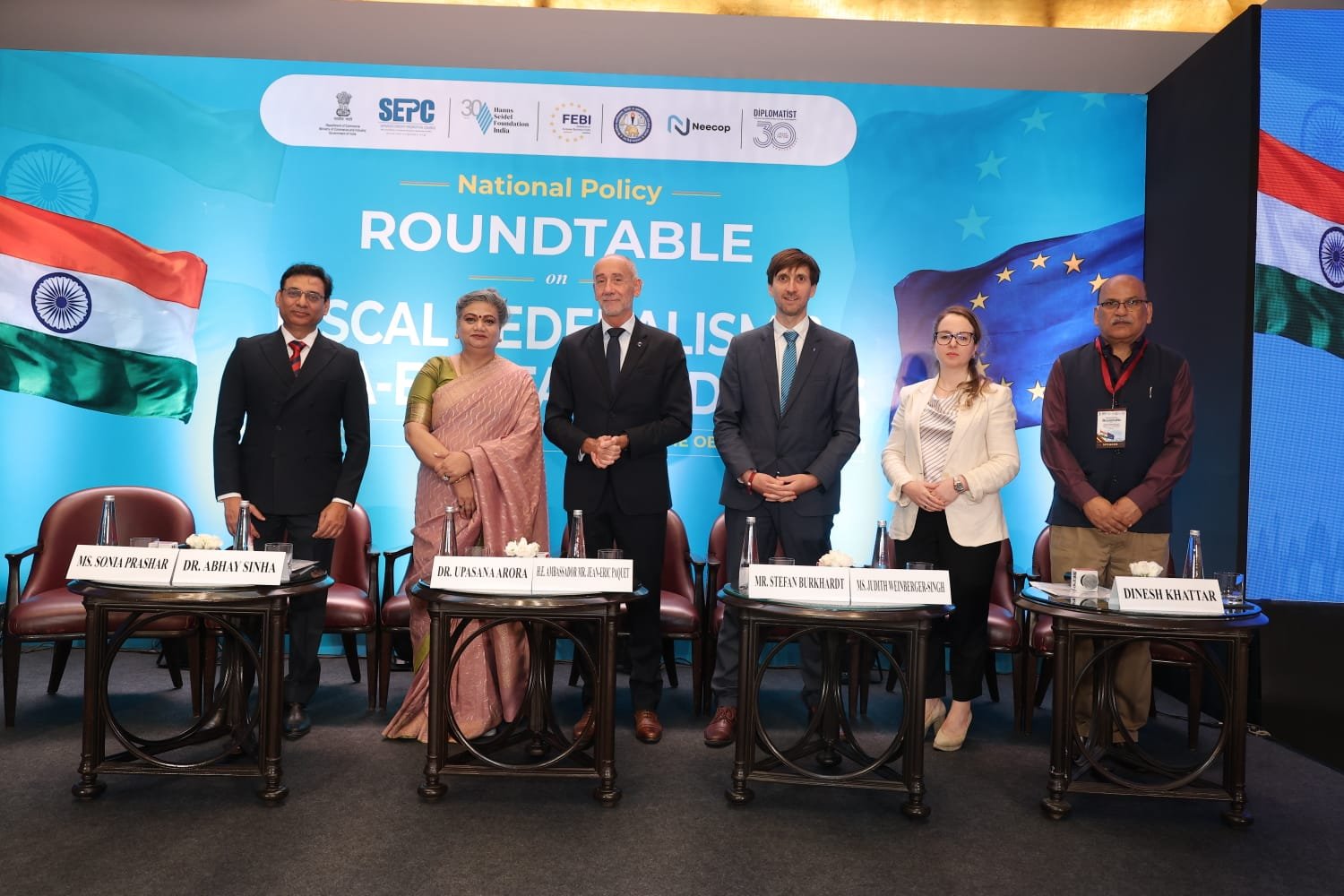
The high-profile inaugural session commenced with a warm welcome address delivered by Dr. Upasana Arora, Chairperson of the SEPC, followed by introductory remarks from Prof. Dinesh Khattar, Principal of Kirori Mal College at the University of Delhi.
Setting the precise context for the day’s deliberations, Dr. Abhay Sinha, Director General of the SEPC, outlined the strategic importance of sub-national preparedness. The opening segment also featured valuable insights from international and industry leaders, including Ms. Judith Weinberger-Singh, Resident Representative of HSS India; Mr. Stefan Burkhardt, Head of Division for South and Southeast Asia at the Hanns Seidel Foundation in Germany; and Ms. Sonia Prashar, Secretary General of the Federation of European Business in India.
Providing a vital European perspective on the evolving economic partnership, H.E. Ambassador Jean-Eric Paquet, Head of the Delegation of the European Union to India and Bhutan, delivered the keynote address. Ambassador Paquet underscored the immense potential of the FTA while stressing the importance of regulatory transparency, cooperative governance, and mutual trust between Indian and European stakeholders.
Assessing Institutional and Fiscal Readiness
The first technical session of the roundtable, titled "Assessing India’s Institutional and Fiscal Readiness for the India-EU FTA," turned its focus toward the broader macroeconomic and administrative frameworks necessary to empower states.
Moderated by Mr. Sujit S. Nair, Chairman of the Europe India Centre for Business & Industry, the session featured prominent academic voices, including Prof. Rekha Saxena, Prof. Chanchal Kumar Sharma, and Prof. V.N. Alok. The panel explored the intricate dynamics connecting fiscal federalism, public capital expenditure, and regional export competitiveness, analyzing how fiscal policies can be optimized to prepare states for emerging international market demands.
Building State Capabilities and Overcoming Non-Tariff Barriers
Transitioning from macro-level fiscal theory to the practical realities of trade implementation, the second technical session examined "Building State Capabilities for India-EU FTA Implementation: Non-Tariff Barriers, Sustainability and Resilience."
Moderated by Prof. Basanta Sahu, Professor and Head of the Economics Division at the Indian Institute of Foreign Trade (IIFT) Delhi, the panel featured a lineup of trade and economic experts. Dr. Bipin Sapra, Partner and Leader of Indirect Tax & Economic Policy at EY; Mr. Ajay Bisaria, Corporate Strategic Advisor and Distinguished Fellow at the Observer Research Foundation (ORF); Dr. James J. Nedumpara, Head of the IIFT Centre for Trade and Investment Law; and Mr. Dinesh Chand Sharma, Director of Standards and Public Policy and Seconded European Standardization Expert in India, contributed their expertise.
The speakers engaged in a deep dive into the hurdles posed by non-tariff measures and stringent European sustainability frameworks. They emphasized that state-level institutions must proactively develop the capabilities required to help domestic businesses—particularly small and medium enterprises—understand and comply with evolving international standards without losing their competitive edge.
From Market Access to Market Presence: The Business Viewpoint
Bringing the corporate voice directly into the policy dialogue, the third technical session was themed "From Market Access to Market Presence: What Businesses Need from States to Make the India–EU FTA Implementation Effective."
Dr. Bidisha Bhattacharya, Associate Fellow and Head of Research at the Centre for Economy and Trade within the Chintan Research Foundation, delivered the context-setting remarks. The session was expertly moderated by Mr. Alok Kesari, Director of Policy Advocacy and Trade Facilitation at FEBI.
The panel offered a pragmatic look at corporate expectations, featuring senior industry executives such as Mr. Bikas Kr. Singh, Vice-President and India Head of Government Affairs at SAP; Mr. Rishi K. Chawla, Vice-President of Corporate Affairs at Carlsberg India; Mr. Sidharth Prasad, Director of Public Affairs & CSR at Michelin India; and Mr. Vineet Gupta, Head of Government Affairs at Siemens Healthineers.
The discussion placed a sharp spotlight on the concrete steps state governments must take to help foreign and domestic enterprises transition past the initial promise of market access and establish a robust, highly competitive long-term presence across India’s diverse commercial landscapes.
A Broad International Stakeholder Dialogue
Reflecting the immense scope of European interest in India’s expanding trade and investment architecture, the roundtable drew an exceptionally diverse roster of international participants. Diplomats and official representatives from the Czech Republic, Malta, Croatia, Poland, Cyprus, Lithuania, Austria, Sweden, the Netherlands, the Russian Federation, Romania, and Belgium took part in the proceedings, alongside a dedicated delegation from the Lumora Foundation representing Estonia.
This multi-faceted participation underscored a core message of the conference: successful trade agreements require continuous, open communication connecting national governments, sub-national administrators, commercial enterprises, academic institutions, and international partners.
Strengthening the Centre–State Connect for Long-Term Competitiveness
As the comprehensive day of discussions drew to a close, a clear consensus emerged around the necessity of bridging the gap between national trade policy and state-level execution. Strengthening the Centre–State connect means ensuring that regional infrastructure is upgraded, regulatory red tape is minimized, institutional mechanisms are fortified, and local enterprises receive the administrative backing required to tap into lucrative foreign markets.
The conference concluded with a formal valedictory session addressed by Dr. Abhay Sinha, Director General of the SEPC, who summarized the key takeaways and outlined the path forward for institutional stakeholders.
As India prepares to deepen its economic partnership with the European Union, the National Policy Roundtable made it abundantly clear that negotiating a landmark trade treaty is merely the beginning. The ultimate test will lie in cultivating the institutional strength, infrastructural depth, and resilient business ecosystems necessary to transform policy frameworks into sustained investments, expanded exports, quality employment, and enduring economic competitiveness across every region of India.