For nearly forty years, John Steinbach has lived in his home in Manassas, Virginia. In January 2026, he opened his mail to find an electricity bill for $281—a sharp increase from the roughly $100 he had paid just the month before. Speaking with Consumer Reports, Steinbach noted that the figure was entirely unprecedented in his decades at the property. What troubles him even more is where utility rates might climb next, especially as a growing network of artificial intelligence data centers plugs into the electrical grid surrounding his community.
Steinbach is far from alone in his anxiety. A Gallup poll conducted in March 2026 revealed that seven in ten Americans oppose the construction of AI data centers in their local areas, with nearly half of respondents expressing strong opposition. This resistance cuts across political lines, with majorities of Democrats, Republicans, and independents alike voicing concern over the rapid proliferation of massive computing facilities.
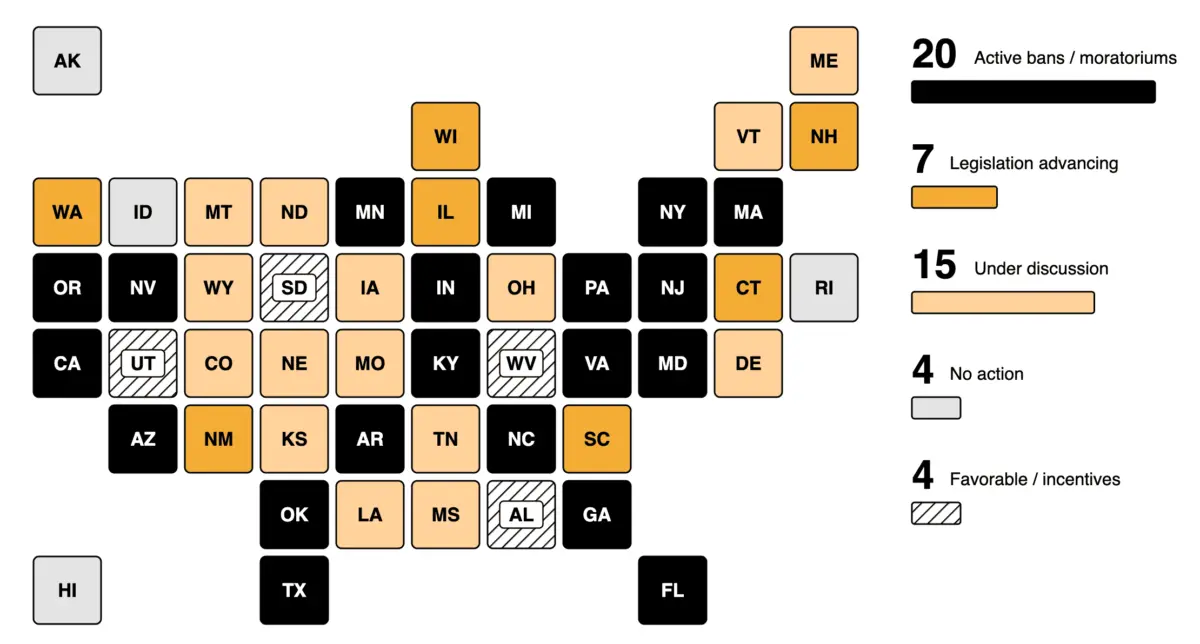
This widespread local opposition has tangible consequences. According to data from Data Center Watch, community pushback disrupted approximately 120 projects during the first half of 2026 alone. At least 45 of those projects, valued at roughly $68 billion, stalled out during the second quarter. Across the United States, roughly 379 jurisdictions have adopted moratoriums or outright barred data centers from their borders.
In August, the Indianapolis City Council voted 23 to 1 to block new data center construction through 2027. Meanwhile, Charlotte enacted a 150-day moratorium on approvals following a municipal survey that found 78 percent of residents opposed such developments. According to the Brookings Institution, political candidates from both major parties are increasingly running campaign advertisements targeting the facilities.
Public debates are typically framed around a binary question: whether data centers should be built at all. Beneath that surface, however, lies a much more complicated and contentious issue concerning who pays for the infrastructure and who gets to decide its fate. The financial and environmental costs tend to land locally and immediately, while the economic benefits often arrive regionally or nationally at a much later date. Crucially, the regulatory rules governing how these costs and benefits are split were written long before AI-scale electricity demand ever existed.
Why AI Changed the Math
Traditional cloud computing data centers were built around general-purpose servers whose power loads rise and fall dynamically with user traffic. In contrast, modern artificial intelligence clusters pack graphics processing units far more densely, generate significantly higher levels of heat per rack, and draw massive amounts of power around the clock during intensive model training runs. This fundamental shift completely alters what a single campus demands from local electrical grids and water systems.
According to a report prepared for the Department of Energy by the Lawrence Berkeley National Laboratory, U.S. data centers consumed approximately 176 terawatt-hours of electricity in 2023, accounting for roughly 4.4 percent of the nation’s total power supply. The primary point of contention, however, centers on the exponential growth projected for the near future.
A power report published in January 2026 by Bloom Energy projected that U.S. data center IT loads will nearly double, climbing from approximately 80 gigawatts in 2025 to roughly 150 gigawatts by 2028. While this projection comes from an industry vendor that sells on-site power systems, it highlights a legitimate logistical bottleneck that utilities and developers face. Regional utilities often expect to deliver necessary grid power 1.5 to 2 years later than developers’ timelines require. Consequently, developers anticipate that roughly a third of data centers will need to run entirely on on-site power generation by 2030. When the public grid cannot keep pace with technological expansion, private companies simply build their own power plants.
Electricity Bills: Who Pays for the Next Grid
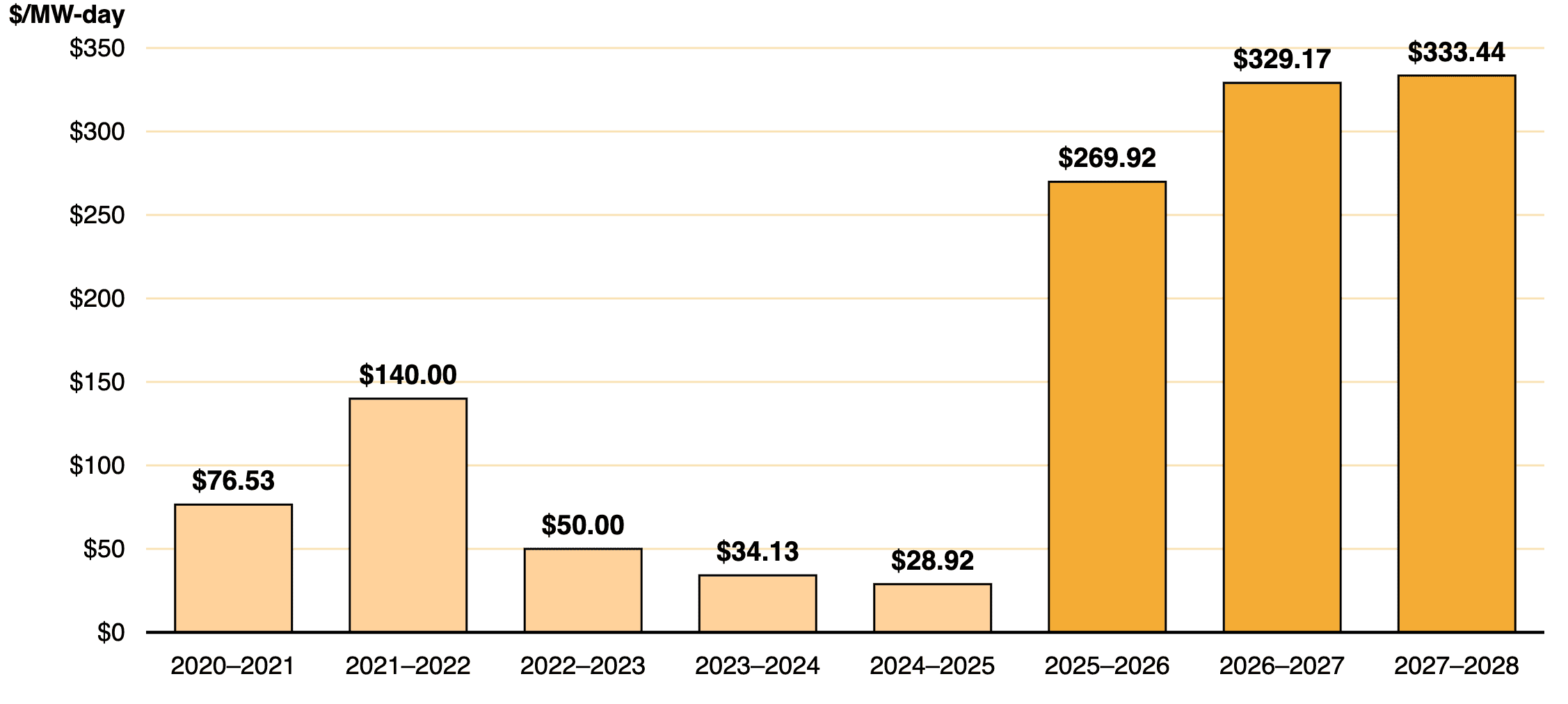
Public concern frequently begins within the wholesale electricity markets. PJM Interconnection, the regional grid operator serving 13 states and Washington, D.C., runs capacity auctions designed to pay power plants to remain available during peak demand periods.
The clearing prices in these auctions have skyrocketed. The rate rose from $28.92 per megawatt-day for the 2024–2025 period to $269.92 for 2025–2026, before hitting the regulatory price cap in subsequent auctions at $329.17 and $333.44. PJM’s independent market monitor attributed 63 percent of the 2025–2026 price increase—amounting to roughly $9.3 billion—directly to rising data center demand.
Other economic indicators point in a similar direction. Data from the U.S. Energy Information Administration shows that residential electricity prices in Virginia rose about 13 percent over a twelve-month period. A January 2026 survey conducted by the Global Strategy Group and the Chesapeake Climate Action Network Action Fund found that nearly three-quarters of Virginia voters blamed data centers for the rising costs.

Looking toward the end of the decade, a peer-reviewed modeling study conducted by researchers from North Carolina State University, Carnegie Mellon, and other institutions projects that wholesale electricity prices will be 6 percent to 29 percent higher nationally by 2030 than they would be without data center growth, with surges of up to 57 percent in the hardest-hit regions. These figures reflect modeled wholesale market prices rather than direct retail utility bills.
Conversely, the technology industry argues that large, stable corporate customers typically help lower overall rates. An Electric Power Research Institute study examining the decade from 2015 to 2024 concluded that each doubling of data center capacity correlated with average retail prices being 3.5 percent lower, because large and steady power loads allow utilities to spread fixed operational costs across a broader sales base.
An Amazon-funded study conducted by the energy consultancy E3 found that Amazon’s utility payments in four service territories met or exceeded the actual cost of serving its data centers, leaving an average net surplus of about $3.4 million per site. A separate E3 report funded by the Data Center Coalition estimated that load growth accounted for roughly 50 percent of the 2025–2026 PJM price increase, a figure notably lower than the market monitor’s assessment. Meanwhile, the Institute for Energy Research published findings indicating no statistically significant correlation between a state’s count of data centers and its average electricity prices.
Empirical studies often arrive at a verdict of "not yet." The New Jersey State Policy Lab at Rutgers University found no statistically significant effect on utility-level residential bills through 2024, while noting that a temporary lack of impact does not mean long-term stability is guaranteed.
Historically, the financial benefits of industrial customers depended heavily on having preexisting spare capacity on the grid. If infrastructure is built out to meet projected energy demands that ultimately fail to materialize, the massive fixed costs associated with expanding grid capacity will inevitably be shifted onto a smaller pool of everyday ratepayers. At the same time, utilities are grappling with rising baseline costs for transmission and distribution updates required for weather hardening and grid modernization, making the central question not just whether bills have risen yet, but who will finance the next wave of mandatory grid expansion.
Water: National Totals, Local Stress
Water-cooled data centers can consume millions of gallons of water on a single hot summer day, putting intense pressure on municipal infrastructure in arid regions. Arizona, for instance, faces a stringent federal mandate cutting its allocation from the Colorado River by 760,000 acre-feet—a reduction of nearly 30 percent.
This regional water scarcity has directly influenced local political decisions. In August 2025, the Tucson City Council unanimously rejected Amazon’s proposed Project Blue amid heavy community pressure, while the nearby town of Chandler rejected another proposed AI facility by a 7–0 vote that December. In Florida, Orange County’s vice mayor proposed a one-year moratorium on new facilities, pointing to a projected local groundwater shortfall of 96 million gallons per day by 2045.
While viral internet estimates suggest that a typical AI prompt consumes significant amounts of fresh water, corporate data provides a more nuanced picture. Google’s operational figures for a median Gemini text prompt indicate a consumption rate of roughly 0.26 milliliters—about five drops of water—though that metric only accounts for water evaporated directly on-site.
From a macro perspective, the Lawrence Berkeley National Laboratory estimated that U.S. data centers consumed roughly 17.5 billion gallons of direct water in 2023, a figure projected to double or quadruple by 2028. However, analysts note that this represents a fraction of total national freshwater consumption, with agricultural sectors routinely accounting for the vast majority of water usage in western states.
Nevertheless, national averages frequently obscure severe local strain. In Botetourt County, Virginia, a planned Google campus could consume up to 2 million gallons of water daily—potentially reaching 8 million gallons—in a rural county where many residents rely entirely on private residential wells. To accommodate the project, the county committed $300 million toward developing a new regional water supply, offset largely by anticipated commercial tax revenues.
Jobs and Tax Revenue: A Strong Case and a Thin One
The most compelling argument in favor of data centers centers on municipal tax revenue and commercial property values. Data centers across Northern Virginia contributed an estimated $1.3 billion in local property taxes in 2024, pushing the total local revenue supported by the sector past $2 billion, according to the Chamber of Progress.
Quincy, Washington, is frequently cited as a model for economic transformation. In the small farming community, roughly 30 data centers account for an estimated 57 percent of the local property tax base. This influx of revenue helped finance a $120 million high school, a local hospital, new police and fire stations, and a $30 million water reuse facility constructed in partnership with Microsoft.
In Texas, industry data cited by the Texas Tribune indicated that data centers accounted for more than 61,000 direct jobs and generated $3.5 billion in state and local taxes in 2023. Company officials estimated that a single proposed $10 billion campus would contribute $50 million annually to Lacy Lakeview, a town of approximately 7,000 residents. Even legislative auditors in Virginia ranked the state’s data center tax exemption as its second-most productive economic development incentive, generating $6.1 million in personal income for every $1 of foregone tax revenue.
In contrast, the employment footprint of these facilities is remarkably modest. An analysis by the Brookings Institution covering roughly 1,500 facilities found that a county’s first major data center adds only 100 to 200 jobs over a decade, with little to no noticeable impact on local wage levels. State incentive programs reflect this reality, with Texas granting tax exemptions to facilities of at least 100,000 square feet that create as few as 20 jobs, and Maryland requiring just five jobs and a $2 million investment in targeted areas. While construction jobs provide a substantial economic boost, those positions vanish once the physical buildings are completed.
Recognizing these structural imbalances, several state governments have begun reevaluating their incentive packages. Governors in Illinois, Massachusetts, Nebraska, Nevada, and Ohio paused or reworked data center tax breaks, while Arizona temporarily froze new awards for three years. Virginia preserved its sales tax exemption but instituted a temporary electricity levy of 1.1 cents per kilowatt-hour on data center power consumption, capped at $600 million annually.
Air Pollution and On-Site Power: The Memphis Case
While most data centers rely on traditional utility connections, some extreme examples illustrate what happens when developers choose to bypass the public grid entirely. To bring its massive Colossus 1 supercomputer online in 2024, xAI deployed dozens of trailer-mounted methane gas turbines in South Memphis. The units were situated near Boxtown, a residential community already burdened by decades of concentrated industrial pollution. For the subsequent Colossus 2 project, the company positioned even more turbines just across the state line in Southaven, Mississippi.
Initially classified as non-road mobile engines, the turbines operated without standard stationary air permits until the U.S. Environmental Protection Agency issued a clarification in January 2026 confirming that large, continuous gas turbines require formal permitting. SpaceX, which acquired xAI, subsequently announced that it would take more than a year to fully phase out the unpermitted turbines while constructing a permanent 1.2-gigawatt natural gas power plant. Civil rights organizations, including the NAACP and Earthjustice, filed federal lawsuits under the Clean Air Act challenging the emissions.
The deployment drew intense debate over air quality and regulatory compliance. While third-party environmental tests indicated that measured pollutant levels remained within acceptable parameters during specific monitoring windows, environmental advocates emphasized that surrounding communities were already facing cumulative health burdens. Atmospheric modeling studies yielded mixed results regarding localized spikes in nitrogen dioxide and particulate matter, highlighting the friction between rapid technological advancement and environmental oversight.
Local Control and the Demand Risk
Much of the public backlash surrounding modern data centers centers on transparency and municipal governance. Across multiple states, major projects have initially advanced under secretive codenames and strict nondisclosure agreements signed by local officials and state lawmakers before the public became aware of the proposals. In response, lawmakers in several states have introduced legislation aimed at banning government-enforced NDAs for economic development projects.
Zoning laws have similarly cut residents out of the decision-making process in numerous jurisdictions. When local governments attempt to implement moratoriums to study the long-term impacts on municipal resources, developers frequently threaten or file multimillion-dollar lawsuits, prompting some counties to rescind temporary bans in favor of standardized review checklists. At the same time, governors and state utility regulators have increasingly stepped in to audit grid capacity and pause local permitting processes until comprehensive statewide assessments can be completed.
Underlying all these policy disputes is a shared assumption by both critics and industry boosters: that the projected demand for AI computing infrastructure is an absolute certainty. Prominent financial forecasts project global capital spending on data centers to reach trillions of dollars by the end of the decade.
If that demand falls short, however, the financial burden will not simply disappear. Utilities that invest billions of dollars in new power generation and transmission lines for projects that are later downsized or canceled are legally permitted to recover those expenditures from remaining ratepayers. This underlying financial risk is precisely why state regulators and grid operators are increasingly implementing minimum contract payments and strict exit terms to ensure that everyday utility customers are not left holding the bill for unfulfilled technological expansion.