Integrating large language models into established machine learning workflows has long presented developers and data scientists with a persistent architectural dilemma. Historically, engineers faced a stark choice between two contrasting paradigms. On one side stood the clean, structured ecosystem of scikit-learn, complete with unified pipelines, integrated cross-validation, and standardized performance metrics reports at the end of a run. On the other side lay the messy reality of custom scripts filled with nested loops over external API calls, fragile string parsing routines, and extensive error-handling blocks wrapped around responses that occasionally arrived as conversational prose rather than the expected categorical label. While both approaches ultimately accomplished classification tasks, only the former provided a maintainable, reusable framework suitable for production environments.
A development initiative known as Scikit-LLM effectively closes that operational gap by wrapping powerful language models directly inside the familiar scikit-learn estimator application programming interface that many practitioners already use across their machine learning stacks. Under this design, every model adheres to standard conventions by implementing the fit method alongside either predict or transform. This architectural alignment allows language model components to drop seamlessly into a standard scikit-learn Pipeline or a cross-validation loop without requiring custom orchestration code.
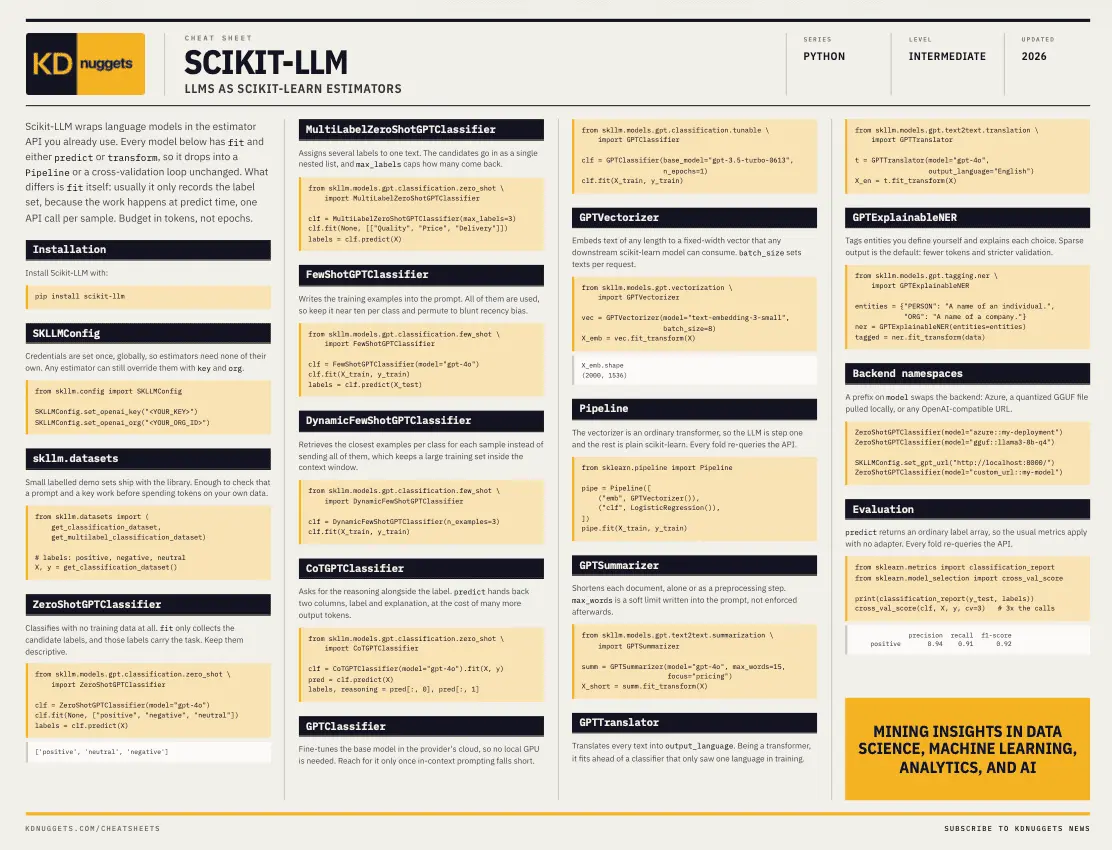
What actually differentiates these estimators during execution becomes apparent when examining the fit method. In traditional machine learning, fit performs heavy computation to learn weights and parameters from training data. Within Scikit-LLM, however, the fit method typically does little more than record the target label set, because the core semantic reasoning and inference work happens dynamically at predict time via individual API calls for each sample. This operational shift requires practitioners to think and plan carefully in terms of token consumption and API overhead, a core concept emphasized in a newly released reference guide by KDnuggets that outlines the essential estimators available in the library.
Among the various components provided by the framework, the one developers will likely utilize most frequently is the ZeroShotGPTClassifier. For many practitioners, adopting this estimator requires an initial adjustment period. Calling the fit method with None for data and passing only candidate labels feels counterintuitive the first few times, until developers fully internalize the reality that the provided labels function as the actual task specification. Because the model relies entirely on these textual strings to understand the classification boundaries, vague labels inevitably yield vague and unreliable results. Consequently, engineers are advised to treat candidate labels less like traditional class indices and more like descriptive instructions.
When a zero-shot approach proves insufficient for complex classification tasks, the library offers more sophisticated alternatives. Rather than relying on plain, static few-shot prompting, the framework provides the DynamicFewShotGPTClassifier as a robust default choice. Instead of cramming the entire training dataset into every single prompt—which quickly exhausts context windows and inflates costs—this estimator cleverly retrieves only the most relevant, contextually close examples per class for each individual sample, ensuring higher accuracy and better utilization of token limits.
Beyond classification, the library includes other notable tools designed to bridge unstructured text and numerical machine learning pipelines. The GPTVectorizer component transforms text of arbitrary length into a fixed-width numerical vector. By positioning this vectorizer as the initial step in a scikit-learn pipeline, developers can leverage the semantic understanding of a large language model while handling all subsequent downstream tasks using traditional, lightweight algorithms, such as running a standard logistic regression directly on the generated embeddings.
Another valuable component is the GPTTranslator, which operates as a transformer capable of preprocessing data before it reaches downstream models. This translator can be positioned ahead of a classifier that was exclusively trained on English text during its initial phase, eliminating the need to retrain the entire downstream system on a multilingual corpus. By translating foreign text into English upstream within the pipeline, existing models can process global data without architectural modifications.
Despite these powerful capabilities, practitioners must remain mindful of the practical trade-offs involved, particularly concerning actual token costs and computational expenses. Executing a standard cross-validation procedure using a metric such as cross_val_score with three folds multiplies the number of required external API calls by three. Furthermore, that multiplier compounds dramatically when combined with hyperparameter grid searches that data scientists previously ran routinely without a second thought in traditional scikit-learn environments. The casual coding habits and iterative experimentation workflows that cost virtually nothing when training local models on a CPU or GPU carry tangible financial and latency costs when routing every sample through a commercial language model API.
Keeping these operational realities in mind, Scikit-LLM emerges as a valuable addition to the modern artificial intelligence engineering toolkit, particularly for practitioners who spend a significant portion of their time working within the scikit-learn ecosystem. It provides an accessible pathway for developers to experiment with generative artificial intelligence and large language models without straying too far from established software design patterns and familiar development environments. To help users navigate these tools, the new KDnuggets cheat sheet offers a concise reference for the core estimators, serving as a practical companion for both newcomers starting their first side projects and experienced users looking for a quick reminder during daily development.