From 255 miles above Earth, the boundaries between science, planetary physics, and rock-and-roll history occasionally blur. Gliding through the darkness of space aboard the International Space Station on September 7, 2026, NASA astronaut Jessica Meir peered through a Nikon Z9 digital camera and witnessed an atmospheric masterpiece. Below her, hovering over Kyrgyzstan, Earth’s upper atmosphere rippled and glowed with an ethereal symphony of emerald greens, deep crimsons, and brilliant, electric purples.
The breathtaking visual display prompted Meir to channel one of rock music’s most enduring legends. Noting the vibrant violet hues painting the orbital horizon, Meir posted on social media that music icon Jimi Hendrix would have "rejoiced" at the brilliant display, adding a playful nod to his 1967 psychedelic masterpiece, "Purple Haze," by noting that the view made her "want to kiss the sky."
The connection between Hendrix’s timeless anthem and the upper atmosphere runs deeper than mere poetic coincidence. According to rock historians and literary lore, one of the primary inspirations for "Purple Haze" was Philip José Farmer’s 1967 sci-fi novel, Night of Light. The story is set on a distant planet caught within a binary star system where, every seven years, a bizarre purple radiance bathes the landscape. This surreal atmospheric glow possesses the uncanny power to rearrange physical reality itself, turning humans into trees and breathing life into inanimate statues.
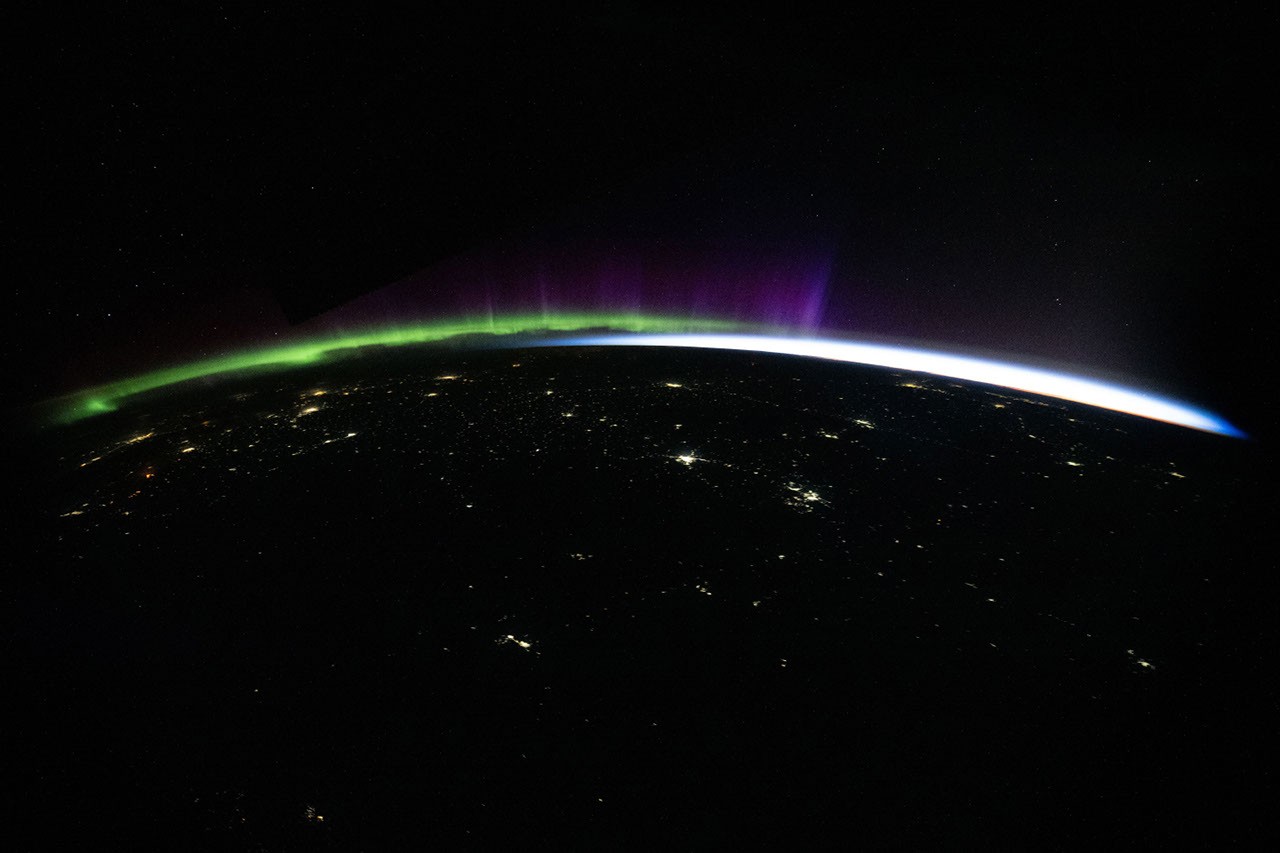
While Earth’s real-world auroras may not transform terrestrial observers into foliage, they are nonetheless products of profound physical interactions between our planet and the wider solar system. The Latin word aurora translates to "dawn" and shares its name with the Roman goddess of the dawn. Historically, Europeans living far south of the Arctic Circle experienced these rare geomagnetic displays as a faint, ominous red glow lingering on the northern horizon, mimicking the reddish light that precedes the sunrise in the eastern sky.
The mechanics behind these celestial light shows begin millions of miles away on the surface of the Sun. Solar flares, coronal mass ejections, and high-speed solar winds launch powerful streams of charged particles hurtling through space toward our planet. When these energetic particles reach Earth, they collide with the magnetosphere—the vast, invisible, comet-shaped bubble of magnetic field lines that shields our world.
As the solar wind buffets this magnetic shield, it compresses and reconfigures the field lines, drawing trapped particles down toward Earth’s polar regions. Once funneled into the upper atmosphere, these charged particles slam into nitrogen and oxygen atoms and molecules, exciting them to higher energy states. As these atmospheric gases return to their normal states, they release photons of light, creating the glowing curtains of color observed by satellites, scientists, and astronauts alike.
According to data and space weather updates from the National Oceanic and Atmospheric Administration’s Space Weather Prediction Center, the specific aurora captured by Meir occurred during a period of minor (G1) geomagnetic disturbances. These conditions were triggered by a high-speed stream of solar wind flowing from an expansive coronal hole on the Sun, compounded by the trailing, lingering effects of multiple coronal mass ejections interacting with Earth’s magnetosphere.
The distinct color palette of an aurora is determined by the specific type of gas involved and the altitude at which the collisions take place. Oxygen atoms, excited to varying energy levels, are primarily responsible for the familiar greens and reds. Green hues typically materialize at altitudes ranging from 60 to 120 miles, while the rarer red auroras occur at higher altitudes exceeding 120 miles. Meanwhile, excited nitrogen gas operating within that same 60-to-120-mile window glows in shades of blue or pink, depending on the energy and composition of the incoming solar particles. When the emissions from these various gases overlap and blend together in the line of sight, the resulting mix can produce stunning shades of purple, magenta, and even stark white.
Although auroras can technically grace Earth’s skies at any point during the year, astronauts aboard the International Space Station find themselves uniquely positioned to witness these light shows most frequently during the spring and fall around the equinoxes. This seasonal peak is driven by a phenomenon known as the Russell-McPherron effect. During the equinoxes, the geometry of Earth’s magnetic field aligns in a manner that is exceptionally favorable for transferring energy from the solar wind directly into the magnetosphere, supercharging global geomagnetic activity.
The photograph captured by Meir on September 7, 2026, using a 15-millimeter focal length, represents just one frame from a much larger collection acquired by the Expedition 75 crew. By stacking multiple long-exposure photographs taken during the orbital pass, scientists and space enthusiasts were also treated to an intricate series featuring the aurora’s green glow mingling with faint star trails, bright moonlight, passing artificial satellites, and the steady twinkle of distant city lights far below.
Jimi Hendrix’s presence in space exploration extends far beyond a passing astronaut’s social media post. The legendary guitarist’s music has crossed the threshold into interplanetary history on previous occasions. In 2024, a curated selection of Hendrix recordings successfully touched down on the lunar surface aboard NASA’s Odysseus lander. Decades earlier, another of his iconic tracks, "Voodoo Chile," was selected as an official wake-up song to rouse space shuttle astronauts aboard mission STS-110, cementing a lasting cultural link between psychedelic rock and humanity’s journey into the cosmos.
The image, cataloged as ISS075-E-88592, was preserved through the ongoing efforts of the ISS Crew Earth Observations Facility and the Earth Science and Remote Sensing Unit at the NASA Johnson Space Center. Program initiatives like these continue to support astronauts in documenting our changing planet from an orbital vantage point, providing invaluable data for researchers while sharing the raw beauty of Earth with the global public.