
Ukrainian military forces have achieved a groundbreaking milestone in modern warfare by successfully evacuating a wounded soldier from the front line using a modified heavy-lift drone. Announced on October 19 by Ukraine’s 92nd Separate Assault Brigade, the operation marks what is believed to be the first documented instance of an unmanned aerial vehicle (UAV) performing a casualty evacuation (MEDEVAC) directly from active combat zones. This historic mission underscores a rapidly emerging frontier in military technology, as domestic Ukrainian manufacturers race to develop dedicated aerial medical evacuation systems capable of operating where traditional ground vehicles cannot go.
According to reports from Ukraine’s ArmyInform military news service, the injured service member was trapped in a highly volatile sector that conventional ground evacuation teams and armored vehicles were entirely unable to safely reach. Heavy minefields blanketed the terrain, and the omnipresent threat of enemy reconnaissance and strike drones rendered standard rescue operations an unacceptable risk for human extraction teams. Facing these insurmountable obstacles, tactical units turned to an unconventional solution: a modified heavy-lift hexacopter engineered specifically to transport personnel away from immediate danger.
The pioneering aircraft utilized in the mission was developed by Gurzuf Defence, a Ukrainian defense manufacturer. Over recent months, the military and the manufacturer have collaborated closely, conducting rigorous testing and implementing crucial design modifications to enhance the aircraft’s flight stability while bearing the shifting weight of a human body. While this individual mission represents a monumental leap forward, military analysts emphasize that a single successful extraction does not yet establish routine battlefield reliability. Further operational deployments, ongoing stress testing, and careful evaluation of environmental limitations will be necessary to determine how widely this capability can be scaled across active fronts.
Adapting Heavy-Lift Logistics Platforms for Human Transport
The aircraft at the center of the historic October 19 rescue is a specialized adaptation of the Gurzuf Defence Ayu-Dag 6, alternatively referenced as the Audag-6. Initially conceptualized and deployed as a heavy-duty hexacopter for front-line logistical supply runs and cargo delivery, the six-rotor platform was designed to move substantial payloads across hostile territory without exposing human pilots or logistics crews to direct enemy fire.
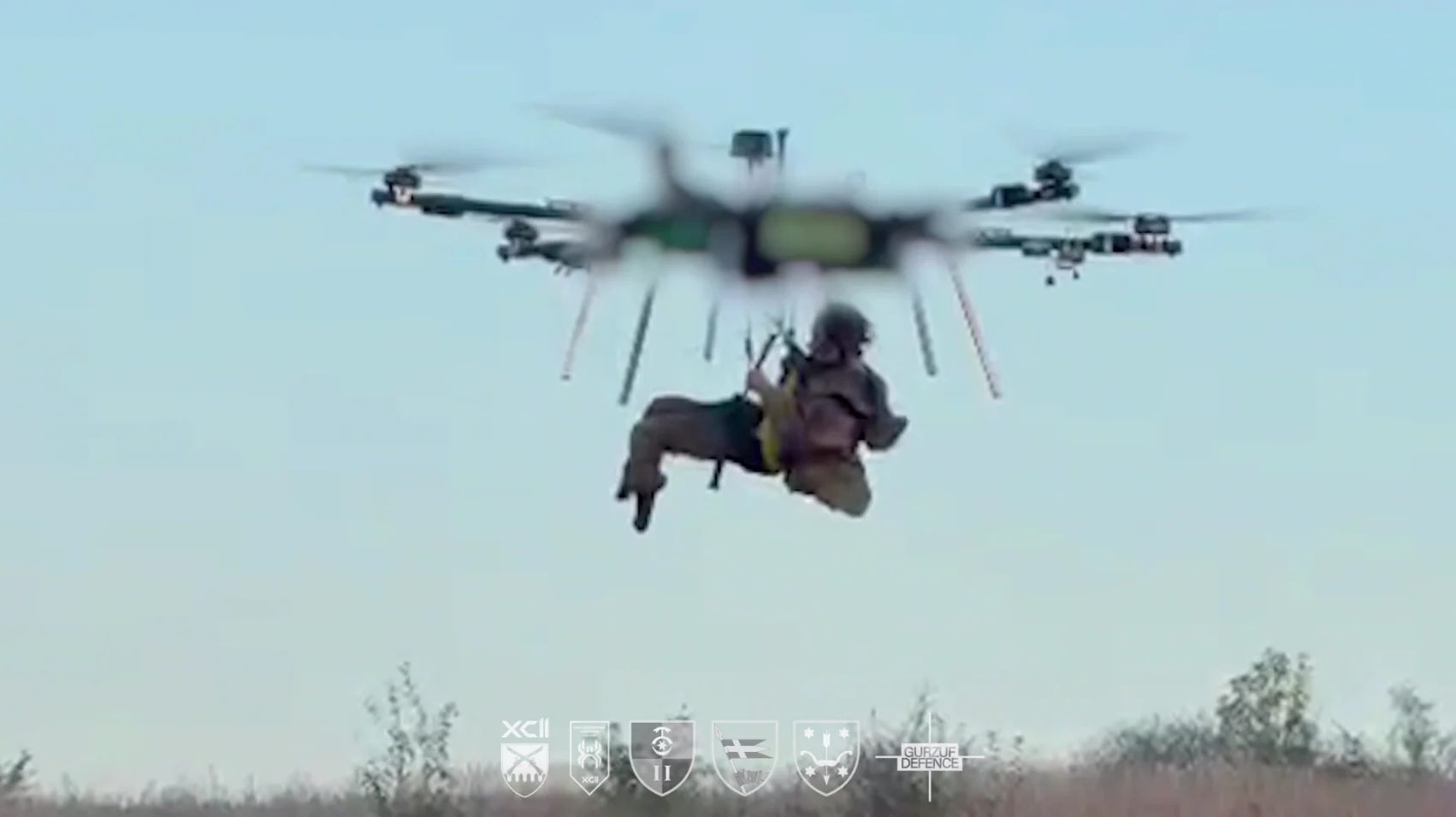
Technical profiles published earlier in the year by Ukrainska Pravda highlighted the impressive baseline specifications of the platform. The standard drone weighs approximately 98 kilograms empty and typically features an operational payload capacity ranging from 70 to 90 kilograms. However, the manufacturer has previously demonstrated the platform’s raw lifting capability with payloads scaling up to 130 kilograms, depending heavily on battery configuration, environmental wind conditions, and the specific mission profile.
Adapting a cargo-hauling platform for human transport, however, required significant engineering overhauls. Engineers had to drastically minimize the risk of aerodynamic swinging, payload shifting, and mid-flight instability that could easily jeopardize the life of an already wounded passenger. This successful integration illustrates the inherent tactical flexibility of modern heavy-lift drone architectures, proving that platforms originally optimized for ammunition and supply delivery can be repurposed for specialized personnel recovery missions when outfitted with the correct stabilization hardware.
At the same time, transitioning from inanimate cargo to human transport introduces an array of complex technical and safety mandates. These include robust patient restraint systems, fail-safe flight stabilization algorithms, redundant communication links, and emergency protocols designed to handle sudden equipment degradation or engine failures in contested airspace.
The Rise of Dedicated Medical Evacuation Drones
The landmark rescue executed by the 92nd Separate Assault Brigade arrives amid a broader wave of innovation within Ukraine’s domestic defense sector, where other manufacturers are actively building drones engineered specifically from the ground up for casualty extraction. Among these initiatives is StarGate, an advanced unmanned aircraft system introduced by the Ukrainian defense developer SkyFall.
A report published by the Associated Press detailed a live demonstration of the StarGate system, shedding light on its intended role in revolutionizing tactical medical evacuation. According to specifications provided by SkyFall, the specialized medical drone is engineered to carry up to 150 kilograms—ample capacity for a wounded soldier alongside medical gear—while achieving top speeds of up to 105 kilometers per hour. The aircraft is designed with an operational combat radius of up to 15 kilometers. Furthermore, the system incorporates heavily hardened, redundant communication channels and inertial navigation safeguards built to function reliably in electronic warfare environments where traditional GPS signals are routinely jammed or spoofed.
SkyFall initiated front-line testing of the StarGate system in October, placing the platform under the rigorous demands of active combat environments to evaluate its practical effectiveness. The parallel development of platforms like the modified Gurzuf Defence hexacopter and the purpose-built StarGate system highlights a concerted push across Ukraine’s defense industrial base to solve one of the most perilous challenges of modern warfare: the golden hour window for treating severe battlefield trauma when ground extraction is completely blocked.
Beyond the immediate theater of war, innovators and observers alike recognize that the maturation of aerial medical evacuation technology holds profound implications for civilian and humanitarian sectors. Similar heavy-lift platforms could eventually be deployed to conduct search and rescue operations in treacherous mountainous terrain, isolated flood zones, or disaster-stricken urban environments where ground access remains severely restricted.
Realizing that civilian potential, however, will require extensive safety certifications, regulatory frameworks, and purpose-built fail-safes designed explicitly for passenger safety. For now, Ukraine’s documented front-line rescue serves as a historic proof-of-concept, offering an early glimpse into how unmanned aviation may reshape emergency extraction. Whether aerial MEDEVAC matures into a standard, repeatable military capability will ultimately depend on continued technological refinement, ongoing field evaluations, and the lessons learned from active operations on the front lines.