As the Indian traveller becomes increasingly discerning, globally mobile, and financially empowered, industry leaders are calling for stronger connectivity, destination-led tourism, enhanced skill development, and infrastructure that matches national ambition.
India’s tourism story is entering a transformative new phase. Domestic travel has emerged as a powerful engine of continuous economic growth, Indian travellers are venturing abroad in unprecedented numbers, and international visitors are actively looking for rich experiences that extend far beyond conventional sightseeing. However, with the modern traveller changing at a rapid pace, a critical question remains: is India’s broader tourism ecosystem—spanning airports, airlines, hotels, local destinations, and public infrastructure—evolving quickly enough to keep up?
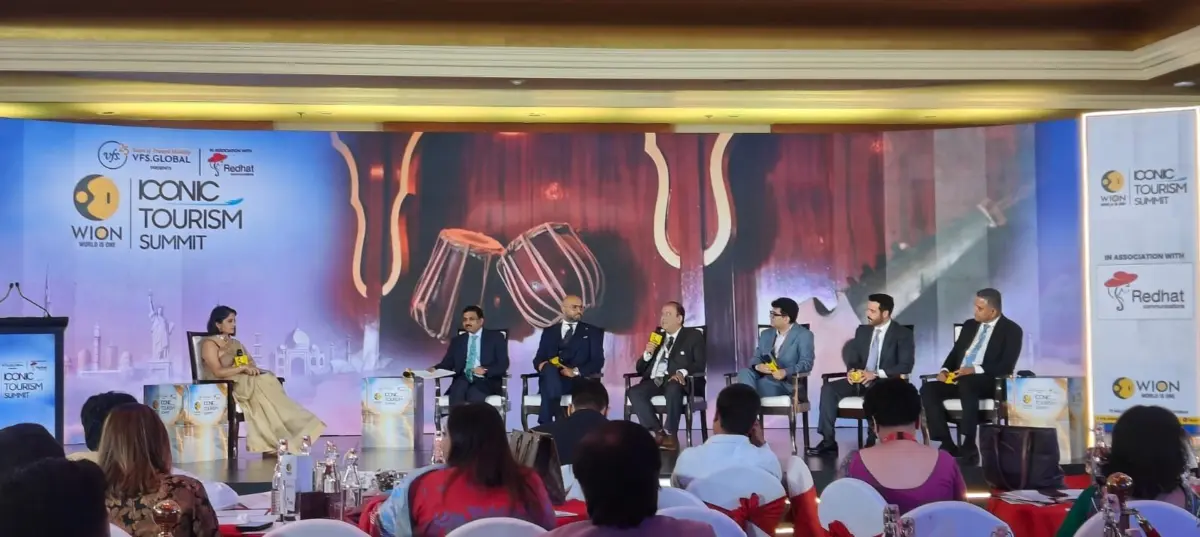
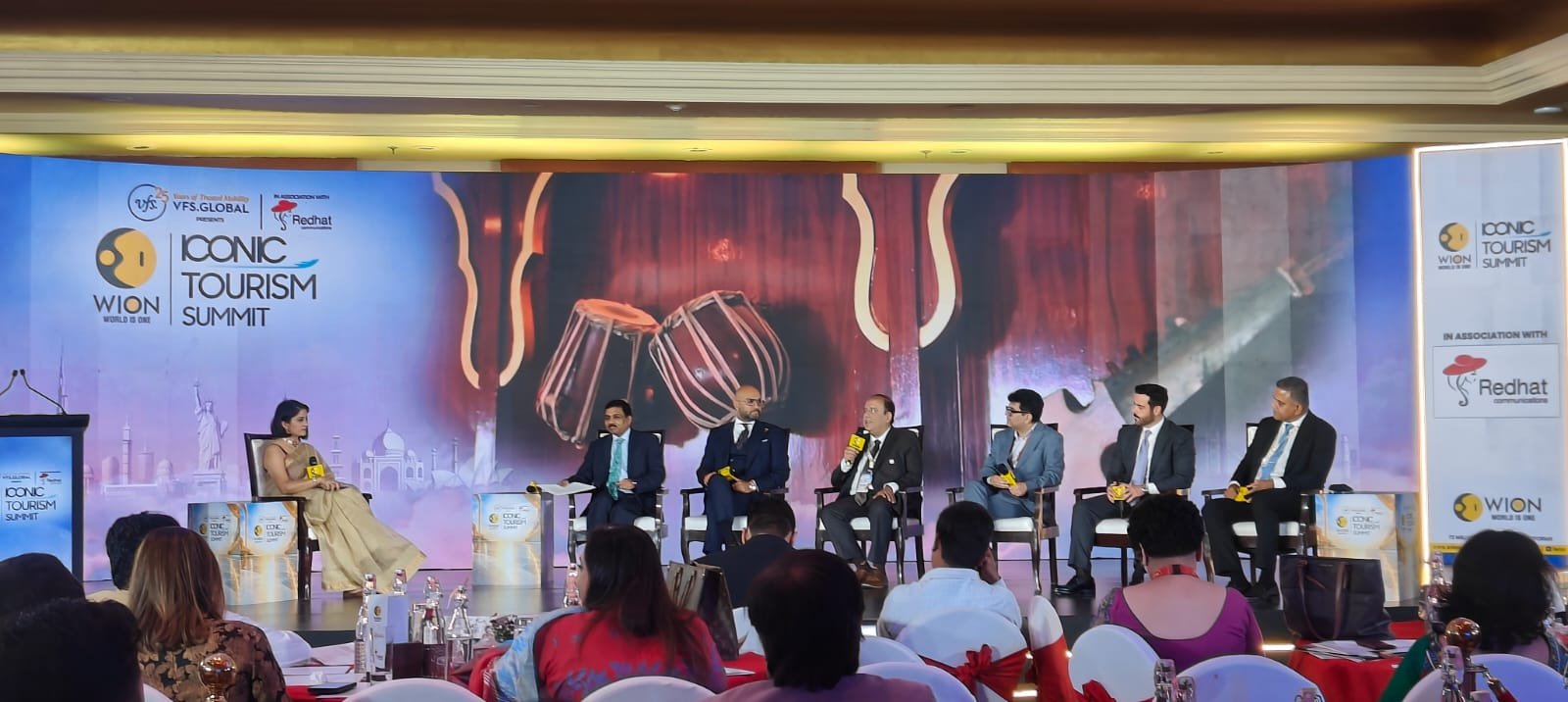
That central question shaped the high-level discussions at the WION Iconic Tourism Summit in New Delhi on September 23. Key industry executives, aviation leaders, and diplomatic voices gathered for a prominent panel discussion titled “The Business of Travel: Aviation, Hospitality & India’s Tourism Infra Story.”
Moderated by Shreya Upadhyay, the distinguished panel featured Vikram Lalvani, Managing Director and CEO of Sterling Holiday Resorts; Saurabh Tiwari, Vice President for the Middle East, Maldives, and Sri Lanka at IHCL; Muktesh Pardeshi, former Secretary to the Government of India and former Ambassador and High Commissioner to Mexico, New Zealand, and Türkiye; Manish Puri, Head of Global Sales for Air India and Air India Express; Ahmed Hamed Sharbak, Regional Manager for APAC at Visit Qatar; and Kamal Munasinghe, Senior Vice President of Colombo Hotels at Cinnamon Hotels & Resorts and General Manager of Cinnamon Life at City of Dreams.
Vikram Lalvani: Tourism Must Become Destination-Led
For Vikram Lalvani, the next chapter of Indian tourism will be driven less by simply adding new coordinates to a map and far more by creating a compelling, multifaceted reason to visit them.
“The way the industry is moving and should move is more destination-led,” Lalvani said, arguing that the underlying motivation to travel matters just as much as the geographical destination itself.
He pointed directly to the shifting needs of family travellers, where different household members frequently seek contrasting experiences. The primary opportunity for the industry, therefore, is to create destinations and multi-stop circuits capable of seamlessly combining diverse experiences—ranging from serene hill stations and wildlife sanctuaries to deep cultural exploration, culinary discovery, and pure leisure—into a single, cohesive holiday.
Lalvani also made a compelling case for viewing the tourism landscape primarily through the lens of India’s massive domestic market.
“The core issue here is domestic tourism,” he said, emphasizing that the post-pandemic recovery clearly demonstrated the profound strength and resilience of domestic travel. International tourism, he noted, can certainly act as a powerful “force multiplier,” but India’s overarching tourism narrative cannot be successfully built around foreign visitors alone.
Furthermore, he advocated for a much stronger national narrative positioning India as a 365-day destination. Rather than concentrating tourism activity around a handful of traditional peak seasons or isolated iconic attractions, the broader industry must effectively communicate the rich variety of experiences available across different regions and distinct seasons. The real opportunity, he suggested, lies in connecting destinations and encouraging modern travellers to discover more of India along the way.
Saurabh Tiwari: The Indian Traveller is Changing the Global Hospitality Equation
For Saurabh Tiwari, the rapid expansion of outbound Indian travel is already forcing major global hospitality companies to fundamentally rethink their service offerings and brand positioning.
“The global hotels and the hospitality industry in general don’t have a choice,” he said, pointing directly to the growing spending power, higher expectations, and sophisticated tastes of Indian travellers abroad.
The modern Indian guest, he argued, is no longer looking simply for a place to sleep. Brand promise, operational consistency, authentic food, modern amenities, and immersive experiences increasingly drive booking decisions. Tiwari also highlighted the changing psychographics of today’s travellers, who are vastly more informed, digitally connected, and acutely conscious of sustainable practices, cutting-edge design, and unique culinary encounters.
“They want the best experiences in terms of culinary,” he said, noting that dynamic restaurants, celebrity chefs, and distinctive dining concepts can heavily influence hotel selections.
Sustainability has similarly climbed to the top of the corporate agenda. Contemporary guests frequently question hotels regarding their water conservation, food waste management, and resource utilization, while visual aesthetics have grown exceptionally important in the age of social media.
Yet Tiwari emphasized that advanced technology does not eliminate hospitality’s most vital ingredient: human connection.
“AI is in the neighbourhood; the human touch and human warmth are the most important thing,” he stated, arguing that technological tools should elevate the guest experience rather than replace the genuine human relationships at its core.
That reality makes ongoing investments in workforce skills critically important. Hotels require employees who are thoroughly trained not only for today’s operational demands but also for tomorrow’s travellers, whose expectations will continue to evolve rapidly.
Ambassador Muktesh Pardeshi: Tourism as an Instrument of Economic Diplomacy
Drawing upon extensive diplomatic experience, Ambassador Muktesh Pardeshi argued that tourism belongs firmly at the center of India’s broader economic and foreign policy strategy.
“Tourism is an important component of economic diplomacy,” he said, describing the sector as an essential vehicle for fostering people-to-people connections and a potent instrument of national soft power.
Drawing from his tenure as India’s ambassador in Mexico, New Zealand, and Türkiye, Ambassador Pardeshi offered a candid assessment of India’s untapped tourism potential. He maintained that India possesses many of the fundamental ingredients required to reign supreme as a major global destination, including diverse landscapes, deep-rooted heritage, vibrant culture, rich wildlife, and the geographic versatility to offer experiences throughout the year.
However, he cautioned that underlying infrastructure and consistent service quality remain major areas for improvement. Ambassador Pardeshi called for much stronger, institutionalized cooperation between government agencies, private industry, and civil society, arguing that the next phase of India’s tourism development cannot possibly be achieved by any single stakeholder acting alone.
His experience in helping organize the G20 Summit and more than 200 associated meetings across 60 distinct locations heavily shaped this perspective. The G20, he noted, demonstrated firsthand how major international events can rapidly accelerate local infrastructure development and successfully expose smaller, lesser-known destinations to global audiences.
Yet infrastructure, he stressed, encompasses far more than physical asphalt, concrete roads, and sprawling airports. Cleanliness, public hygiene, urban mobility, language proficiency, and frontline hospitality are equally vital. He recalled a revealing interaction involving a foreign ambassador staying at a prominent Delhi hotel where no member of the reception desk staff could converse fluently in English.
For Ambassador Pardeshi, such encounters matter deeply because a visitor’s entire perception of India is frequently shaped by the smallest details.
“Unless industry and government work together, we cannot move to the next stage,” he concluded, summarizing the core challenge facing the sector.
Manish Puri: Unlocking India’s Potential as a Global Aviation Hub
With the aviation sector sitting squarely at the heart of India’s rapid tourism expansion, Manish Puri addressed the staggering scale of capacity currently being added by domestic carriers and airport operators alike.
He described India’s ongoing aviation boom as a classic chicken-and-egg scenario: enhanced air connectivity naturally encourages robust tourism demand, while growing passenger volumes provide the economic justification required for additional fleet and terminal capacity.
Puri argued that India is exceptionally well-positioned to strengthen its standing as a major global aviation hub over the next five to ten years, backed by aggressive fleet expansions from Indian airlines and the continuous development of modern mega-airports.
Nevertheless, he identified transit infrastructure and the seamless passenger transfer experience as crucial areas demanding further attention if India is truly to compete with established international mega-hubs in the Middle East and Southeast Asia. The ultimate objective, he suggested, should be to make the transit experience smooth and attractive enough that global passengers view India not merely as a final point of origin or destination, but as a preferred hub through which they actively choose to connect.
Under Puri’s leadership, Air India and Air India Express have already successfully integrated their respective sales organizations, creating a unified commercial sales function that spans both domestic and international markets.
Puri also noted a noticeable behavioral shift among contemporary travellers: people are booking trips much closer to their departure dates, particularly when shifting geopolitical developments or lingering visa uncertainties influence destination choices. The resulting market is considerably more agile and less predictable, making seamless connectivity and ease of entry direct drivers of passenger demand.
Ahmed Hamed Sharbak: Building Stronger India-Qatar Travel Flows
For Ahmed Hamed Sharbak, the primary strategic opportunity lies in deepening the already substantial travel links connecting India and Qatar.
He outlined lucrative opportunities across family leisure trips, corporate business travel, and multi-day stopovers, emphasizing the vital importance of giving Indian travellers compelling reasons to experience Qatar rather than simply passing through its transit terminals.
Qatar’s tourism strategy, he explained, increasingly relies on major international events and sports tourism. The nation’s busy calendar of global events, combined with robust aviation connectivity, creates consistent opportunities to attract visitors for short, high-value stays alongside longer holidays.
The concept of the 48- or 72-hour stopover was highlighted as particularly relevant to Indian travellers. For passengers already flying long-haul between India and Europe, the United Kingdom, or North America, Qatar can be strategically positioned as an exciting supplementary experience within a wider journey.
Streamlined visa facilitation remains a cornerstone of this proposition. Visit Qatar’s current entry guidelines confirm that citizens of more than 100 countries can access convenient visa-free entry or visa-on-arrival arrangements, subject to specific nationality and regulatory conditions.
For Sharbak, the overarching goal is not simply to chase higher arrival numbers, but to successfully convert basic flight connectivity into memorable cultural and family-oriented experiences.
Kamal Munasinghe: South Asia Must Embrace Regional Tourism Integration
Bringing the panel discussion outward to examine the broader South Asian tourism ecosystem, Kamal Munasinghe argued that the region’s collective future relies on collaborative cross-border thinking.
For Sri Lanka, he maintained, the next great opportunity does not lie in competing directly with isolated hotspots like the Maldives or Dubai, but rather in jointly developing comprehensive regional tourism circuits where international visitors can seamlessly combine multiple countries and experiences in a single trip.
“Regional tourism is very, very important,” Munasinghe asserted.
He pointed to the immense commercial possibilities of combining India’s rich cultural heritage and diverse wildlife excursions with Colombo’s vibrant urban and luxury lifestyle offerings, while extending journeys further into neighboring South Asian destinations.
Robust connectivity, he noted, is central to realizing this collaborative vision. Munasinghe highlighted strengthening air links between India and Sri Lanka, arguing that tourism flows must move smoothly in both directions to keep bilateral economic corridors commercially sustainable.
He further stressed that true connectivity extends far beyond commercial flight schedules. Harmonized visa frameworks, interoperable payment systems, deeper cultural understanding, shared food preferences, and structured human resource exchanges all play a critical role in determining whether a regional tourism corridor succeeds.
Cinnamon Hotels & Resorts has actively pursued this kind of cross-market engagement, implementing regional staff exchange programs and targeted hospitality training initiatives. Munasinghe also spotlighted Cinnamon Life at City of Dreams as a major milestone in Colombo’s evolving identity as a premier destination for luxury hospitality, business tourism, and entertainment.
His broader message to the summit was clear: South Asia must stop marketing itself as a collection of isolated national destinations and begin presenting itself as a seamlessly connected, globally competitive region.