The architecture underpinning modern artificial intelligence integrations underwent a significant shift this summer following major updates to the Model Context Protocol (MCP). With the formal release of the July 28, 2026, specification, the core of the protocol transitioned to a completely stateless model. Modern clients no longer need to establish a dedicated protocol session prior to dispatching requests, and backend servers are no longer dependent on tracking session identifiers for ordinary interactions. This foundational change removes substantial infrastructure friction, making it significantly easier to scale MCP servers behind standard HTTP load balancers and conventional web architectures.
Concurrently, the official Python SDK has advanced to version 2 as its primary stable line. This updated SDK introduces a high-level MCPServer application programming interface designed to streamline how developers define tools, data resources, and prompt templates using regular Python functions. Rather than manually constructing complex JSON schemas or maintaining verbose protocol boilerplate, engineers can rely on native type hints and standard Python syntax to expose capabilities to large language models. This development significantly lowers the barrier to entry for building robust, network-accessible AI utilities.
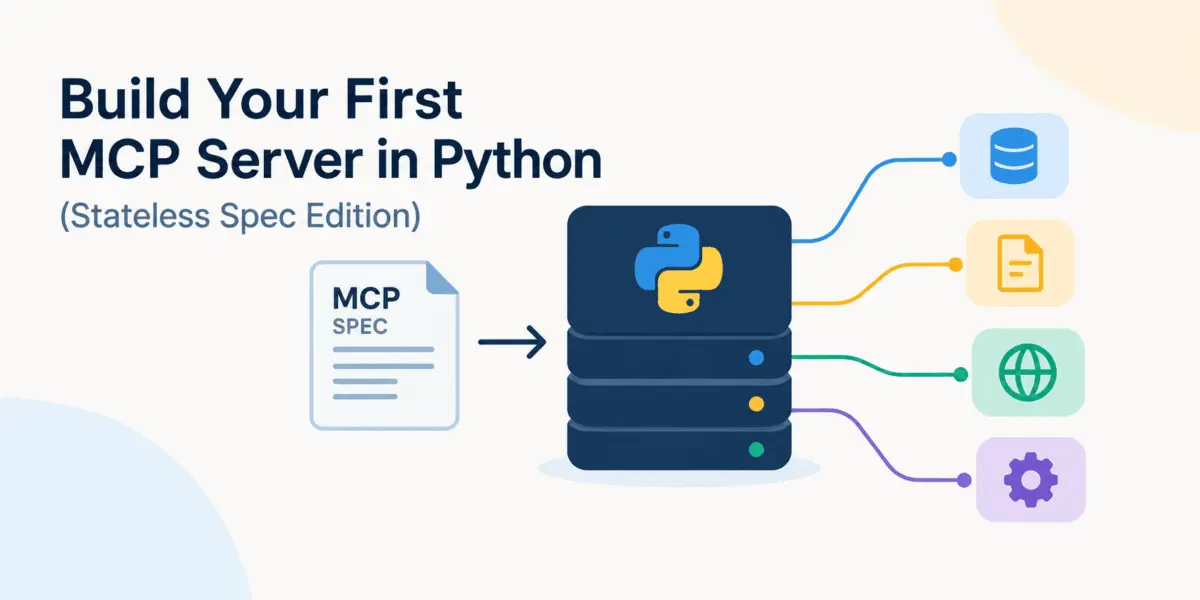
To understand the practical implications of these architectural updates, developers are examining how a lightweight developer knowledge-base server can be constructed under the new paradigm. The conceptual model is straightforward: an AI host issues a protocol request directly to a Python MCP server that handles queries, serves static resources, and provides templated prompts without retaining user session state on the server side. Every incoming request contains all the necessary parameters to process it independently, perfectly illustrating the stateless design philosophy championed by the protocol maintainers.
The current Python SDK requires Python 3.10 or newer and recommends utilizing modern dependency managers alongside the command-line interface extra for development workflows. Projects can be initialized rapidly using tools like Astral’s uv or standard pip installations. The project layout remains remarkably minimal, typically consisting of a server implementation file and a client testing script, eliminating the need for heavy web framework boilerplate or complex directory hierarchies.
At the heart of this development experience is the MCPServer class, which serves as the high-level interface in the v2 SDK. While the library retains a lower-level server class for advanced scenarios requiring exact control over schemas and protocol metadata, the high-level API handles the heavy lifting for standard applications. Developers can initialize a server with a descriptive title and instructions, then populate it with data arrays and functional components that map directly to the model’s capabilities.
The integration of tools within this framework highlights the elegance of the updated Python SDK. An MCP tool represents a function that an artificial intelligence model can autonomously decide to invoke during a conversation. By decorating a standard Python function and providing clear type hints and docstrings, developers automatically generate the necessary input schemas for the model. The SDK extracts parameter names, types, and default values directly from the function signature, translating Python defaults into optional parameters within the generated schema. This eliminates the traditional requirement of writing manual JSON schemas or tool manifests, allowing the Python function signature to double as the formal interface definition.
In addition to tools, the protocol distinguishes between actions and static data through resources. While tools function similarly to action-oriented operations that perform work, resources expose information that a host application can directly load into the conversation context. Defined via specific uniform resource identifiers, resources provide read-only data access comparable to GET requests in traditional web development. Alongside tools and resources, the SDK supports reusable prompt templates, which are typically initiated by users or host applications rather than being invoked autonomously by the model. These three primitives—tools, resources, and prompts—are managed uniformly through the SDK’s decorator-driven interface, allowing developers to assemble a complete network-accessible application within a single file.
For local development, the SDK incorporates a dedicated development command that launches the server alongside the MCP Inspector utility. This graphical environment provides a browser-based user interface for inspecting available tools, testing parameters, and viewing responses in real time, establishing a streamlined feedback loop for developers. When transitioning from local development to production-grade deployment, the server can be executed over Streamable HTTP or integrated into larger ASGI applications using frameworks like Uvicorn, FastAPI, or Starlette. The SDK provides standard methods to export a compatible ASGI application, allowing MCP endpoints to coexist seamlessly within existing microservice architectures.
The transition to a stateless core represents a departure from older protocol lifecycles. Under previous iterations, HTTP clients were required to initialize a session and pass session identifiers with subsequent requests, creating a stateful relationship that often necessitated sticky routing or shared session storage across backend instances. The updated protocol design replaces this bidirectional statefulness with self-contained request and response cycles. Because modern requests do not rely on protocol-level sessions to tie interactions together, incoming calls can be distributed across any available worker in a multi-instance deployment without risking session loss.
This stateless architecture does not mean that applications built on MCP are entirely devoid of state; rather, it shifts the responsibility of state management from the protocol layer to the application layer. If an application requires user-specific state—such as a shopping cart or a multi-step workflow—developers can implement explicit identifier patterns. By designing tools that accept and return explicit identifiers like basket tokens, the model passes these handles back and forth during the conversation. This explicit-handle pattern keeps the underlying protocol stateless while granting application developers full control over how and where business state is persisted.
The operational benefits of this design become particularly evident when scaling server deployments. By utilizing standard process managers or container orchestration tools to run multiple worker instances behind a load balancer, administrators can achieve high availability and horizontal scaling without configuring complex session affinity. Any worker can successfully handle any incoming request, simplifying deployment topologies and aligning MCP servers with modern cloud-native infrastructure patterns. As machine learning engineers and backend developers continue to adopt these protocols, the combination of a stateless specification and an intuitive Python SDK offers a scalable foundation for integrating custom tools and data sources into artificial intelligence ecosystems.