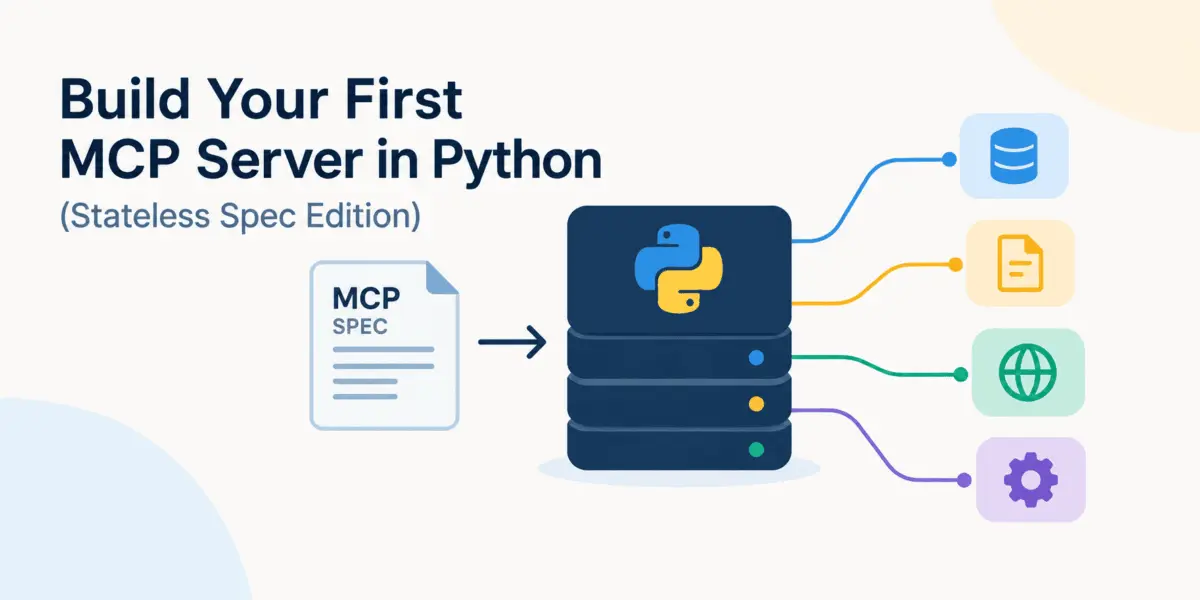
The architecture of modern artificial intelligence integrations underwent a significant operational shift following a fundamental update to the Model Context Protocol. According to technical documentation released by the protocol maintainers, the core specification has transitioned to a fully stateless model. This structural overhaul removes the traditional requirement for modern clients to establish an explicit protocol session prior to dispatching requests, while simultaneously eliminating server-side dependencies on session identifiers for standard interactions.
The transition marks a departure from earlier iterations of the architecture, which relied heavily on bidirectional state management and session persistence. Under the revised specification, ordinary requests no longer require sticky routing or specialized stateful infrastructure behind standard HTTP deployments. Industry observers note that this architectural evolution significantly reduces the operational complexity of scaling AI agent tools and server-side components within standard web infrastructures.
Concurrently, the official Python software development kit has advanced to its second major stable line, introducing a streamlined interface designed to simplify how developers expose functionality to language models. The updated SDK centers on a high-level server application programming interface that allows developers to define tools, resources, and prompts using standard Python functions, type hints, and decorators without writing complex JSON schemas or manual manifests.
The practical impact of these changes centers on how Python applications interact with large language models through standardized primitives. Tools, which act as executable actions that an autonomous model can decide to invoke, are now defined entirely through native function signatures and type annotations. The framework automatically derives the input schema, parameter requirements, and default values directly from the code, allowing developers to build robust knowledge-base search utilities, external API connectors, and execution loops using familiar programming paradigms.
In addition to tools, the updated framework handles resources and prompts through the same unified decorator-oriented server interface. Resources allow host applications to load external information directly into context using uniform resource identifiers, operating similarly to read-oriented data retrieval. Prompts provide reusable templates that are typically initiated by users or host applications to guide interactions. By housing these diverse primitives within a single high-level application server instance, developers can construct comprehensive server-side applications with minimal boilerplate code.
The elimination of protocol-level session management addresses a long-standing scaling bottleneck for developers deploying AI applications in production environments. In previous protocol versions, maintaining a continuous dialogue required tracking specific session identifiers across multiple network calls, necessitating specialized load balancers and sticky routing configurations to ensure requests reached the exact server instance that initiated the connection.
Under the revised stateless model, every incoming request contains all necessary data for independent processing. This design allows deployments to distribute traffic dynamically across multiple worker processes or server instances without risking session corruption or state loss. If an application requires user-specific state, such as a shopping basket or an active user session, the protocol maintainers recommend an explicit-handle design pattern. Rather than concealing state within hidden protocol sessions, applications pass explicit identifiers like unique keys or tokens through the regular tool parameters, ensuring that the model and the application maintain shared visibility over the transactional context.
The release of the updated Python software development kit also incorporates modern development tooling, including specialized command-line workflows and inspection utilities designed to streamline local testing. Developers can launch their server applications in development environments to inspect available tools, examine generated schemas, and simulate model invocations through a dedicated user interface before deploying the service to production. Furthermore, the server applications can be mounted directly into standard ASGI web frameworks, enabling seamless integration into larger web applications and microservices architectures.
As organizations increasingly adopt agentic workflows and complex AI integrations, the shift toward a stateless protocol core provides a scalable foundation for enterprise deployments. By aligning Model Context Protocol servers with standard HTTP scaling practices, development teams can leverage conventional infrastructure patterns, load balancers, and container orchestration platforms to manage high volumes of concurrent AI traffic reliably and efficiently.