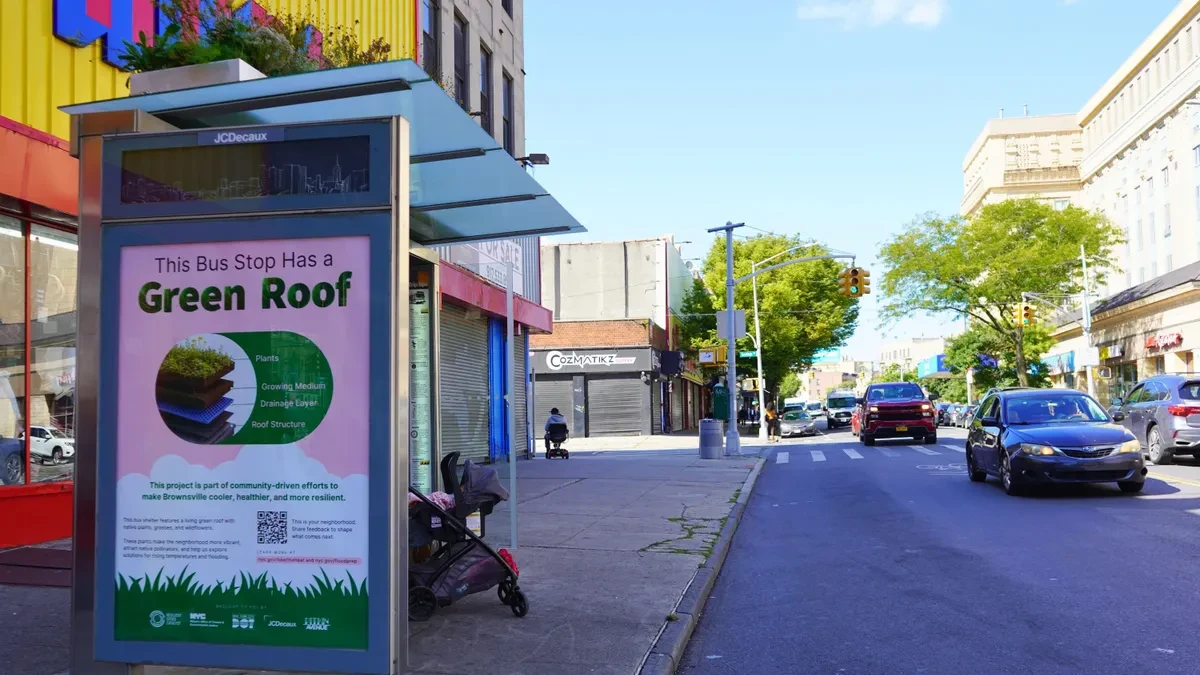
NEW YORK — As cities across the globe grapple with the escalating realities of climate change, New York City is testing a novel approach to urban cooling right at the curb. In one of the municipality’s most heat-vulnerable neighborhoods, officials have installed a specialized bus shelter featuring a living roof topped with native plants, grasses, and wildflowers.
The pilot project, launched along a bustling commercial corridor in Brooklyn’s Brownsville neighborhood, represents a growing movement to adapt everyday transit infrastructure to increasingly severe weather. City officials hope the living installation will offer immediate relief to commuters while providing a scalable blueprint for cooling vulnerable urban pockets.
The initiative arrives as municipal leaders face mounting pressure to protect residents from dangerously high temperatures during the summer months. According to the 2026 New York City Heat-Related Mortality Report, approximately 500 residents die from heat-related causes each summer, making extreme heat one of the city’s deadliest climate threats.
Disadvantaged communities, which often feature higher concentrations of asphalt, concrete, and historical underinvestment in green spaces, bear the brunt of these temperature spikes due to the urban heat island effect. To combat these disparities, the state of New York’s Extreme Heat Action Plan calls for targeted interventions. These include identifying priority corridors for expanded shading, converting paved medians into green spaces, constructing structural shade, and incorporating cooling enhancements directly into transit stops.
“As New York City sees hotter and wetter weather due to climate change, we must develop new ways of using green infrastructure to adapt,” NYC Department of Transportation Commissioner Mike Flynn said in a statement.
The pilot shelter is designed to merge public transit functionality with ecological resilience. By transforming a standard, heat-absorbing metal and glass structure into a living garden, the city aims to lower localized temperatures while simultaneously managing stormwater runoff and enhancing neighborhood aesthetics.
“Climate change is already redefining what it means to live in New York City, and our response has to protect New Yorkers where they are, including at bus stops,” municipal leadership noted in a statement. “We are turning everyday infrastructure into an opportunity to make our neighborhoods cooler, greener, and more resilient.”
The Science and Global Precedent of Green Roofs
The deployment of living roofs on transit shelters is not entirely unprecedented, drawing inspiration from successful international and domestic precedents. Living or green roofs can reduce surrounding air temperatures by up to 20 degrees Fahrenheit, according to Jean-Luc Martel, a construction engineering professor at the School of Superior Technology in Montreal, Quebec, as noted in reporting by the Washington Post.

Green roof bus stops were first popularized in the Netherlands, where transit agencies began transforming utilitarian roofs into miniature meadows to attract pollinators and cool waiting passengers. Over the past decade, the concept has steadily expanded across Europe, Japan, Singapore, and Canada.
Domestically, other major cities have begun exploring similar technologies. Boston has installed green roofs on 30 bus shelters, utilizing drought-resistant plantings specifically chosen to withstand local weather extremes. These installations are designed to provide shade, improve local air quality, increase stormwater retention, and introduce vital green space along the city’s heavily traveled 28 bus route.
In Brownsville, the deployment of native plants, grasses, and wildflowers on the shelter roof serves a dual purpose. Beyond cooling the air immediately surrounding waiting commuters, the flora helps absorb rainwater during intense downpours—a critical secondary benefit as New York City faces increasingly severe precipitation events alongside rising summer temperatures.
Addressing Transit Vulnerabilities in the Climate Crisis
For transit advocates and municipal planners, the humble bus stop has long represented an overlooked frontier in climate adaptation planning. While investments in green roofs and urban forestry often focus on parks, municipal buildings, or large commercial developments, public transit riders—who frequently rely on walking and outdoor waiting periods—remain uniquely exposed to environmental extremes.

“Extreme heat kills hundreds of New Yorkers a year, and for too long our bus stops — where people can wait exposed for periods of time — have been overlooked in the climate crisis,” said Elizabeth Adams, senior advisor for Fast and Free Buses for Mayor Mamdani, in a statement.
The Brownsville pilot will be closely monitored by city agencies to evaluate its durability, maintenance requirements, and overall cooling efficacy. If the trial proves successful, the Department of Transportation and partnering agencies will evaluate whether the living roof design can be expanded to additional bus shelters across other heat-vulnerable corridors in the city’s outer boroughs.
As New York City continues to navigate the complexities of a changing climate, projects like the Brownsville green-roof shelter signal a shift in municipal design philosophy. By viewing everyday infrastructure through an environmental lens, city planners are working to transform standard commuter amenities into frontline defenses against urban heat.