For decades, climate scientists and polar researchers have wrestled with a persistent discrepancy in how they understand the Arctic. While wind is universally recognized as one of the primary physical forces driving the motion of Arctic sea ice, standard predictive models have long failed to match real-world observations. Ice often travels at speeds that simple wind-based calculations cannot account for, and it spreads across the open ocean much more sluggishly than equations suggest.
Now, a team of researchers at the University of California, Riverside, has discovered that a simple yet historically overlooked mechanical process helps explain this discrepancy: individual pieces of Arctic ice repeatedly collide with one another as they drift.
The findings, which could eventually help scientists significantly improve forecasts of how sea ice moves across the Arctic as the region continues to warm, were recently published in the scientific journal Physical Review Letters. The study was led by Bryan Shaddy, who conducted the work as a UC Riverside undergraduate and is now a researcher at the University of Southern California. He was joined by UCR materials scientist Alex Greaney and Bhargav Rallabandi, an associate professor of mechanical engineering at UCR.
Arctic Sea Ice Is Made of Moving Floes
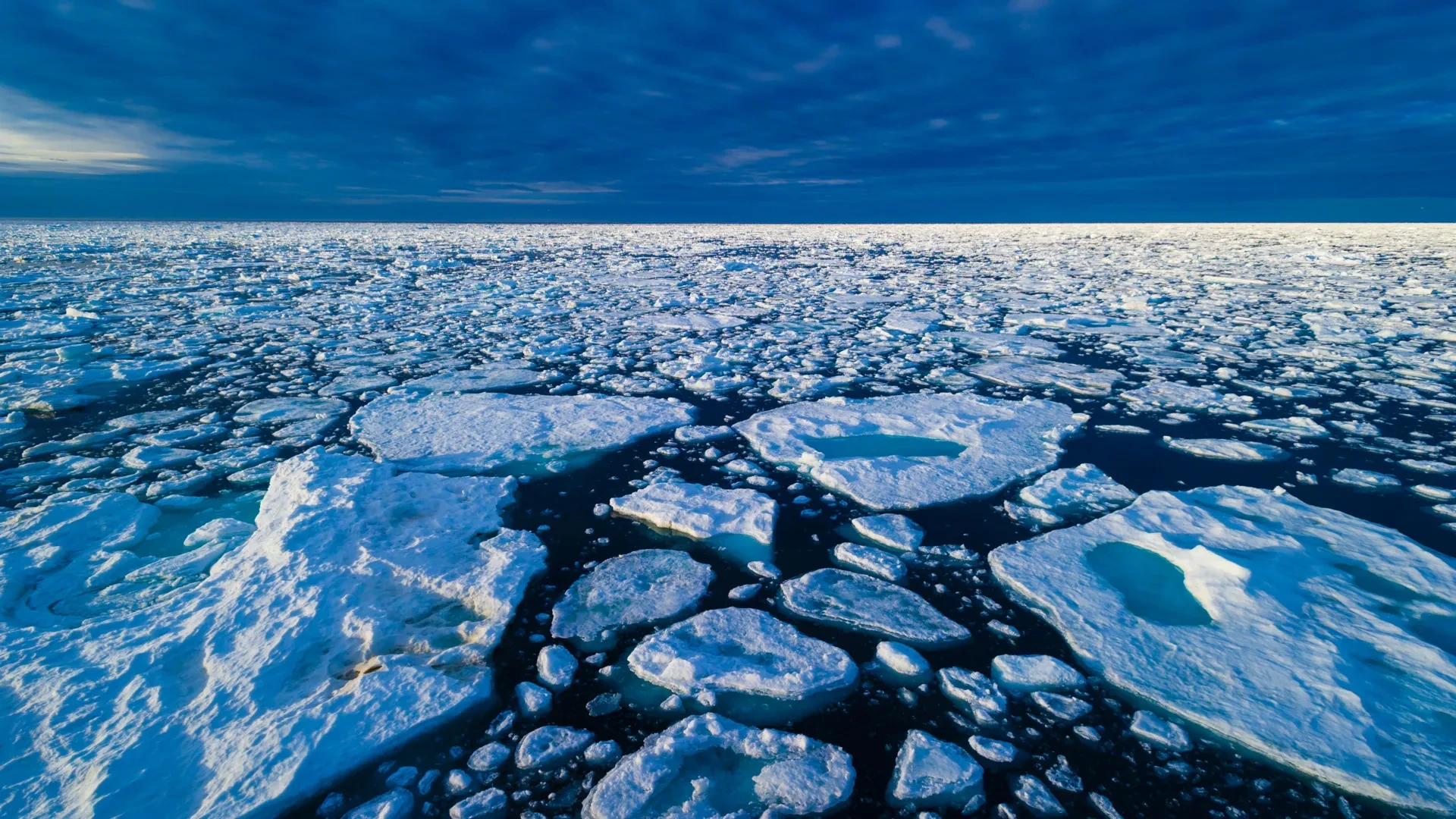
To understand the mechanics of the new study, researchers emphasize the unique physical composition of the region’s cover. Rather than forming one continuous, unbroken sheet of frozen water across the top of the planet, Arctic sea ice is actually divided into distinct, separate slabs known as floes. These dynamic pieces vary dramatically in scale, ranging from just several meters across to sprawling blocks several kilometers wide.
When gale-force winds and polar breezes sweep across the high north, they push against these massive floes, causing them to fracture, drift, and slowly move apart. Yet, despite the dominance of wind as a forcing mechanism, empirical observations from satellites, buoys, and field researchers have consistently shown that wind alone tells only part of the story.
The ice routinely travels at speeds that defy simple wind-driven models, and it disperses across the ocean surface at a much slower rate than those theoretical frameworks predict. Over the years, scientists have proposed several possible explanations for these deviations, pointing to unusual wind behaviors, turbulent ocean eddies, and fractures or cracks forming within the ice sheets themselves.
The new research suggests that many of these puzzling, complex patterns can instead be attributed to one remarkably basic physical process: frequent, high-frequency collisions between neighboring ice floes.
"If you get a lot of ice floes together in the same place with some wind, they bump into each other and transfer energy to neighbors," Rallabandi said, explaining the core dynamic of the study. "We showed that that’s the only ingredient you need to explain these observations."
Simulating a Crowded Field of Ice
To test this hypothesis, the research team developed an advanced computer simulation designed to treat floating sea ice in a manner analogous to granular materials, such as grains moving through a storage silo. The crucial difference in their model is that these granular "grains" are not dry particles; rather, they are buoyant slabs of ice floating on liquid water and being relentlessly pushed by turbulent, unpredictable winds.
The mathematical framework incorporated both the physical drag exerted by the underlying ocean currents and the repeated, inelastic collisions occurring continuously among the crowded floes.
Once the simulation was built and refined, the researchers validated their model by comparing its output against real-world measurements collected from the Fram Strait. Located between Greenland and the Norwegian archipelago of Svalbard, the Fram Strait serves as a major oceanic gateway through which vast amounts of Arctic sea ice flow on their journey southward toward the Atlantic Ocean.
By inputting actual historical measurements of local wind speeds, ocean conditions, and ice concentrations—along with just one additional parameter that had a negligible effect on the overall outcome—the computer model successfully reproduced three distinct real-world observations that had previously stumped polar scientists.
Specifically, the model accurately matched the rate at which sea ice spreads over time, the diverse range of speeds at which individual floes travel, and the ways in which overall ice motion fluctuates over durations ranging from hours to days.
Why Collisions Matter So Much
Collisions exert such a profound influence on Arctic dynamics primarily because sea ice is frequently packed tightly together under the influence of regional weather patterns.
Within these dense ice fields, individual floes collide with neighboring pieces far more frequently than the local wind speed and direction changes. Every single physical impact acts as an energy sink, removing a portion of the kinetic energy originally supplied by the wind and abruptly curtailing how far an individual floe can travel before it strikes another barrier of ice.
This constant, repetitive jostling provides a clear physical mechanism for why sea ice does not simply continue accelerating indefinitely or spreading outward uncontrollably in response to persistent winds.
The newly established research framework successfully connects these microscopic, local mechanical interactions with macro-scale movement occurring across vast geographic areas. While the study does not definitively predict the exact geographical endpoints of Arctic sea ice under future warming scenarios, the implications for climate science are broad.
Both the total surface area of the ocean covered by ice and the average size of individual floes directly dictate how often collisions will occur. Those collision rates, in turn, govern how rapidly an ice field can spread or break apart. Rallabandi noted that the model could eventually help scientists investigate critical questions, such as whether evolving ice conditions might allow floes to fracture and spread apart more easily, driving them into warmer southern waters where they would melt at an accelerated pace.
Furthermore, the work holds significant utility for global climate modeling. Comprehensive global climate models lack the computational power required to track every single one of the vast number of relatively small floes that blanket the Arctic Ocean. Instead, researchers require reliable ways to parameterize and represent their collective, combined behavior. A physically grounded model of how these floes interact provides a vital tool to help capture complex processes that occur at scales otherwise too small to follow individually.
For the research team, one of the most compelling takeaways of the project is that a relatively straightforward physical process can account for the highly complicated motion observed in the natural world.
Physics That Extends Beyond Sea Ice
The underlying mechanical principles identified in the study are not restricted exclusively to frozen oceans. The mathematical relationships and collision dynamics uncovered by the UC Riverside team may apply to a wide variety of natural and industrial systems far beyond the Arctic Circle.
Any physical scenario involving a large ensemble of objects that collide with one another while simultaneously being driven by a noisy, unpredictable source of external force could behave in a fundamentally similar manner. Pointing to potential cross-disciplinary applications, the researchers suggest the framework could be adapted to study phenomena such as avalanches, landslides, complex problems in materials science, and even the behavior of particle-filled inks utilized in advanced 3D printing technologies.
"The model is not restricted to ice," Rallabandi said. "It just needs a noisy source of force and the things that are moving to experience collisions."