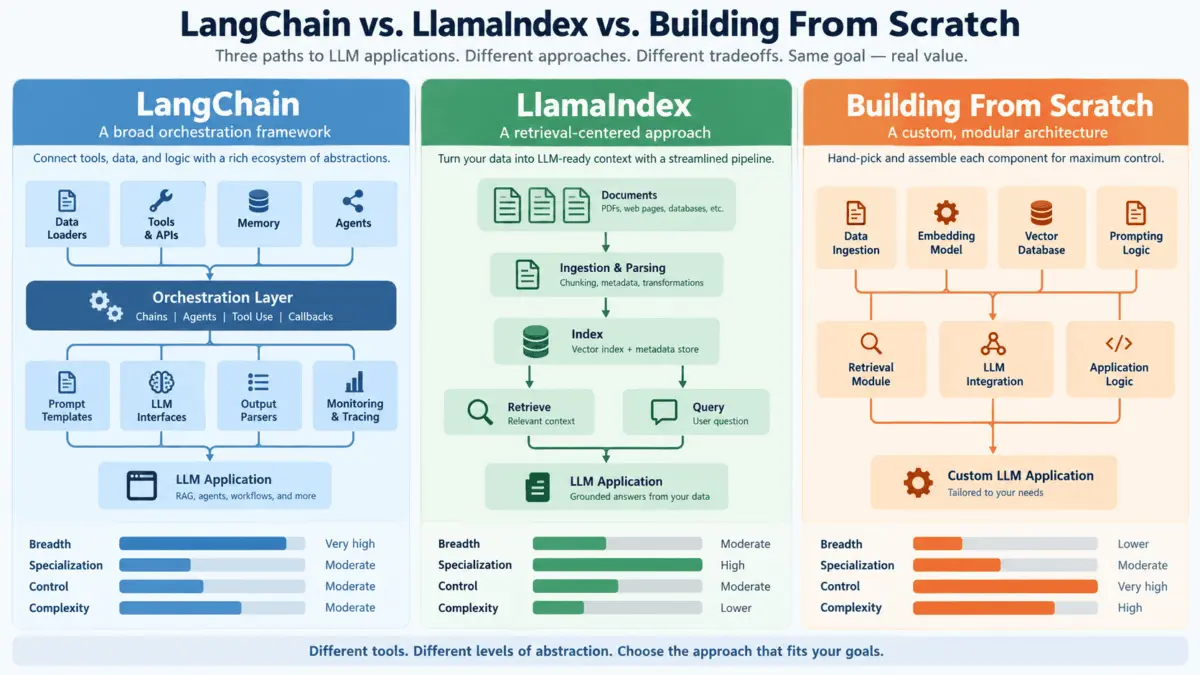
The tooling ecosystem surrounding large language models has expanded at a pace that few developers and engineering teams can comfortably track. In nearly every technical conversation regarding modern artificial intelligence application development, two prominent names inevitably dominate the discussion: LangChain and LlamaIndex. Both frameworks have captured significant market mindshare by promising to reduce the inherent friction of building applications on top of generative AI models. Both boast large, highly active open-source communities, steady development cycles, and the status of default recommendations whenever a software engineer asks how to get started in the space.
Yet, as production deployments mature and engineering teams encounter real-world bottlenecks, a growing consensus suggests that neither framework serves as a universal solution for every project, every team, or every stage of development. Consequently, a third path is increasingly earning serious consideration across the industry: building application architectures entirely from scratch, relying on nothing more than raw base application programming interfaces and custom-tailored internal abstractions.
To understand the current state of AI engineering, it is necessary to examine what these competing approaches actually offer, where each one introduces friction, and how technical leads can determine which path aligns best with their specific operational realities. The overarching objective across the industry is not to crown a singular winner among software tools, but rather to help technical decision-makers make deliberate, strategic choices rather than defaulting blindly to whichever repository commands the highest number of GitHub stars.
Understanding What These Orchestration Tools Actually Do
Before undertaking any meaningful comparison of the available development paths, developers must maintain precision regarding the exact nature of the problem these technologies are designed to solve. Large language models in their native state function as stateless text predictors. They accept a prompt, generate a completion based on statistical patterns, and retain zero memory of past interactions once the request cycle closes.
Constructing practical, business-valuable applications on top of these models—ranging from document question-answering systems and multi-step autonomous agents to advanced retrieval pipelines and sophisticated conversational interfaces—demands rigorous orchestration. Developers must actively manage context windows, route user intents between various functional tools, retrieve relevant external information, handle conversation memory, and chain multiple logical operations together in a coherent sequence.
Both LangChain and LlamaIndex step into this architectural void by providing a comprehensive orchestration layer. They attempt to abstract away the tedious, repetitive plumbing so that software engineers can focus their energy on core application logic rather than managing low-level infrastructure. Conversely, building from scratch means taking on the responsibility of writing, maintaining, and scaling that plumbing internally.
LangChain: Broad, Flexible, and Occasionally Overwhelming
LangChain arrived early in the generative AI boom and aggressively expanded its functional surface area. Its primary competitive advantage lies in its sheer breadth. The framework provides structured abstractions for chains, autonomous agents, memory systems, external tools, document retrievers, output parsers, prompt templates, and dozens of pre-built integrations connecting LLMs to external services, databases, and enterprise APIs.
For engineering teams tasked with connecting large language models to a wide, heterogeneous variety of external tools and data sources, LangChain’s expansive integration library proves genuinely useful. It covers a remarkable spectrum of modern infrastructure providers, ranging from distributed vector databases to specialized search engines and proprietary corporate APIs. Furthermore, the surrounding community has generated extensive documentation and countless examples illustrating common architectural patterns.
LangChain also manages multi-step agentic workflows reasonably well. When a production application requires an LLM to dynamically select between various tools, evaluate intermediate results in a loop, or execute a sequential plan of action based on previous outputs, LangChain’s agent abstractions offer a viable starting point that spares developers from writing custom decision loops from the ground up.
However, the very breadth that makes LangChain attractive to newcomers also introduces significant architectural complexity. Its abstraction layers run deep, and when a production pipeline encounters an unexpected failure, tracing the root cause through multiple layers of wrapped classes can prove exceptionally difficult. Many software engineers report that LangChain’s abstractions accelerate initial prototyping phases only to create severe drag during later stages of debugging, optimization, and customization.
Compounding this complexity is the rapid evolution of the framework itself. Rapid iteration cycles mean that official documentation frequently lags behind the current state of the API, older tutorials often reference deprecated design patterns, and routine framework upgrades can introduce breaking changes. For enterprise systems demanding strict stability, predictability, and long-term maintainability, this architectural churn represents a substantial operational cost. Ultimately, LangChain excels during rapid prototyping phases when exploring potential AI capabilities takes precedence over achieving tight control over low-level implementation details.
LlamaIndex: Focused, Opinionated, and Purpose-Built for Retrieval
LlamaIndex, originally launched under the name GPT Index, deliberately chose a narrower scope from its inception: simplifying the complex process of building retrieval-augmented generation systems. That unwavering focus remains the defining characteristic of the platform.
When an application’s primary mandate involves extracting precise information from vast document repositories and feeding those passages as relevant context to a language model, LlamaIndex proves exceptionally well-suited to the task. Its specialized data connectors, diverse indexing strategies, and modular query engines are purpose-built for the RAG paradigm, resulting in abstractions that generally feel more coherent and unified than those found in broader frameworks.
Furthermore, LlamaIndex provides robust tooling designed to support advanced RAG architectures, including semantic re-ranking, hybrid keyword-vector search, hierarchical retrieval structures, and intelligent query routing. Organizations constructing production-grade document search engines, internal corporate knowledge assistants, or regulatory compliance tools often discover that LlamaIndex successfully navigates the complex edge cases that simpler, ad-hoc retrieval pipelines routinely overlook.
The platform has also committed meaningful engineering resources to developing dedicated evaluation tooling. In the realm of artificial intelligence development, measuring whether a retrieval system is actually surfacing high-value context—and confirming this metric before deploying changes to end users—remains one of the most persistent hurdles. LlamaIndex addresses this operational requirement directly.
Despite these strengths, LlamaIndex encounters limitations when applied to use cases extending far beyond document retrieval. If a software project demands rich, autonomous agent behaviors, complex tool utilization, or multi-faceted operational workflows that do not center tightly on static data retrieval, engineering teams may find themselves fighting against the framework’s underlying assumptions rather than leveraging them. Like other heavy frameworks, it introduces abstraction overhead that can restrict architectural flexibility as project requirements expand.
Building From Scratch: More Accessible Than It Sounds
Choosing to build an application from scratch does not imply writing a foundational language model from the ground up. Rather, it means interacting directly with model provider APIs, implementing custom retrieval algorithms, and writing only the specific abstractions demanded by the application at hand.
This decentralized approach has grown significantly more viable as base provider APIs have matured. Major industry players like OpenAI, Anthropic, and Google now maintain highly reliable, thoroughly documented interfaces backed by robust client software development kits. Similarly, vector database providers such as Pinecone, Weaviate, and Qdrant offer native SDKs that integrate smoothly into custom application code. The underlying infrastructure is readily available; developers are simply choosing to assemble the pieces themselves rather than relying on an intermediary framework.
Constructing an application from scratch grants developers absolute visibility into system behavior at every operational step. There are no hidden prompt injections embedded within framework templates, no unexpected retry loops operating in the background, and no opaque abstraction layers intercepting API payloads. When a component behaves unexpectedly, engineers know precisely where to inspect the codebase.
This level of granular control becomes invaluable in production environments. Engineering teams that have shepherded AI applications through a complete development lifecycle frequently report that framework constraints become increasingly burdensome as business logic evolves. Implementing custom retrieval heuristics, specialized context window management, domain-specific prompt engineering, and performance optimizations is considerably more straightforward when the team maintains direct ownership of the entire implementation stack.
Moreover, building from scratch enforces a healthy discipline regarding software requirements. Heavy frameworks can inadvertently encourage over-engineering by making complex architectural patterns superficially easy to implement. When engineers build retrieval and memory systems manually, they naturally develop precisely what the immediate use case requires—eliminating unnecessary complexity.
Nevertheless, this path requires a tangible upfront investment. Teams must write significantly more foundational code, make architectural decisions explicitly from day one, and spend time building infrastructure that frameworks might otherwise handle automatically. For organizations still trying to validate whether an AI application is commercially or technically viable, that initial engineering investment can slow down the learning process. Additionally, building robust retrieval pipelines requires a solid foundational understanding of embedding models, vector mathematical similarity, text chunking strategies, and context window limitations—knowledge gaps that raw implementations will quickly expose.
Strategic Decision-Making and Future Outlook
Ultimately, choosing an architectural path depends heavily on three primary variables: the current stage of the project, the collective technical expertise of the engineering team, and the core functional type of the application being developed.
For projects situated in early exploratory phases, utilizing an established framework often makes pragmatic sense. Both LangChain and LlamaIndex allow teams to test initial product assumptions faster than constructing a custom stack from scratch. The friction of abstraction matters far less when the primary goal is rapid learning rather than long-term production stability. LangChain generally serves as the safer choice when the exact architectural requirements remain uncertain, whereas LlamaIndex is preferable when document retrieval is undeniably central to the product vision.
Conversely, teams building retrieval-heavy production systems with dedicated engineering resources often find that LlamaIndex provides a strong foundation. Its targeted scope ensures that its abstractions align closely with standard retrieval workflows, while its evaluation utilities support ongoing quality assurance. Meanwhile, projects demanding deep, multi-layered customization or teams boasting strong engineering foundations frequently benefit from the long-term maintainability, superior debuggability, and performance flexibility of a scratch-built architecture.
As the generative artificial intelligence landscape continues to mature, engineering leaders emphasize that these choices are rarely permanent. A common, highly practical pattern involves prototyping initial concepts using a framework to accelerate early discoveries, then subsequently refactoring and rebuilding the core retrieval and orchestration logic from scratch once the true production requirements become clear, retaining framework integrations only for peripheral components.
Vinod Chugani, an AI and data science educator who bridges the gap between emerging technologies and practical industry applications, notes that successful AI integration relies on a thorough understanding of underlying software principles rather than blind adherence to trending tools. As frameworks continue to shift, the fundamental tenets of sound software architecture remain the most reliable guide for engineering teams navigating the modern development stack.