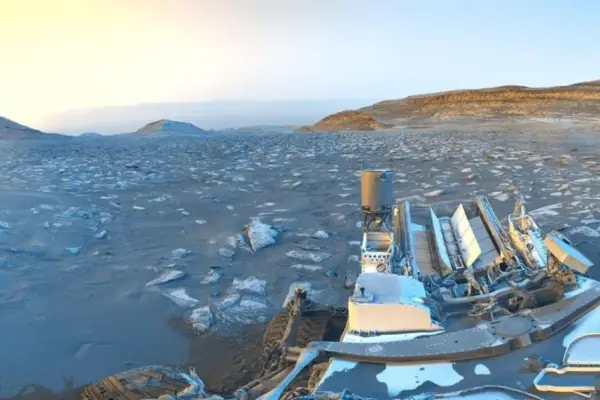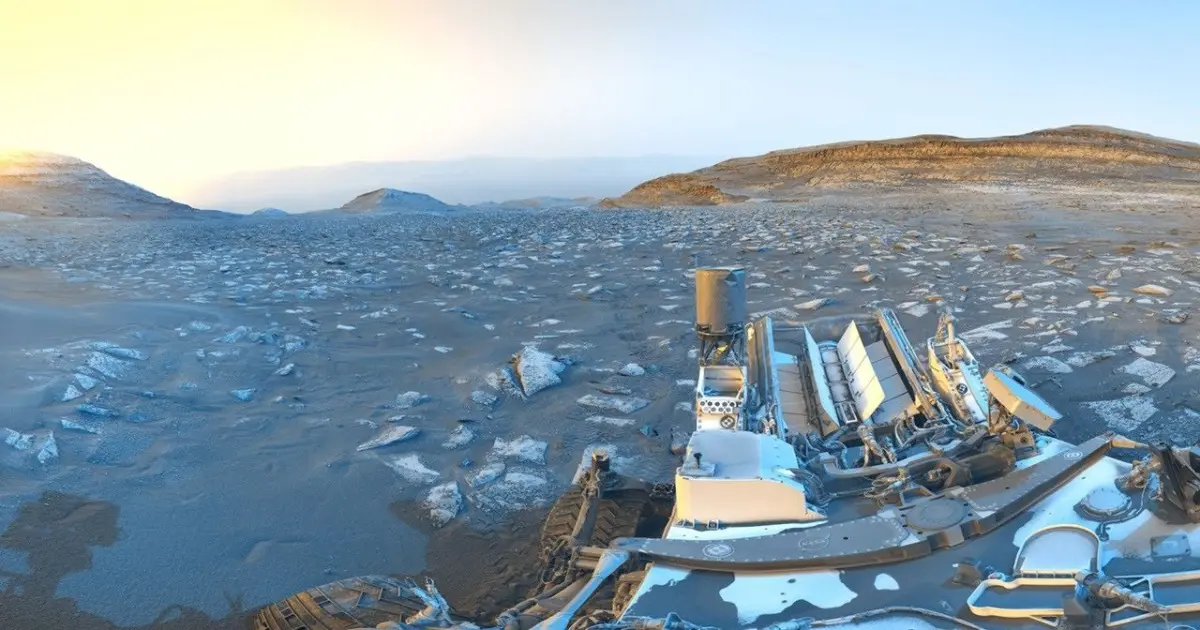
PASADENA, California — Resting quietly against the rugged, desert backdrop of a Martian sand ridge known affectionately as "Chocolatal," NASA’s venerable Curiosity rover has hit a monumental milestone in its ongoing exploration of the Red Planet. Marking its 5,000th and 5,003rd Martian days—or sols—on the surface of Mars, the robotic explorer utilized its onboard navigation cameras to capture a breathtaking dual-time panorama that bridges the passage of a Martian day in a single artistic frame.
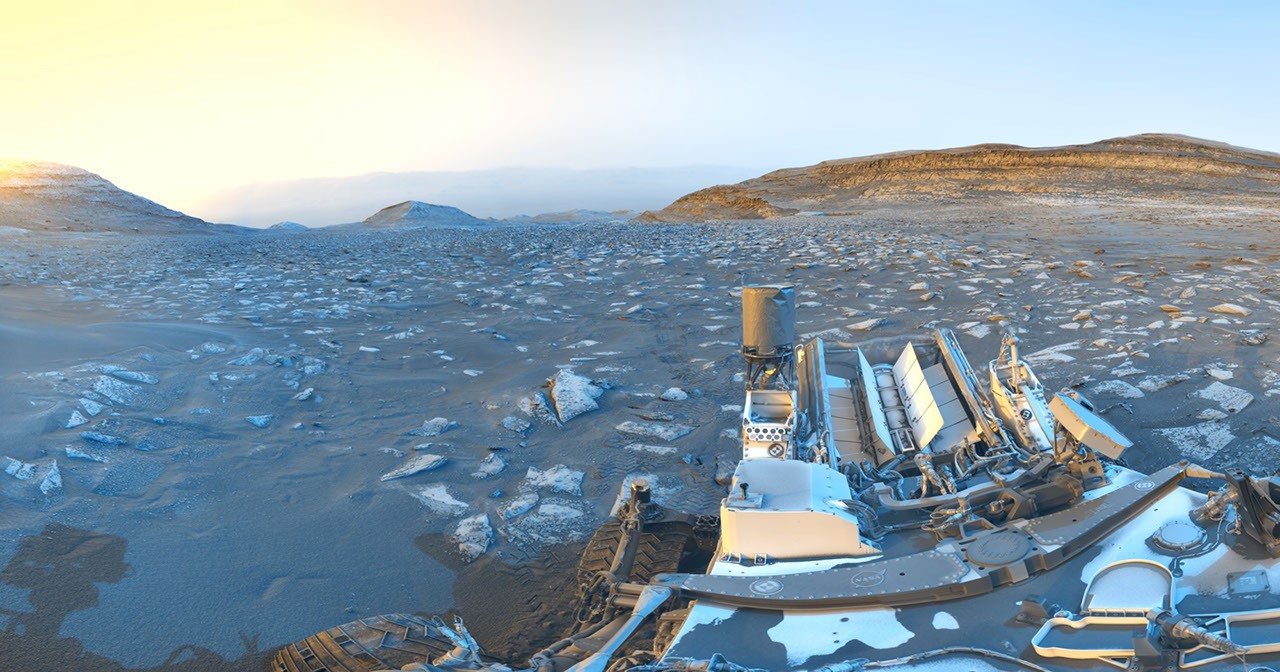
The resulting mosaic, painstakingly stitched together from images transmitted back across the interplanetary void to Earth, offers space enthusiasts and scientists alike a poignant look at the alien environment through a creative lens. In this newly released composite "postcard," digital color has been thoughtfully blended to distinguish the passing hours: cool shades of blue highlight the crisp morning atmosphere, while warm hues of yellow wash over the scene to represent the descending afternoon light. This artistic synthesis echoes similar historic visual composites released by the mission team in the past, most notably a memorable panoramic view captured back in November 2021.
Capturing the Passage of Time on Sol 5,000 and Beyond
The raw ingredients for this latest postcard were gathered by Curiosity during a quiet stop at the "Chocolatal" sand ridge, a typical feature within the diverse terrain the rover has been navigating for over a decade. The first component of the panorama was recorded on August 30, 2026, precisely at 9:56 a.m. local Mars time, marking the mission’s 5,000th sol on the planet. Just a few days later, on September 2, 2026, at 5:39 p.m. local Mars time—corresponding to Sol 5,003—the rover turned its black-and-white navigation cameras outward once again to capture the afternoon shift in lighting and shadows.
Once these digital data packages made their multi-million-mile journey across space and were received by deep space tracking networks, mission specialists merged the two distinct perspectives into a cohesive visual narrative. The wide-angle composition provides a comprehensive look at the surrounding terrain while offering a detailed glimpse of the rover itself. In the immediate foreground, the familiar mechanical anatomy of Curiosity dominates the lower portion of the frame: its can-shaped Ultra High Frequency (UHF) antenna, essential for relaying heavy data packets back to orbiters circling overhead, stands ready, while the finned Multi-Mission Radioisotope Thermoelectric Generator (MMRTG)—the reliable nuclear power source that keeps the rover functioning through freezing Martian nights—grows quiet at the vehicle’s rear. Stretching away from the mechanical body, deep parallel tracks gouged into the soil trace the rover’s historic path, vanishing into the dusty distance as a testament to the miles it has conquered.
Delving Deeper into Gale Crater and Mount Sharp
At the time of this imaging milestone, Curiosity finds itself positioned within the lower foothills of Mount Sharp, an immense, three-mile-tall (five-kilometer-tall) layered mountain that towers directly from the center of the sprawling Gale Crater. From this vantage point, the camera angle looks outward and downward toward the rugged floor of the crater, where ancient geological processes once pooled liquid water billions of years ago. In the far distance, the sweeping rim of Gale Crater appears faint and blurred against the dusty horizon, half-lost in the soft, diffused scattering of the Martian atmosphere.
This environment has been Curiosity’s primary scientific laboratory since its dramatic "Seven Minutes of Terror" landing back in August 2012. Designed to assess whether Mars ever possessed environmental conditions capable of supporting microbial life, the rover has steadily climbed the lower slopes of Mount Sharp, reading the geological history written in the stratified rock layers like pages in a deep-time book. Each upward movement brings scientists closer to understanding how the planet transitioned from a relatively warm, wet world into the arid, freezing desert visible in the rover’s latest panoramic postcard.
Engineering and Mission Management
The longevity of the Curiosity mission continues to stand as a monumental achievement for aerospace engineering and planetary science. The mobile laboratory was designed, developed, and built by NASA’s Jet Propulsion Laboratory (JPL), a premier division of Caltech located in Pasadena, California. JPL continues to direct the day-to-day operations of the rover on behalf of NASA’s Science Mission Directorate in Washington, functioning as a core element of NASA’s expansive Mars Exploration Program portfolio.
As Curiosity presses onward past its 5,000-sol milestone, the engineering and science teams behind the mission continue to monitor its systems, plan its routes across treacherous sand dunes and sharp rock fields, and extract invaluable data from one of the most hostile environments in the solar system. For those wishing to follow the ongoing journey of the robotic geologist as it explores the foothills of Mount Sharp, further mission updates, raw image logs, and scientific findings remain accessible through NASA’s official mission resources.