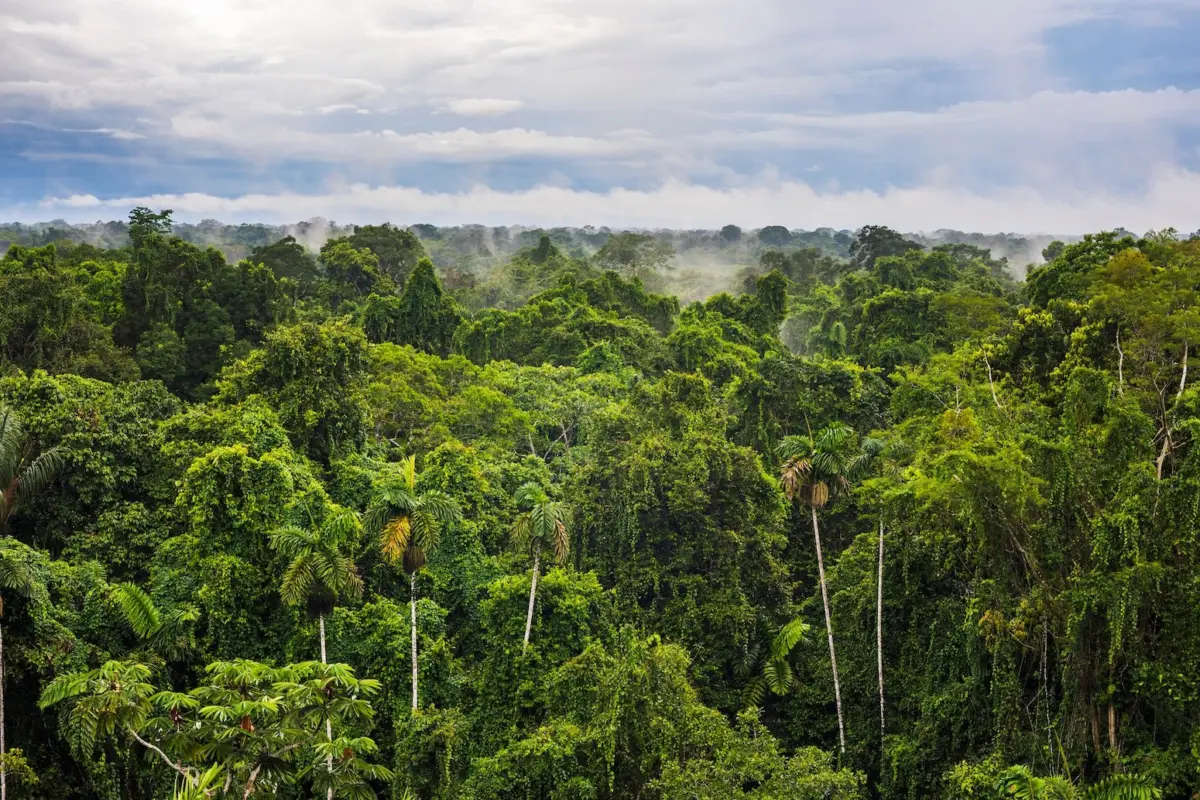
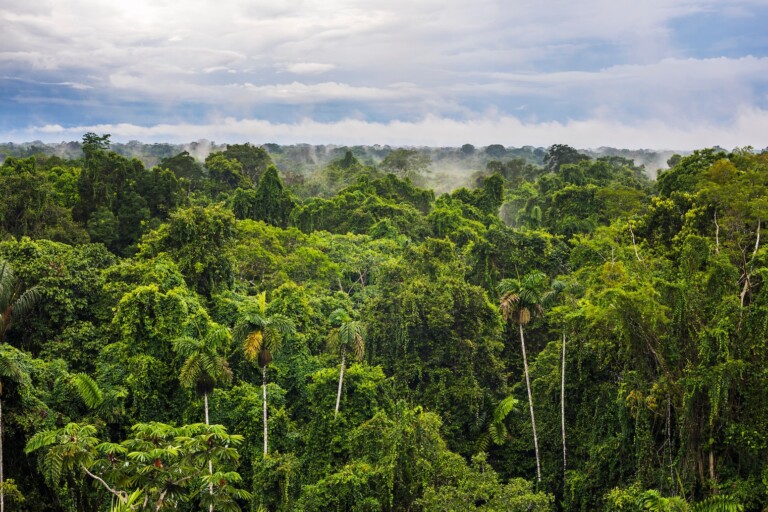
An area of the Amazon rainforest roughly equivalent to the size of the US state of New Jersey has remained standing due to President Luiz Inácio Lula da Silva’s environmental policies since he took office in Brazil, according to a new analysis by Carbon Brief.
Lula defeated Jair Bolsonaro in the fiercely contested 2022 presidential election, returning to lead the nation that houses nearly 60% of the world’s largest tropical rainforest. While forest loss had surged to alarming heights during Bolsonaro’s far-right administration, it has dropped sharply under Lula’s left-wing leadership, with Amazon deforestation on track to hit its lowest level on record.
Now, as another high-stakes presidential election approaches in Brazil, Lula is locked in a tight race against Flávio Bolsonaro, a senator and the son of the former president. The younger Bolsonaro’s anti-environmental platform closely mirrors the deregulatory policies of his father, posing a formidable challenge to the fragile ecological gains achieved over the past four years.
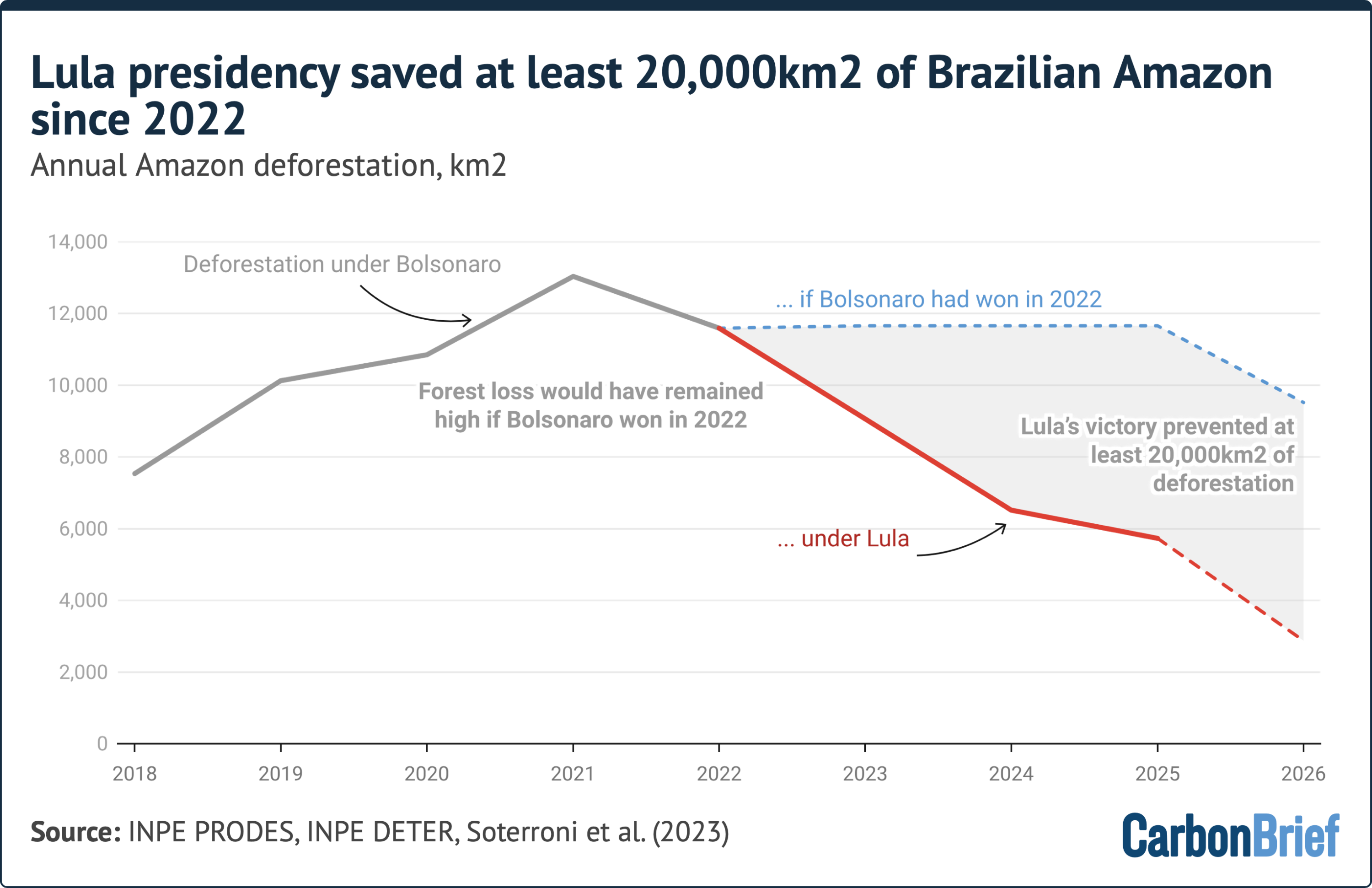
Carbon Brief’s analysis suggests that at least 20,000 square kilometers of deforestation have been successfully avoided since Lula returned to power and prioritized the protection of the Amazon basin. This figure is derived from sophisticated modeling by an international team of researchers who simulated an alternative scenario in which Brazil’s flagship Forest Code legislation—which requires landowners to preserve native vegetation on their properties—was left unenforced, serving as a baseline proxy for Jair Bolsonaro’s style of leadership.
Leading experts consulted by Carbon Brief note that this estimate is likely conservative and that actual deforestation rates under an uninterrupted Bolsonaro administration could have been significantly higher. With Lula and Flávio Bolsonaro currently tied in opinion polls ahead of the upcoming election, the political outcome will profoundly dictate the environmental trajectory of the world’s fourth-largest greenhouse gas emitter, where national emissions are predominantly driven by land-use change and deforestation.
“Brazil is Back”
During his tenure from 2019 to 2022, Jair Bolsonaro aggressively championed Brazil’s powerful agribusiness sector, rolling back federal environmental regulations, slashing the budgets of key enforcement agencies like IBAMA, and publicly undermining Indigenous communities and conservation groups. This systematic dismantling meant that the Forest Code was rendered largely toothless, allowing illegal logging, land grabbing, and wildcat mining to proliferate unchecked across the Amazon.
Following his narrow victory in late 2022, Lula pledged to steer the country toward a goal of “zero deforestation” by 2030. Stepping onto the global stage at the COP27 UN climate summit, he famously declared that “Brazil is back,” signaling a major pivot in the nation’s international climate commitments.
Under the direction of Environment Minister Marina Silva, a celebrated environmentalist, the government swiftly reinstated its Action Plan for the Prevention and Control of Deforestation in the Legal Amazon. Federal enforcement agencies scaled back their paralysis, ramping up active policing and monitoring across vulnerable forest frontiers.
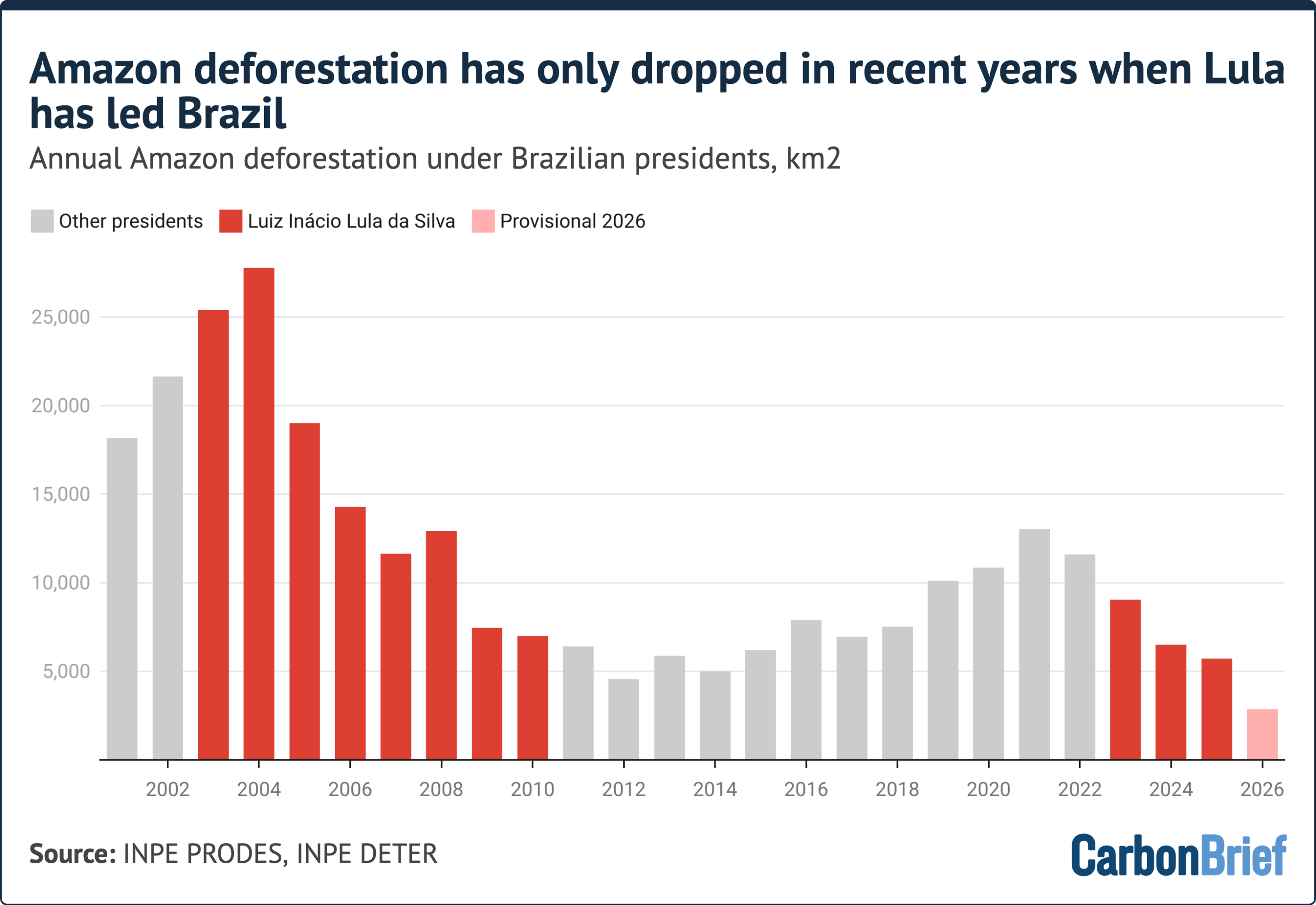
The policy shift yielded immediate results. Annual deforestation in the Amazon more than halved, plunging from 11,594 square kilometers per year in 2022 down to 5,731 square kilometers by 2025. Although official government tallies for the August 2025 to July 2026 monitoring period are still being finalized, preliminary real-time satellite alerts indicate a further drop to 2,874 square kilometers. While final verified figures traditionally trend higher than preliminary alerts, environmental experts widely anticipate that 2026 will mark the lowest annual deforestation rate since official record-keeping began in 1988.
A Forest the Size of New Jersey
The Carbon Brief analysis underscores the profound real-world impact of political shifts on tropical ecosystems. When compared against the modeled baseline of a hypothetical Bolsonaro victory, Lula’s leadership has directly preserved at least 20,000 square kilometers of pristine rainforest.
This protected expanse matches the land area of countries like Belize, Slovenia, or Wales, or the US state of New Jersey.
The methodology underpinning these findings relies on a 2023 update to academic modeling published in scientific journals, utilizing the GLOBIOM-Brazil model developed by researchers at the University of Oxford, the International Institute for Applied Systems Analysis, and Brazil’s National Institute for Space Research. Dr. Aline Soterroni, a University of Oxford researcher who led the 2023 study, emphasized that the rapid turnaround in forest loss demonstrates how swiftly ecosystems can respond to genuine political will.

However, Soterroni cautioned that the modeling used for the "no forest code" scenario remains conservative. It assumes deforestation would remain high but stable, constrained by slower global demand growth for Brazilian beef and soy, and does not fully account for potential surges in opportunistic, illegal land clearing driven by political impunity.
Claudio Angelo, international policy coordinator at the Brazilian Climate Observatory, argued that a second Bolsonaro term would likely have unleashed a destructive wave far exceeding the devastation of his first administration. The political signal sent by a right-wing victory, Angelo noted, would have likely catalyzed an explosion of illegal wildcat mining and widespread land clearances, compounded by legislative efforts in the Brazilian Congress to permanently gut the Forest Code.
Soterroni also observed that deforestation rates did not plummet overnight the moment Lula took office, reflecting the complex, gradual administrative challenge of rebuilding gutted enforcement frameworks. Nevertheless, she stressed that the stark contrast between weak governance and strict adherence to environmental laws remains the central takeaway for policymakers today.
Election Significance
With Jair Bolsonaro currently imprisoned following his conviction for plotting a coup after his 2022 electoral defeat, his son Flávio has stepped forward as the standard-bearer for the right wing. Running as a senator for Rio de Janeiro, Flávio Bolsonaro is one of 13 registered candidates, though he and Lula remain the clear frontrunners, locked in a dead heat in national polls.
Should Lula secure another term, analysts expect him to double down on his zero-deforestation agenda, reinforcing a historical trend where measurable drops in Amazon destruction have exclusively occurred during Lula’s three presidencies. Conversely, a victory for Flávio Bolsonaro—an outspoken climate skeptic who has pledged to prioritize mining and agribusiness—is viewed by experts as a looming catastrophe.
Dr. Patricia Pinho, deputy science director at the Amazon Environmental Research Institute, warned that the nation cannot afford another four years of escalating deforestation and institutionalized violence against Indigenous populations. Dr. David Lapola, an ecologist at the University of Campinas, concurred, stating that a return to right-wing rule would render Brazil’s climate targets obsolete. He warned that the systematic dismantling of environmental agencies under the previous administration proved how easily decades of institutional progress can be undone in a matter of months.
The election takes place within a broader regional context. Environmental groups have warned that if conservative leaders sweep upcoming regional contests, up to 95% of the entire Amazon basin could fall under the control of right-wing national governments in Bolivia, Colombia, Ecuador, and Peru—nations whose administrations similarly favor extractive industries over conservation. With the first round of voting set for October 4, a runoff on October 25 appears increasingly likely if no candidate clinches an outright majority.
Shifting Policy Landscapes and Legislative Battles
Regardless of who occupies the presidential palace, structural threats to the Amazon remain volatile. Earlier this year, the Amazon Soy Moratorium—a landmark voluntary pact whereby major grain traders agreed not to purchase soybeans grown on lands deforested after 2008—effectively collapsed after major agricultural traders withdrew from the agreement. Widely lauded by international conservation groups as the most effective supply chain policy ever implemented, its demise is projected by recent scientific studies to potentially unleash an additional 14,000 square kilometers of deforestation by 2036.
At the same time, the composition of the Brazilian Congress will heavily influence future environmental oversight. Right-wing parties, including the Liberal Party associated with the Bolsonaro family, maintain substantial sway in both legislative chambers. This dynamic has frequently pitted lawmakers against the executive branch, as seen when Congress overrode Lula’s vetoes on controversial legislative packages dubbed "devastation bills" by critics.
As voters head to the polls to elect a president, governors, and members of Congress, experts emphasize that the choice before the electorate transcends standard partisan politics. For Brazil’s scientific community, the upcoming vote will determine whether environmental stewardship is recognized as a fundamental societal necessity or dismissed as a disposable political preference.