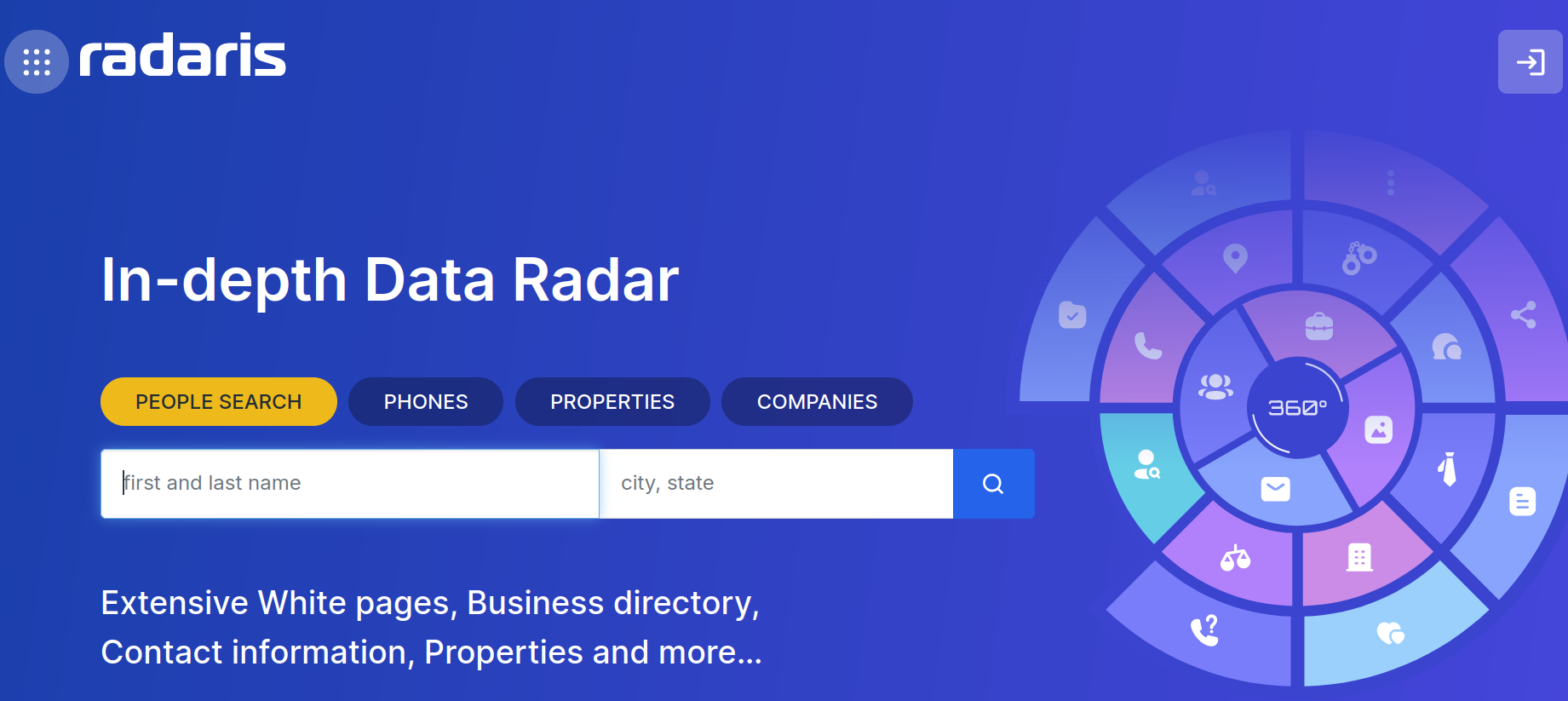
The controversial consumer data broker Radaris.com has finally seen its long-standing reputation for ignoring online removal requests catch up with it in a dramatic legal showdown. For years, the people-search giant operated with relative impunity, frequently dismissing or stonewalling requests from individuals seeking to scrub their personal information from its expansive digital footprint. That operational model collided with a powerful New Jersey privacy statute designed to protect state law enforcement officials, resulting in a federal and state court battle that culminated in a judge ordering the transfer of radaris.com—alongside more than a dozen sister domains—directly to the plaintiffs.
The legal reckoning began in February 2024, when Atlas Data Privacy Corp filed a lawsuit targeting Radaris for alleged violations of New Jersey’s Daniel’s Law. Named in honor of a tragic family incident involving a federal judge, the statute grants state law enforcement personnel, judges, government officials, and their immediate families the explicit right to have all personal records completely removed from commercial data brokers and people-search engines. Furthermore, the statute imposes substantial financial penalties, providing for fines of $1,000 per individual violation against companies that fail or refuse to comply with lawful removal requests.
Unraveling the Network Behind the Operation
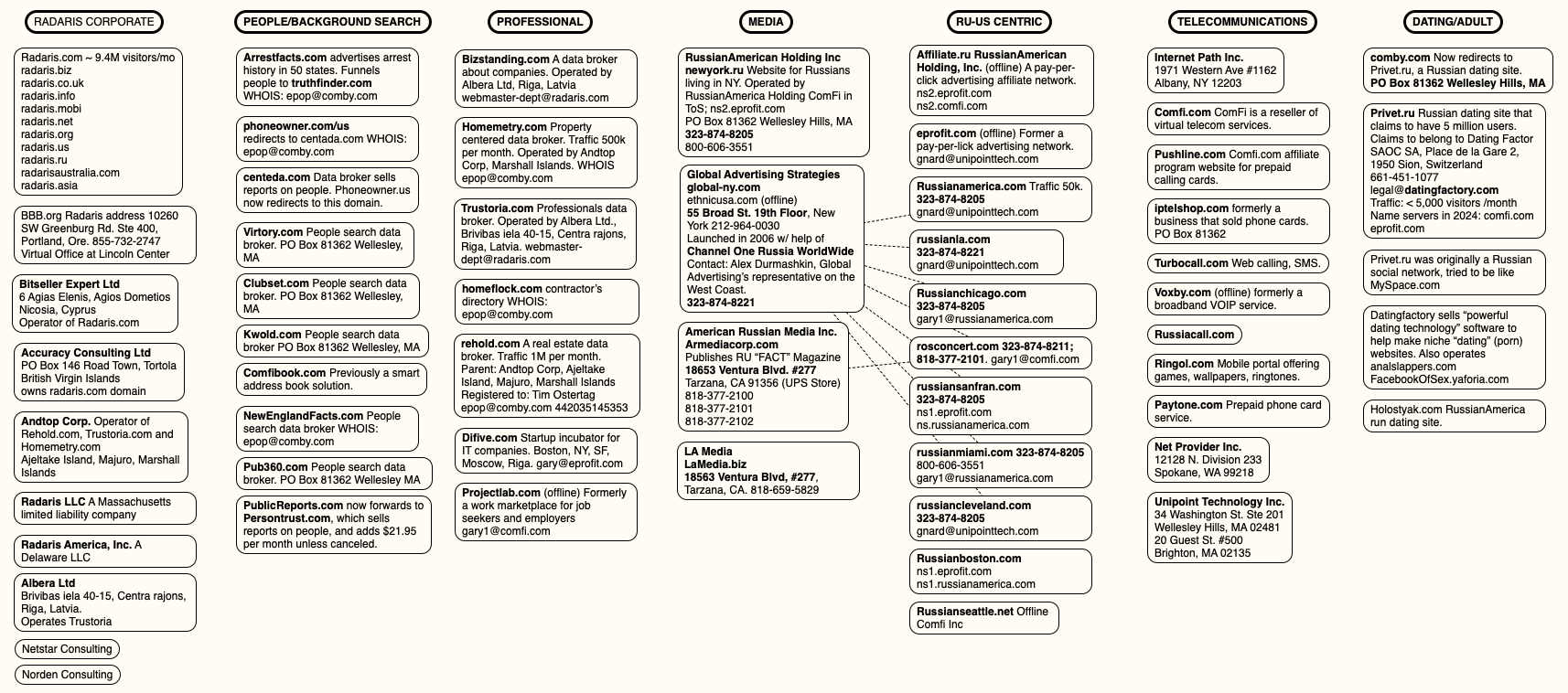
Just weeks after Atlas initiated its legal action, investigative reporting from KrebsOnSecurity cast a harsh spotlight on the co-founders of Radaris: Igor and Dmitry Lubarsky, Russian-born brothers residing in Massachusetts. According to the investigative findings, the brothers managed a sprawling network of people-search platforms, alongside various Russian-language dating services and digital affiliate programs.
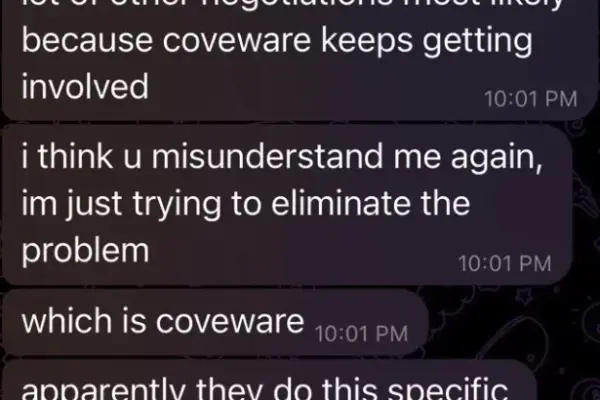
Attorneys representing the Lubarsky brothers initially threatened a defamation lawsuit if the reporting was not retracted and an apology issued, asserting that the reports were inaccurate and claiming the actual owners were Ukrainians living in Ukraine. However, follow-up reporting dismantled these claims, demonstrating how the brothers orchestrated their vast data broker ecosystem using a fictitious CEO named "Gary Norden." Radaris’s own legal counsel at the time, Boston Law Group attorney Val Gurvits, eventually acknowledged that his clients had fabricated the pseudonym and utilized it in corporate press releases to attract potential investors.
When the litigation progressed, Radaris legal representatives routinely delayed court appearances until the final possible moment, repeatedly attempting to challenge jurisdiction by arguing that the plaintiffs had failed to properly serve the actual corporate entities behind the network.
A Shell Game of International Jurisdictions
Recognizing the complex procedural hurdles, Atlas re-filed its lawsuit in June 2025, significantly expanding the scope of the complaint to include a broader array of corporate entities tied to the Radaris family. Matt Adkisson, president and CEO of Atlas, described the defense strategy as a classic shell game designed to frustrate accountability through exhaustion.
"We refer to this period as their island-hopping phase," Adkisson explained. "Privacy policies changed constantly, and new entities kept appearing from places like the Marshall Islands, the British Virgin Islands, and Seychelles. Behind the scenes, it felt like a shell game."
Adkisson noted that when the defendants updated their terms of service to claim that management of Radaris had shifted to a newly minted company in the Marshall Islands, Atlas investigators traveled to the region only to discover that the named entity did not even legally exist. Raj Parikh, a partner at PEM Law in New Jersey who handles Daniel’s Law litigation for Atlas, observed that the operators had relied on a strategy of attrition for over a decade. Plaintiffs’ attorneys would historically grow fatigued by procedural obstacles and drop their claims, a tactic that had shielded the network for years before Atlas committed the necessary time and resources to see the fight through.
By late August, a New Jersey judge ruled that the defendants had been granted ample opportunities to defend themselves in court but consistently failed to do so. While Val Gurvits declined to comment and pointed inquiries to another attorney, Victor Worms, the defense team argued that the transfer of radaris.com was legally flawed. Worms asserted that a motion had been filed to vacate the default judgment, maintaining that Radaris.com was merely a domain name rather than a formal legal entity with the capacity to be sued, and that the domain transfer represented an unconstitutional forfeiture.
Although radaris.com still appears in search engine results for residential records, the site no longer functions as a commercial broker of detailed personal dossiers. Instead, visitors to the homepage are greeted by a formal notice detailing the court-ordered transfer to Atlas, alongside links to prior investigative coverage.

Documenting the Corporate Web
During the extensive discovery process in New Jersey, Atlas accumulated more than 10,000 internal emails and corporate documents. According to the plaintiffs, these records conclusively tie together a complex web of nominal corporate vehicles—including Radaris America, Inc., Bitseller Expert Limited, Digital Orbit Corp, Core Solutions Group Inc, Lucky Solutions Inc, Virtura Corp, Veripages Inc., Nuform Solutions Inc., Growth Data Advisors Inc., and Property Experts, Inc.
The documentary evidence, drawn from independent banks, payment processors, hosting providers, and software vendors, establishes that radaris.com and at least 25 other people-search websites were managed as a unified operation by a small group based near Boston. Administrative, financial, and technical communications were routed through infrastructure tied to specific mail domains. Furthermore, the uncovered records revealed substantial monthly revenues generated by the network, including approximately $42,000 a month for Radaris.com and roughly $45,000 monthly for Veripages.com via partnerships with major marketing and advertising entities like the Lifetime Value Company. Additional revenue streams were reportedly linked to partnerships with privacy removal services such as Onerep.
To date, the New Jersey court has transferred 14 distinct domain names from the Radaris network to Atlas.
The Broader Legal Landscape and Federal Stalled Privacy Reform
While the Radaris companies continue to face potential statutory fines under Daniel’s Law, the broader enforcement mechanism is confronting significant constitutional challenges. Roughly 150 consumer data brokers targeted by Atlas have coordinated challenges in federal court, arguing that Daniel’s Law is overly broad and infringes upon First Amendment protections. The U.S. Court of Appeals for the Third Circuit has yet to deliver a definitive ruling on the constitutional questions, though legal observers anticipate the dispute will ultimately reach the U.S. Supreme Court.
Meanwhile, at least 14 additional states have introduced or passed legislation modeled after New Jersey’s statute, though similar legislative efforts have faced judicial hurdles elsewhere. In August 2025, a federal district court ruled West Virginia’s version of Daniel’s Law facially unconstitutional under the First Amendment.
Privacy experts point out that state-level measures remain piecemeal solutions to a systemic national issue. Justin Sherman, a privacy researcher and author examining the data broker industry, noted that federal legislative efforts have historically faced intense, well-funded opposition from technology companies, social media giants, cryptocurrency firms, and artificial intelligence proponents. According to Sherman, people-search operations will continue to flourish unless Congress enacts comprehensive federal privacy and data protection legislation. Most state-level privacy statutes deliberately carve out broad exemptions for records categorized as public or government documents, leaving voting registries, property deeds, marriage certificates, motor vehicle logs, and criminal filings readily available for commercial harvesting.
"The average person can look at Daniel’s Law and have a perfectly normal reaction, which is that everyone should be covered, not just police and judges," Sherman said. "But we don’t need more wake-up calls. We’ve had eight million wake-up calls already on the need for better privacy laws. The lack of comprehensive federal privacy law is not for a lack of knowledge, and anyone claiming otherwise is either not reading the news or kidding themselves."