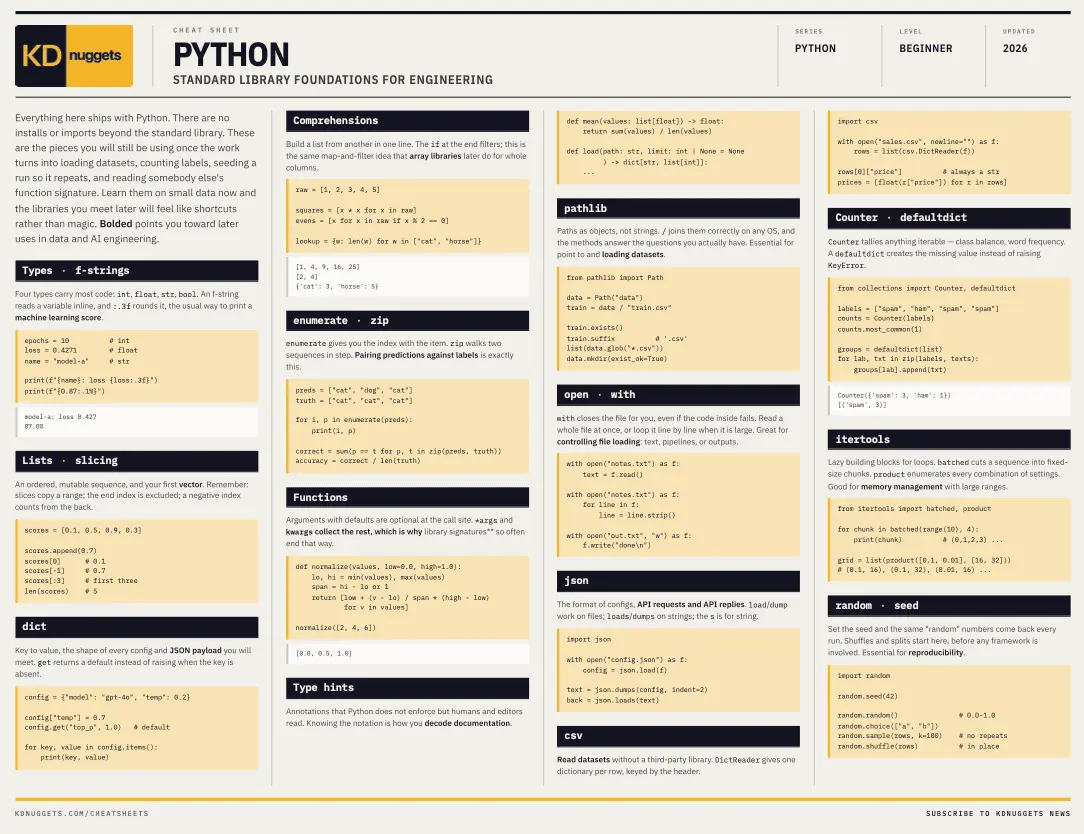
Newcomers entering the fast-paced fields of data science and artificial intelligence frequently treat the foundational elements of Python as little more than a temporary waiting room. The prevailing strategy among many aspiring practitioners is to rush through the basics as quickly as possible in order to arrive at the prime-time libraries where the real, headline-grabbing work is assumed to take place. It is a completely understandable strategy given the excitement surrounding modern machine learning frameworks and large language models. However, this common educational path produces a very specific kind of practitioner: one who can follow a tutorial or a Jupyter notebook precisely step-by-step, yet becomes entirely stranded the moment real-world data deviates even slightly from the tutorial parameters.
To address this persistent industry challenge, KDnuggets has released its latest resource designed to reinforce core technical competencies: the Python Engineering Foundations cheat sheet. This newly published reference material gathers the essential concepts and mechanics that do not get left behind as a developer progresses in their career. Almost none of the fundamental principles outlined in the cheat sheet are ever replaced by a higher-level framework later on. Instead, those foundational operations get scaled up, given faster underlying machinery, and handed a nicer syntactic surface, but the underlying logic remains entirely the same.
A data transformation written across a handful of native Python items operates on the exact same logical principles that a massive array library applies to a column of ten million records. Consequently, even if a beginner first encounters a fundamental programming idea on a small, manageable dataset, the vectorized or scaled version encountered later remains entirely understandable without requiring blind edits. It ceases to be merely a piece of syntax that a developer copies from a forum and pastes with crossed fingers while hoping for the best.
This distinction matters most when something inevitably breaks in a production environment, because debugging code without a genuine understanding of its foundational mechanics is widely recognized as a frustrating and ineffective endeavor. When an unexpected exception halts a pipeline, recognizing the fundamental operations at play allows a practitioner to diagnose the root cause rather than guessing at arbitrary fixes.
Beyond the execution of code, there is substantial hidden value in mastering these fundamentals that directly relates to reading and comprehending technical documentation. Function signatures, optional arguments, collected arguments, and type annotations—which are rarely enforced strictly by the interpreter itself but are heavily utilized throughout modern documentation—form the exact notation every major library uses to describe its own behavior. Not being conversant in this specific style of programming prose means that reference documentation effectively remains closed off and intimidating.
As a result, every minor coding question turns into an exhausting quest to find somebody who has encountered the exact same issue before, or worse, a reason to repeatedly consult automated assistants like ChatGPT for an answer that inevitably presupposes an actual underlying understanding of the problem. When developers rely entirely on generated solutions without grasping the underlying language syntax and structure, they fail to build the mental models necessary for long-term technical growth.
What remains after stripping away the flashy wrappers of high-level frameworks are the fundamental engineering concepts that actually underpin the vast majority of any real-world working project. These essential tasks include finding files on a local or cloud filesystem and opening them safely, seamlessly moving between the diverse data formats that configuration files and application programming interface traffic actually arrive in, counting and verifying what is truly inside a dataset before trusting any sweeping claims about its distribution, and fixing a random seed so that experimental results can be reliably reproduced across different environments.
Far from being mere preliminaries or boring administrative hurdles to get out of the way before the real engineering work begins, these mundane operations turn out to constitute a remarkably large share of what professional data and AI engineering actually entails on a day-to-day basis. Production software is built on robust file handling, data validation, and reproducibility, not just on training complex neural networks.
An additional advantage of focusing on these native elements is that everything featured on the new KDnuggets cheat sheet ships directly with standard Python installations. There is nothing extra to install, no complicated dependency trees to pin, and no frustrating version drift issues to manage across different development machines or production servers. By relying on native language features and standard libraries, developers can ensure greater stability and portability for their foundational scripts.
Ultimately, the release of this cheat sheet highlights a broader shift in how the data and AI community views foundational education. As the industry matures, the emphasis is slowly moving away from merely memorizing framework-specific syntax toward cultivating a deeper, more resilient understanding of core engineering principles. By equipping practitioners with a solid grasp of Python’s foundational mechanics, resources like this help bridge the gap between fragile tutorial followers and confident, capable software engineers ready to tackle unpredictable real-world data challenges.