Over the past three years, Ukraine has been quietly implementing one of the most ambitious governance overhauls in its modern history: a comprehensive Public Investment Management (PIM) reform. While executing such a systemic transformation would be a monumental undertaking for any nation under normal circumstances, Ukraine is achieving this feat while contending with daily wartime challenges, including hundreds of missiles and drones targeting its infrastructure and cities every week. International financial and institutional estimates currently place the ultimate cost of rebuilding the war-torn country at upwards of US$ 588 billion, encompassing thousands of complex infrastructure projects being pursued simultaneously by local communities, regional authorities, national ministries, and dozens of international donor partners.
At the very heart of this vast administrative and financial restructuring sits DREAM, Ukraine’s open digital ecosystem designed specifically for public investment management. Developed on core principles of open government and open contracting, the DREAM platform serves as a vital technological bridge. It connects disparate state-owned and external registers, underpins rigorous project monitoring and comprehensive data analysis, and establishes a single, streamlined digital pipeline for public investment projects across the country. Today, DREAM functions as the undisputed digital backbone of the nation’s reform agenda, supporting more than 12,900 public investment projects spanning 18 distinct sectors. The system is actively utilized by over 1,300 municipalities, every single regional state administration, all national ministries, and major state-owned enterprises.
The platform covers the entire lifecycle of an investment project, stretching from initial project conception and feasibility appraisals through to formal prioritization, funding coordination, and ongoing implementation monitoring. As this comprehensive reform enters its critical full-scale implementation phase, officials and technology partners are now exploring how artificial intelligence can serve as the next practical enabler. The goal is to strengthen institutional capacity, translate complex Public Investment Management rules into actionable guidance usable by every municipality in Ukraine, and ultimately improve both the quality of investment projects and the overall efficiency of planning and delivery.
The Scale of the Challenge
This unprecedented scope brings with it a severe practical capacity challenge. Public officials on the ground must navigate an intricate web of complex laws, rigid methodologies, public procurement rules, strict construction norms, financial requirements, and strict donor conditions. Local governments across the country frequently operate under immense strain, characterized by limited staff, fragmented technical expertise, and very little time to pore over hundreds of pages of legal texts, methodologies, and operational manuals.
For instance, completing a full cycle of investment pre-feasibility studies for a relatively modest local project typically demands about four weeks of dedicated, full-time work for a single local government team. Consequently, preparing just ten such projects simultaneously becomes an overwhelming administrative hurdle for a small municipal administration. During peak planning cycles, the central DREAM Project Office routinely handles more than 850 support requests per day, even with extensive training programs, dedicated helpdesks, and established expert networks already functioning across the country. In 2025 alone, organizers managed 96 separate training events that engaged nearly 30,000 participants, highlighting that traditional administrative support models struggle to scale at the rapid pace demanded by wartime reconstruction.
This acute capacity shortage is further exacerbated by the relentless pressures of active conflict. More than 230 communities, representing roughly 15 percent of the nation’s territory, currently hold frontline status, facing dense shelling, continuous drone attacks, severe energy infrastructure breakdowns, and massive waves of internally displaced persons on a daily basis. Despite these extreme conditions, all of these communities must remain included in the national PIM process and retain equitable access to critical reconstruction financing. When administrative capacity is stretched this thin, even sound and well-designed rules become exceedingly difficult to apply in everyday practice.
Our Approach to AI
Artificial intelligence cannot replace public servants, expert professional judgment, or political accountability—at least not today. However, it can dramatically improve how critical institutional knowledge, including policies, methodologies, regulatory requirements, and sectoral expertise, is accessed, interpreted, and applied, particularly within a fast-evolving and highly complex reform environment. Closing this critical gap is the primary objective of the current technological integration.
Within the DREAM ecosystem, artificial intelligence is not viewed as an external automation gimmick, but rather as an intelligent support layer embedded directly into standard governance workflows. Its fundamental purpose is straightforward to explain yet difficult to execute: to assist users in preparing and appraising better projects, understanding regulatory requirements much faster, and making more consistent, evidence-based decisions.
Three years of intense reform implementation have provided the initiative with something that most artificial intelligence projects typically lack: a solid, battle-tested foundation. The project team possesses a verified knowledge base, a clear mapping of where municipal users frequently encounter bottlenecks, and the hard-won operational data necessary to build an assistant that is genuinely useful. It is designed not merely as a flashy technological feature to showcase, but as a practical mechanism to support and empower the local officials tasked with rebuilding the country.
With strong political backing from the Ministry for Development and the Ministry of Economy, the DREAM Project Office—supported by the Open Contracting Partnership and its established expertise in deploying AI tools for public procurement—has joined forces with uStudio as an IT and AI innovation partner, alongside GCIEP and PwC with support from the UK Foreign, Commonwealth & Development Office (FCDO). Together, this coalition is developing a specialized, AI-powered assistant fully integrated into the DREAM ecosystem. This collaborative approach rests upon a working prototype, a carefully curated and verified knowledge base, and a hybrid technical architecture strictly aligned with Ukraine’s national data sovereignty and ethical AI principles as outlined in the official White Paper on Artificial Intelligence Regulation in Ukraine.

The DREAM AI Assistant: Three Stages of Implementation
The rollout of the DREAM AI Assistant is strategically synchronized with the broader PIM Reform Roadmap spanning from 2024 to 2028, advancing through three distinct and deliberate stages of implementation.
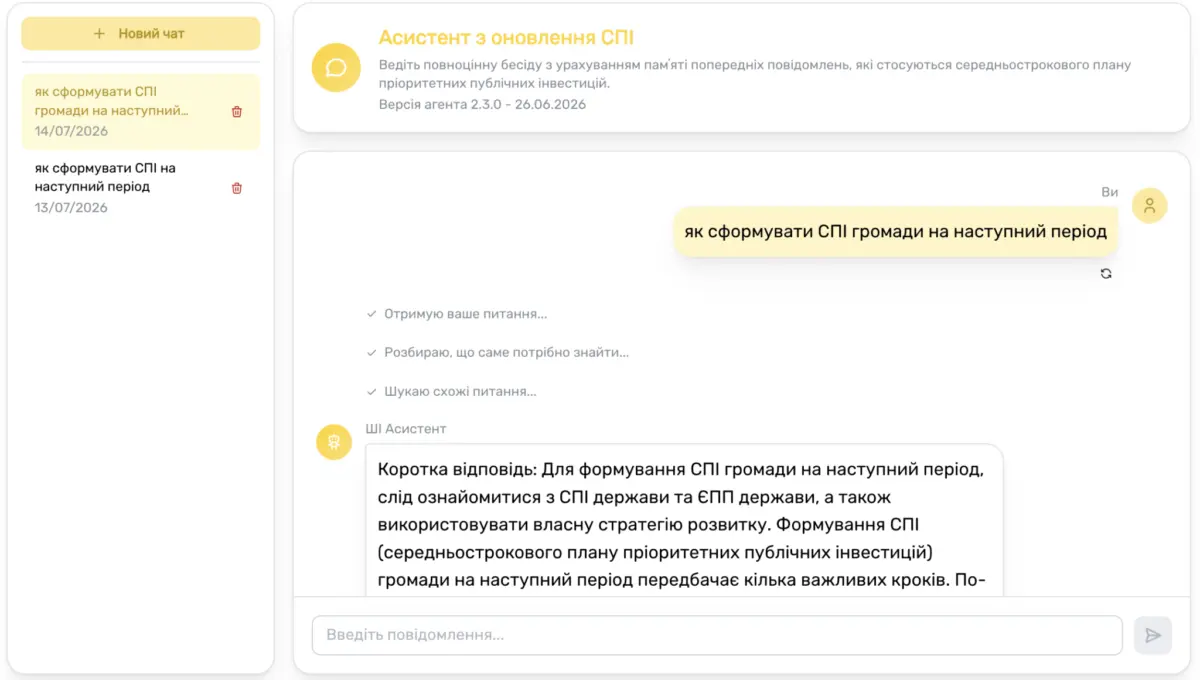
During the initial phase rolling out through 2026, the AI assistant provides real-time guidance on PIM rules and the intricate project preparation process directly within the DREAM interface. This phase aims to bridge the gap between complex legal language and practical municipal application by translating dense methodological requirements into accessible, clear explanations tailored specifically to each user’s individual role, operational sector, and geographic location. Serving as a trusted, round-the-clock entry point into the comprehensive PIM knowledge base, the assistant delivers practical guidance for government bodies at every administrative level.
The system underwent rigorous testing in April 2026, when focus group participants representing local communities utilized the assistant for actual project preparation tasks, awarding it an average satisfaction score of 4.33 out of 5 points. While developers continue to refine and upgrade the assistant, preliminary findings demonstrate that the tool successfully reduces administrative workloads and accelerates procedures by guiding users smoothly through project preparation.
Looking ahead to 2027, the DREAM AI assistant is scheduled to expand its capabilities into the realm of quality assurance. In this second stage, it will assist expert appraisal teams in identifying missing performance indicators or logical inconsistencies within submitted feasibility studies, while proactively suggesting ways to better align proposed projects with national sectoral priorities. This includes improving their economic, environmental, and financial viability cases. By comparing new project submissions against historical, validated cases from the database, the system will significantly enhance the consistency and transparency of thousands of upcoming investment decisions.
In the final targeted phase spanning 2028 to 2029, the objective shifts toward advanced investment modeling. Utilizing geographic, demographic, fiscal, and economic data, the system will help officials explore various development scenarios and model alternative investment options. This advanced functionality will enable comprehensive, scenario-based assessments to determine precisely where public resources can achieve the greatest possible socioeconomic impact.
Building a Safe and Responsible AI Architecture
Because public investment decisions involve exceptionally high stakes and sensitive state data, the DREAM AI assistant is constructed upon a hybrid and fully auditable technical architecture designed to guarantee responsible governance from the ground up.
The core of the system relies on Retrieval-Augmented Generation, commonly known as RAG, which ensures that every response generated is grounded exclusively in verified laws, official manuals, and approved guidelines. To safeguard sensitive information against external exposure, the system employs local language models hosted entirely on secure domestic infrastructure to protect national data sovereignty. Every generated answer is fully traceable to an approved regulatory source, timestamped, and version-controlled to maintain absolute accountability. Furthermore, the underlying architecture incorporates a mandatory human-in-the-loop validation process, ensuring that all functional content remains accurate and reflects the most recent legislative updates.
To minimize the inherent risks of artificial intelligence hallucinations or the accidental reliance on outdated regulatory guidance, every response produced by the system includes direct citations to approved sources alongside specific timestamps and version markers. Potential operational risks, such as factual inaccuracies or privacy concerns, are proactively mitigated through structured prompt design and rigorous administrative access controls. Additionally, a dedicated multidisciplinary oversight team continuously monitors system performance to guarantee strict adherence to ethical standards and maintain an unwavering focus on its core public purpose.
Ukraine’s Lesson for the World
Ukraine’s ongoing experience demonstrates convincingly that effective artificial intelligence in government does not begin with complex algorithms. Instead, it begins with clear operational rules, robust institutions, and the systemic discipline required to design technology that directly serves the public good. The artificial intelligence layer currently being integrated into the DREAM platform is only as effective as the underlying reform infrastructure upon which it rests—an infrastructure that required three years of relentless effort and immense national determination to construct.
If executed successfully, this pioneering initiative has the potential to become much more than a vital catalyst for Ukraine’s postwar recovery and long-term development. It can serve as a globally relevant test case illustrating how artificial intelligence can be deployed responsibly to strengthen public investment management systems within highly complex environments. A nation actively rebuilding itself under fire, while simultaneously maintaining a cutting-edge digital governance framework, offers a compelling testing ground for what is truly possible in modern public administration.