Global fossil-fuel carbon dioxide emissions are projected to decline by approximately 0.5% in 2026, driven by profound disruptions stemming from the ongoing geopolitical crisis in the Strait of Hormuz. According to comprehensive new analysis by Carbon Brief, the cascading effects of the US-Iran war have fundamentally reshaped international energy markets, triggering severe trade blockades and subsequent price volatility that continue to ripple throughout the global economy.
The conflict has severely restricted maritime trade through the vital chokepoint of the Strait of Hormuz, causing acute spikes in oil and natural gas prices. With every month of prolonged disruption—and the emergence of secondary flashpoints, such as renewed violence in Yemen—governments, industries, and consumers face intensifying economic incentives to pivot away from volatile hydrocarbons toward alternative energy sources.
While these pressures have driven a temporary, localized resurgence in coal demand, comprehensive data indicates that the resulting rise in coal emissions will be more than fully offset by steep, unprecedented contractions in global oil and gas consumption. Consequently, total carbon dioxide emissions originating from fossil fuels are expected to register a net reduction of roughly 0.5% compared to 2025 levels. Given that fossil fuels account for roughly two-thirds of all global greenhouse gas emissions, this shift marks a significant, albeit crisis-driven, inflection point in the global energy landscape.

Shifting Forecasts Across Coal, Oil, and Gas Markets
The latest emissions estimates are synthesized from updated market forecasts published by the International Energy Agency (IEA), which have undergone sweeping revisions throughout the year to account for the escalating global energy crisis.
At the close of 2025, the IEA had anticipated a modest decline in global coal demand for the upcoming year. Publishing its annual coal report in mid-December, the agency projected that declining consumption in China would successfully counteract the implementation of pro-coal policies enacted under US President Donald Trump.
However, the reality of the post-Hormuz economic environment upended those projections. By September 2026, the IEA released a revised mid-year update forecasting that global coal demand would instead rise by 1.2% over the course of the year. This upward tick seemingly lent credence to widespread media narratives predicting a major "return to coal" in response to soaring gas prices.
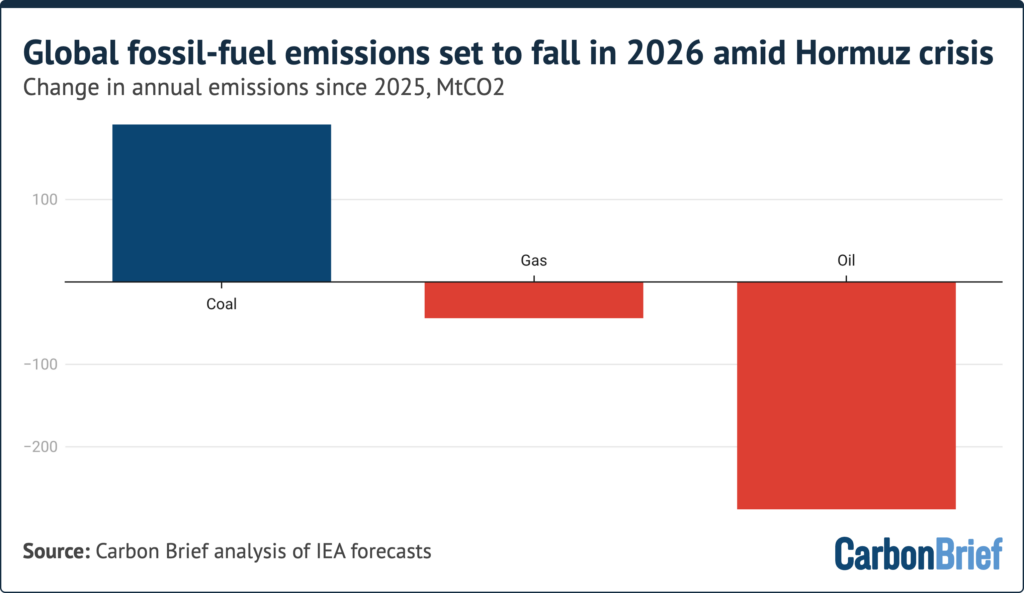
Yet, analysts emphasize that this rebound has strict boundaries. The ability of power sectors and heavy industries to substitute expensive gas with coal on a large scale remains physically and logistically constrained in most regions. Furthermore, the IEA’s updated assessment highlights that coal’s upward trajectory is being driven by a confluence of short-term factors rather than a uniform structural reversal. These include a robust El Niño weather pattern that has simultaneously driven up electricity demand for cooling while depressing vital hydropower generation in key markets. Additionally, rising volumes of curtailed or "wasted" wind and solar generation in countries like China have temporarily influenced regional balancing acts within the energy mix.
The trajectory for natural gas has followed a different path. Having entered the year anticipating a robust 2.0% expansion in global gas demand, the IEA held firm on that projection through January. By July, however, mounting price pressures forced the agency to revise its outlook downward, pointing toward a 0.6% contraction in demand for 2026. In the months since, intensified price stress and supply anxieties have only served to cement that downward trend.
For petroleum products, the downward revisions have been both immediate and dramatic. In its January 2026 oil market report, the IEA projected an increase in global oil demand of approximately 930,000 barrels per day (bpd) for the year. As the conflict in the Middle East ignited and subsequently extended into a protracted standoff, those growth forecasts were steadily dismantled.
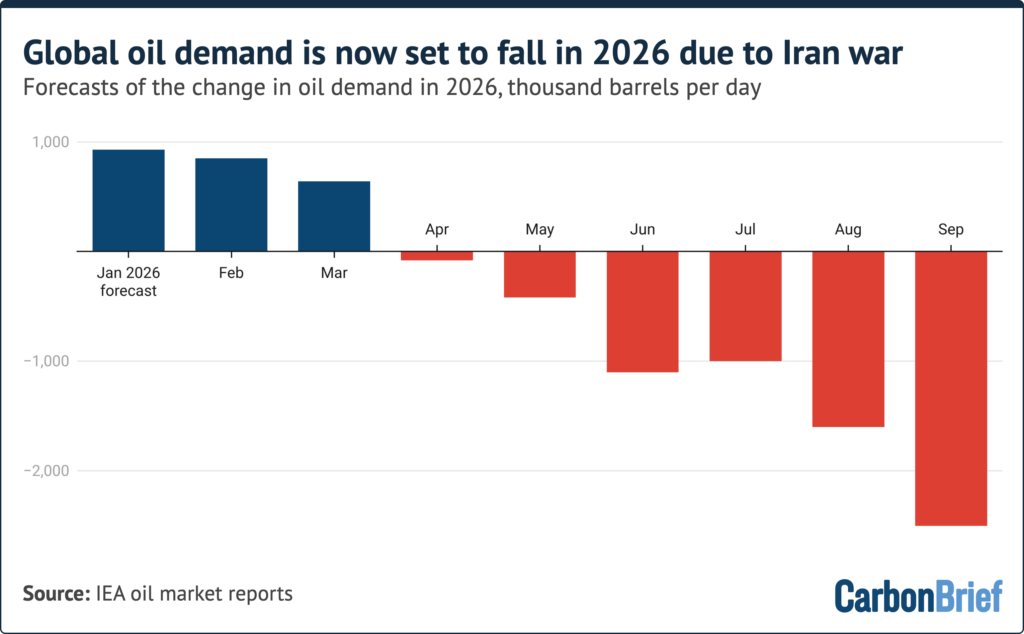
By September, the IEA’s outlook had shifted into deeply negative territory, projecting a staggering demand drop of 2,500,000 barrels per day—equivalent to a 2.4% reduction from 2025 consumption levels. This assessment aligns closely with broader financial sector consensus; a mid-September research note from Morgan Stanley estimated a comparable demand drop of 2,415,000 barrels per day for 2026.
Permanent Demand Destruction and the Accelerated Energy Transition
While immediate market dynamics and crisis management measures dominate short-term statistics, energy experts point out that the fallout from the current crisis will inevitably leave lasting structural imprints on global fuel demand well beyond the current year.
Prior to the outbreak of hostilities, standard long-term projections anticipated that global oil demand would follow a gradual upward curve before eventually peaking around 2030. The severity of the current price shock, however, has forced major forecasters to re-evaluate those timelines. While the IEA initially modeled an oil demand rebound in 2027 that would carry consumption well past 2025 benchmarks, current expectations point toward global oil use remaining effectively flat for at least a two-year horizon.

This prolonged stagnation places a major question mark over previous assumptions regarding the peak of global oil consumption. Analysts at energy consultancy DNV noted in a late-August analysis that the probability of permanent oil demand destruction escalates with each passing month that the conflict persists.
As petroleum prices surged to punishing heights, electric vehicles achieved historic market share milestones across major economies worldwide. Record adoption rates have been documented not only in traditional strongholds like China and Europe, but also across emerging automotive markets in Australia, Indonesia, and Thailand. Data from mid-summer indicated that EV sales nearly doubled year-on-year across these expanding international markets, signaling that high oil prices are permanently altering consumer purchasing habits and fleet electrification strategies.
A similar recalibration is underway in the global gas market, particularly regarding liquefied natural gas. Developing nations across Asia that had originally structured their long-term energy security around projected imports of LNG have encountered severe financial and logistical hurdles amid soaring spot prices. In the wake of multibillion-dollar import bills, regional governments are increasingly signaling strategic shifts away from reliance on foreign gas supplies. Instead, policymakers are accelerating investments in domestic clean energy infrastructure or, in some cases, extending the operational lifespans of existing coal-fired generation assets to ensure grid stability.

The convergence of these economic and geopolitical pressures suggests that the 2026 energy crisis may serve as a powerful catalyst for structural transformation. By accelerating the deployment of domestic renewables, forcing rapid fleet electrification, and penalizing hydrocarbon dependence, the crisis has demonstrated the potential to lower fossil-fuel consumption not merely as a temporary emergency response, but on a lasting, structural basis.