Large language models have established themselves as remarkable text generators, yet they continue to grapple with a well-documented and persistent vulnerability: hallucinations. When operating without direct access to verified, up-to-date information, these models can confidently produce plausible-sounding answers that are factually incorrect. To combat this limitation, Retrieval-Augmented Generation, commonly known as RAG, emerged as the standard industry solution. By grounding model outputs in external knowledge sources, RAG dramatically reduced instances of hallucination across a wide array of enterprise applications.
However, as organizations increasingly push these artificial intelligence systems into more complex operational workflows, a new systemic problem has surfaced. Standard RAG pipelines are inherently linear, executing a single retrieval operation, passing those initial results directly to the model, and immediately generating an answer. While this straightforward approach functions effectively when handling simple queries within a well-structured knowledge base, it begins to fracture under heavier cognitive loads. When a query demands multi-step reasoning, cross-referencing across multiple distinct sources, or synthesizing information that is scattered rather than concentrated in a single document, the traditional pipeline struggles to keep pace.
This operational bottleneck has paved the way for Agentic RAG. Rather than treating information retrieval as a single, fixed procedural step, this advanced architectural paradigm equips the system with the capability to actively reason about how it should search, critically evaluate the information it uncovers, and iterate through the process until it reaches a genuinely satisfying and accurate answer.
To understand the trajectory of enterprise search and generative applications, industry engineers and architects must examine how both architectures function, pinpoint the exact operational thresholds where standard RAG hits its limits, and analyze the specific capabilities that make agentic systems profoundly better suited for complex tasks. This evolution marks a major shift in how organizations approach knowledge management and automated reasoning.
The Baseline: Understanding Naive RAG
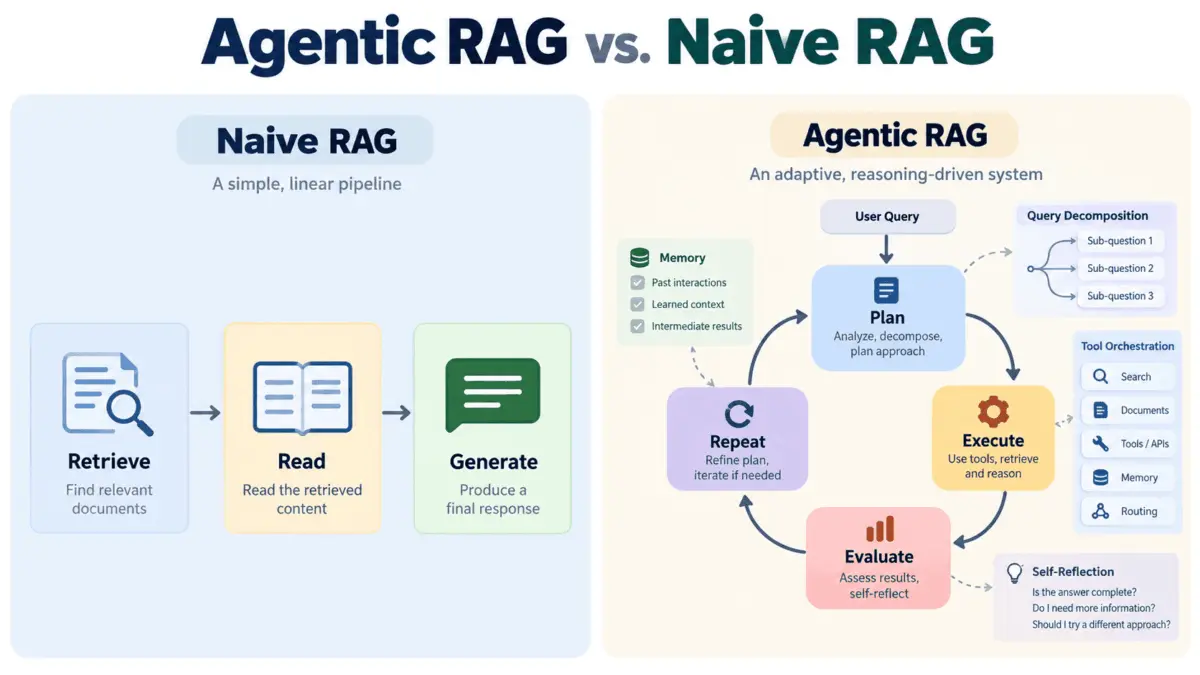
Before examining where modern retrieval systems are heading, it is necessary to examine the foundational mechanics of where they started. Naive RAG, frequently referred to as standard RAG, follows a rigid and predictable three-stage pipeline consisting of retrieval, reading, and generation.
In this traditional workflow, a user submits a query, and the system instantly converts that input into a vector embedding. It then executes a similarity search against a vector database, retrieves a predetermined number of the most relevant document chunks, and passes those chunks directly to the large language model as contextual reference material. The model subsequently formulates its response strictly on the basis of what was provided within that specific context window.
This process can be conceptualized by imagining a student preparing for an exhaustive examination inside a vast library. Naive RAG resembles a student who types a single keyword into the digital catalog, blindly grabs the first three books pulled from the shelf, and attempts to write a comprehensive essay using only the open pages directly in front of them, without ever pausing to verify whether those particular sources actually answer the prompt.
Under the hood, the technical workflow is straightforward. When raw documents are ingested into the system, they are systematically split into smaller chunks and converted into dense vector representations via an embedding model. These vectors are then securely stored within a database optimized for approximate nearest-neighbor searches. At inference time, the user’s incoming query is embedded using that exact same model, prompting the database to return the chunks whose high-dimensional vectors sit closest in spatial proximity. Those specific chunks are then injected into the language model’s context window as a reference point.
This architecture represented a genuine breakthrough for the artificial intelligence community. Naive RAG made it feasible to deploy enterprise-grade question-and-answering systems, internal corporate knowledge assistants, and automated document summarizers that remained firmly anchored in verified institutional sources. For a vast majority of straightforward enterprise applications, this method remains an exceptionally reliable and cost-effective choice.
The Bottleneck: Where Naive RAG Breaks Down
Despite its widespread adoption and initial success, the core weakness of the standard architecture lies entirely within its linearity. A single retrieval pass either successfully captures the necessary context or it completely misses the mark. If the initial user query is poorly formulated, if the critical information is fragmented across multiple disparate documents, or if the answer fundamentally requires multi-step deductive reasoning, the standard pipeline possesses zero native mechanisms to recover.
The single-pass limitation means that the system receives only one chance at accurate retrieval. If the embedding of the query fails to surface the correct document chunks, the language model is left with no alternative but to generate a response from incomplete, tangential, or entirely irrelevant context. The system cannot independently recognize that the retrieval phase failed, nor can it dynamically alter its search parameters to try a different approach.
This limitation becomes acutely apparent during complex inquiries involving multi-hop reasoning. Consider a prompt asking about the regulatory policies followed in the European Union by the specific corporate entity that acquired WhatsApp. Answering this question correctly requires at least two distinct informational hops: first, identifying the parent company that purchased WhatsApp, and second, retrieving the specific regulatory compliance frameworks that govern that parent organization within the European Union.
A single vector search targeting the exact phrase of the initial query will frequently fail to bridge that logical connection, particularly if the corporate acquisition history and the regional regulatory policies reside in completely separate internal or external documents. Naive RAG lacks the architectural capacity to decompose the broader prompt into sequential sub-questions, execute a primary search for the intermediate answer, and subsequently feed that newly acquired insight into a secondary, more targeted search.
Furthermore, the system remains highly susceptible to the hazards of bad retrieval. When the top search results returned by the vector database are genuinely irrelevant to the user’s intent, the language model faces an impossible operational dilemma. It must either generate a response that deliberately ignores its grounding context—which inevitably triggers hallucinations—or output an honest but unhelpful statement indicating a lack of sufficient information. Within high-stakes enterprise environments, neither outcome is acceptable for deployment.
Agentic RAG: Giving the System a Brain
Agentic RAG completely reframes the philosophy of the retrieval problem. Instead of treating the language model as a passive text generator that merely digests provided context and produces output, this advanced framework treats the model as an autonomous reasoning engine that actively and dynamically orchestrates the entire retrieval process from start to finish.
Where Naive RAG operates as a static pipeline, Agentic RAG functions as a continuous, adaptive loop involving planning, execution, evaluation, and iteration. Returning to the library analogy, a dedicated professional research assistant does not simply grab the first three books on a shelf and immediately begin writing. Instead, they read through initial sources, notice when a vital piece of evidence is missing, open an alternative database, cross-reference conflicting claims between authors, and only sit down to compose their final findings once they possess absolute confidence that their source material is robust and complete. Agentic RAG successfully builds that exact investigative behavior directly into the retrieval infrastructure itself.
Within this agentic framework, the language model stops being a mere consumer of retrieved context and assumes the role of an active orchestrator. It decides what information needs to be retrieved, where that information should be sourced from, whether the initial search results are of sufficiently high quality, and what tactical adjustments must be made if the current data falls short. This transforms retrieval from a fixed, front-loaded pre-processing chore into a dynamic, self-correcting cognitive process.
The fundamental shift is clear: in a naive setup, the model witnesses the retrieved context only once. In an agentic configuration, the model actively reasons about the retrieval operation itself, exercising constant judgment regarding when to search, what specific terminology to search for, and precisely when it has gathered enough verified information to construct a reliable, trustworthy response.
Four Mechanisms That Make RAG Agentic
The functional gap between a naive pipeline and an agentic architecture is not defined by a single design modification, but rather by the integration of four distinct operational mechanisms. Each mechanism is engineered to solve a specific structural failure mode that linear retrieval cannot overcome independently.
Query routing addresses the reality that not all user questions belong to the same underlying data repository. A complex financial analysis query might be best handled by querying a structured SQL database, while an internal human resources policy question might demand semantic search across unstructured document repositories, and a request for current market news might require a live web search. Query routing grants the system the autonomous ability to evaluate where it should search before any retrieval is executed, allowing the language model to examine the incoming query and select the appropriate tool or data source from a predefined registry.
Query decomposition tackles complex questions that inherently contain multiple underlying sub-questions. An agentic system handles this complexity by breaking down the original prompt into smaller, independently answerable components before initiating any retrieval actions. Returning to the corporate acquisition example, the system avoids searching for the entire compound phrase at once. Instead, it first identifies the acquiring entity, retrieves that intermediate answer, and uses that newly discovered information to construct a subsequent, highly precise query regarding regional regulatory obligations. Each answer informs the next search phase, building toward a comprehensive response through a chain of targeted retrievals.
Self-reflection and critique represent perhaps the most consequential capabilities within the agentic toolkit. Following a retrieval pass, the system deliberately pauses before forwarding information to the generation phase. It evaluates whether the retrieved chunks actually answer the core question, verifying their relevance and filtering out search noise. If the model determines that the retrieved context is insufficient, contradictory, or off-target, it rewrites the query parameters and initiates an entirely new retrieval pass. This evaluation-and-retry loop persists until the system satisfies a strict confidence threshold or reaches a controlled iteration limit, successfully preventing runaway processing loops while catching retrieval failures in real time.
Tool use and function calling further expand the boundaries of what a retrieval system can accomplish. Agentic RAG systems are not confined strictly to querying text databases. Through advanced function calling, the language model can invoke external computational tools mid-reasoning, such as an arithmetic calculator, a live web search application programming interface, a structured database executor, or a custom internal enterprise API. The model determines which tool is appropriate for each specific sub-task and invokes it seamlessly within the broader reasoning loop.
Making the Choice: When to Use Which
The decision facing enterprise engineering teams when choosing between Naive RAG and Agentic RAG ultimately boils down to an operational trade-off between implementation cost and raw capability.
Naive RAG involves a single embedding operation and a single language model execution call. This keeps latency exceptionally low, operational costs highly predictable, and the overall system remarkably easy to debug and maintain. Conversely, Agentic RAG introduces multiple language model reasoning steps, each of which contributes to higher latency and increased token consumption. A complex user query that requires three distinct retrieval iterations and multiple tool invocations will naturally incur a significantly higher computational expense than a single-pass retrieval.
Organizations are advised to choose Naive RAG when deploying applications where queries are uniformly straightforward, the available knowledge base is exceptionally well-structured and clean, low latency is an absolute operational requirement, and budget constraints demand predictable, minimal inference costs.
On the other hand, organizations should pivot toward Agentic RAG when dealing with multi-faceted enterprise use cases that demand deep cross-document reasoning, environments where data is messy, heterogeneous, and distributed across multiple conflicting sources, or scenarios where accuracy is critical and the cost of an incorrect answer is exceptionally high.
For many production-grade enterprise systems, a hybrid architecture provides the most pragmatic path forward. By routing simple, high-volume queries through a fast, inexpensive naive pipeline while reserving the resource-intensive agentic loop exclusively for queries flagged as complex or high-stakes, organizations can effectively balance performance, accuracy, and operational expenditure as artificial intelligence continues to mature across corporate landscapes.