The landscape of enterprise resource planning is undergoing a profound structural shift, moving away from foundational adoption toward rigorous execution, advanced artificial intelligence, and complex digital transformation. According to the latest annual research conducted by Precisely and the Americas SAP Users Group (ASUG), the maturity of automation within SAP-run organizations has accelerated significantly over the past several years, signaling a new era for enterprise IT strategies.
In 2023, approximately 13% of surveyed SAP stakeholders reported possessing no automation maturity whatsoever. By 2026, that figure plummeted to just 3%, illustrating that automation has firmly established itself as an indispensable component of daily operations for organizations leveraging SAP software. However, industry experts note that while achieving widespread baseline automation sounds like reaching a major finish line, it merely exposes the complex challenges that lie ahead.
The comprehensive findings are detailed in a newly released analyst report titled Advancing Automation, AI, and Process Transformation in SAP: 2027 Trends and Challenges. Marking the fourth consecutive year of collaborative research between Precisely and ASUG, the findings are derived from survey responses provided by 169 SAP stakeholders across a diverse cross-section of industries, including consumer products, manufacturing, healthcare, and utilities. The data offers an insightful preview of the shifting priorities facing IT leaders, enterprise architects, and business process owners as they look toward 2027.
What the SAP Automation Trends for 2027 Say About Maturity and Strategy
The latest metrics reveal that automation usage specifically targeted at SAP migrations and broader digital transformations has climbed to 61%, up from 57% in the previous year’s survey. Meanwhile, the proportion of organizations still searching for the right automation approach has dwindled to a mere 5%.
Beneath these adoption metrics lies a more telling evolution in core strategy. The adoption of a best-of-breed automation approach jumped sharply from 19% to 33% in a single year. This significant shift indicates that mature IT teams are moving away from selecting fragmented, single-use solutions on a case-by-case basis. Instead, they are standardizing on a core set of specialized, robust tools that can be deployed seamlessly across a wide variety of SAP use cases and business functions.
Concurrently, business-user enablement is on the rise as organizations seek to democratize digital workflows. Despite this growing aspiration, the data indicates that the largest share of enterprises still relies heavily on specialized SAP IT developers to build and deploy automations. This disconnect highlights an ongoing operational gap where organizational ambition frequently runs well ahead of current internal resource realities. The broader research underscores these dynamics, shedding light on which teams are currently building automations, the toolsets they prefer, and the mounting pressure to connect vital SAP data with third-party systems such as ServiceNow and Salesforce.
How SAP Teams Are Using AI and AI Agents
For the first time in four years of collaborative research with ASUG, the study examined the integration of artificial intelligence and AI agents within SAP automation frameworks. The overarching takeaway is that AI is no longer a distant theoretical concept for enterprise resource planning; it has firmly arrived within active workflows.

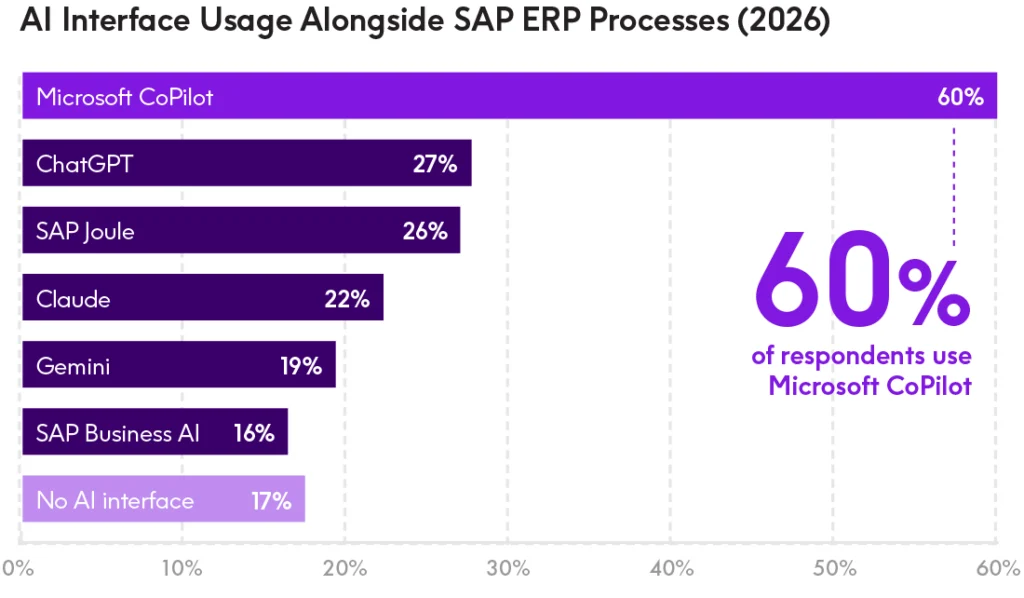
Survey insights reveal that only 17% of respondents currently report using no AI interface whatsoever to support their core SAP ERP processes. Among the various technologies being integrated, Microsoft Copilot leads the market, utilized by 60% of respondents. Despite this widespread experimentation, only 3% of organizations report operating fully automated, AI-driven processes, demonstrating that the vast majority of businesses are currently employing AI to support and augment human judgment rather than replace it entirely.
Industry experience suggests that artificial intelligence yields optimal results when it is implemented on top of robust, mature automation foundations paired with highly reliable data. Unlike human workers, AI does not inherently pause to question inputs; if underlying data is flawed, autonomous agents will execute processes based on that incorrect data regardless. This reality places a premium on AI-ready data—information that is fully visible, reliable, accountable, and complete. Within complex SAP environments where master data governance and delicate business processes carry high financial and operational stakes, ensuring data integrity is paramount.
Why SAP S/4HANA Migrations Are Getting Harder as More Teams Go Live
While overall market momentum toward modern enterprise infrastructure remains strong, the nature of enterprise migrations is shifting. The research indicates that 67% of organizations are now fully or partially live on SAP S/4HANA, representing a steady increase from 59% in 2025. Furthermore, only 1% of surveyed organizations report having no plans to migrate, signaling a near-universal industry consensus around the necessity of moving away from legacy environments.
However, the remaining migrations are proving to be exceptionally difficult. Handling custom developments and modifications built within legacy SAP ECC environments has emerged as the single greatest migration hurdle, cited by 53% of respondents. In addition, the challenges of transferring intricate process complexity and executing complex data transformations are among the fastest-rising barriers reported by IT leaders.
Data cleansing practices tell a parallel story of persistent friction. While 83% of respondents continue to view SAP master data cleansing as a critical component of a successful migration, fewer organizations are completing comprehensive data cleansing before they actually move. Instead, an increasing number of companies are pushing vital data preparation work to be executed during or immediately after the migration process.
Industry analysts observe a recurring pattern where enterprises approach go-live milestones only to encounter unexpected data and process surprises that were never factored into the original project timeline. The report demonstrates that organizations leveraging dedicated automation platforms to handle complex data transfers and process migrations consistently report experiencing significantly lower rates of these disruptive challenges.
What Is Changing with SAP Fiori and SAP BTP
User interface paradigms within the enterprise ecosystem have similarly reached a critical tipping point. SAP Fiori is now utilized in some capacity by 81% of organizations, while enterprises relying exclusively on the legacy SAP GUI have dwindled down to a mere 2%. For most modern enterprises, a hybrid operational reality persists: 67% of surveyed organizations operate Fiori concurrently alongside the traditional SAP GUI. This dual-interface environment requires enterprise automation strategies to function reliably and consistently across both modern and legacy user interfaces without interruption.
Concurrently, adoption of the SAP Business Technology Platform (BTP) continues its upward trajectory, with more than half of all respondents now leveraging various BTP services. Beyond mere adoption rates, the more compelling narrative centers on the specific use cases driving this utilization and the persistent hurdles holding back broader deployment. Among established users, process automation and artificial intelligence applications are exhibiting the most substantial gains.
Interestingly, the primary obstacle to wider BTP utilization has shifted over time. Rather than struggling to understand the fundamental scope of what BTP offers, organizations now cite a lack of internal skills and human resources as the principal barrier to effective execution. The research report offers a detailed breakdown of which specific BTP capabilities are growing most rapidly, alongside the strategic criteria organizations use when deciding whether to deploy native BTP tools or third-party alternatives.
Assessing the Value of the Research for Enterprise Stakeholders
The findings compiled by Precisely and ASUG serve a critical benchmarking function across multiple corporate disciplines. For leaders managing SAP IT infrastructure, enterprise architecture, or large-scale migration programs, the data provides essential baselines for planning project timelines, allocating staffing resources, and refining cloud platform strategies. For business process owners overseeing critical domains such as finance, master data management, and supply chain operations, the research offers a clear window into how industry peers are safely integrating automation and AI agents into comparable functional areas.
Furthermore, leaders of citizen development and internal automation programs can utilize the data to measure their internal maturity levels and tool strategies against broader industry benchmarks. Because the survey participants represent a wide cross-section of global commerce, the reported automation trends reflect a realistic, multi-industry perspective on the state of modern enterprise modernization.
The overarching theme connecting four consecutive years of this ongoing research remains the persistent challenge of operational complexity—specifically legacy processes, fragmented data landscapes, and constrained internal human capacity. Organizations that proactively address these hurdles by establishing strong automation foundations, rigorous data quality management programs, structured citizen development models, and unified data management are ultimately better positioned to maximize the return on investment from their core SAP systems as they navigate ongoing digital transformations.