The Federal Aviation Administration (FAA) is moving forward with a significant update to its Part 107 remote pilot knowledge test, introducing a modern, image-based testing format designed to better evaluate a candidate’s real-world competency. Beginning October 26, individuals pursuing their initial remote pilot certification will encounter questions that require them to interpret dynamic aviation charts and graphical data directly within the examination interface, rather than relying exclusively on traditional printed supplements.
The upcoming modification applies directly to the Unmanned Aircraft General-Small (UAG) knowledge test, the foundational examination required for anyone looking to obtain a commercial drone license in the United States. According to the FAA’s August 2026 Airman Testing Community Advisory, the regulatory agency has been collaborating closely with its official testing provider, PSI, to seamlessly integrate high-resolution images and custom-tailored graphics directly into the digital exam questions.
While the underlying regulations governing commercial drone operations remain completely unchanged, the way prospective pilots are tested on their spatial awareness and navigational understanding is evolving. This update reflects a broader, ongoing initiative by federal aviation authorities to modernize airman knowledge testing, ensuring that newly minted drone operators possess the practical, visual interpretation skills necessary to safely share the National Airspace System with crewed aircraft.
What Is Changing in the Exam Format?
Under the updated testing framework, applicants sitting for the UAG exam on or after October 26 may encounter questions featuring updated aviation chart images that do not exist within the current printed testing supplement. This transition shifts the testing paradigm away from rote memorization of static figures and standard reference materials found in traditional study guides.

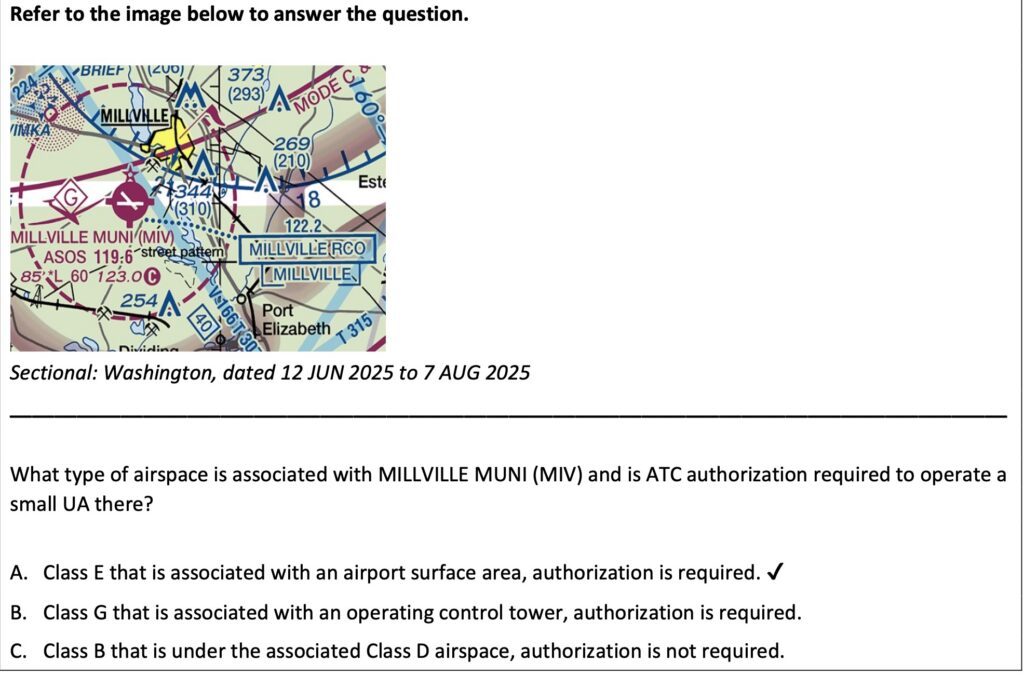
To provide clarity on the new format, the FAA highlighted specific examples in its recent advisory. In one sample scenario, an exam question presents a graphic asking the applicant to precisely identify the controlled airspace surrounding a specific airport and subsequently determine whether proposed drone operations at that location necessitate prior air traffic control authorization. Another sample question challenges the test-taker to examine an unedited chart snippet to pinpoint the correct local airport communications frequency.
These practical applications mean that future drone pilots must cultivate a deeper, more adaptable understanding of aeronautical charts. Instead of recognizing familiar chart excerpts from standard study textbooks, candidates must be prepared to analyze unfamiliar graphic excerpts on the fly, demonstrating a true comprehension of sectional charts, airspace classifications, and operational restrictions.
Despite the introduction of these interactive visual elements, the FAA has confirmed that printed testing supplements will remain accessible to applicants during a transitional period. The agency has not yet announced a definitive date for the complete retirement of the physical testing supplements, ensuring that current study materials retain a degree of utility while the industry adapts to the new digital standards. Furthermore, it is critical for prospective commercial operators to understand that the structural rules of Part 107—such as altitude limitations, visual line-of-sight requirements, and operations over people—remain entirely untouched by this testing update.
Resources and Preparation Strategies for Applicants
As the commercial drone community prepares for the October 26 rollout, aviation education platforms and testing providers have begun releasing guidance to help applicants navigate the transition. The FAA strongly encourages all prospective remote pilots to review official sample questions directly through its designated testing provider, PSI, to become thoroughly familiar with the updated visual interface and question layout before exam day.
Independent training providers have also stepped up to assist candidates through the adaptation process. Organizations such as Fly107Prep have published detailed breakdowns of the upcoming October changes, accompanied by specialized study tools geared specifically toward advanced chart interpretation. These preparatory resources range from free informational guides to comprehensive paid test preparation applications designed to simulate the new digital testing environment.
Ultimately, while the format of the examination is experiencing a notable technological evolution, the core competencies required of a certified remote pilot remain steadfast. Prospective drone operators must continue to master the essential principles of weather, meteorology, loading and performance, emergency procedures, radio communication, and airspace classification. The change simply ensures that when the FAA certifies a new pilot, that individual has proven their ability to read, interpret, and navigate the skies using the exact types of visual tools they will encounter in the field.