By DRONELIFE Features Editor Jim Magill
The inspiration needed to start a successful, high-impact enterprise can often strike in the most unexpected places and at the most formative times. For Andrew Ashur, CEO and co-founder of Lucid Bots, that defining moment arrived while he was still a college undergraduate. As a junior studying economics and Spanish at Davidson College in North Carolina, Ashur happened to witness a crew of building maintenance workers suspended high above the ground on a traditional window-washing platform. The scene was far from tranquil; a sudden surge of high-altitude winds was violently buffeting the staging, leaving the workers desperately clinging to their harnesses.
As they fought to keep their balance and protect themselves from the dizzying drop, Ashur watched from the ground with a mixture of concern and disbelief. In that moment of acute vulnerability for the laborers, a fundamental question formed in his mind that would ultimately alter the course of his professional life: Why hadn’t anyone found a way to make this perilous job fundamentally safer?
That single observation served as the catalyst for launching Lucid Bots, an aerial robotics company headquartered in Charlotte, North Carolina. Today, the enterprise designs and manufactures specialized commercial drones and related hardware deployed to wash building exteriors, towering industrial infrastructure, and bridges across the United States and 18 other international markets.
Driven by his initial encounter, Ashur began diving deep into the research surrounding the commercial exterior cleaning industry, quickly realizing that the job of a window washer or building maintenance technician was vastly more dangerous than he had initially imagined. The statistics surrounding industrial cleaning and facade maintenance revealed a grim industry reality—one that compelled him to look toward modern technological solutions.
Reflecting on the lethal hazards of the profession, Ashur noted that approximately once every four days, a worker somewhere dies while cleaning a building. To him, such a high mortality rate in the modern era is completely unacceptable, especially given the leaps forward achieved in aerospace engineering and automation. When society possesses the sophisticated technology required to launch rockets and send human beings into outer space, he reasoned, risking human lives merely to wash the exterior glass and walls of urban high-rises should belong to the past.
At the same time, Ashur’s foundational background in economics led him to examine the broader market fundamentals underpinning the industry. He quickly recognized the massive global demand for exterior cleaning and maintenance services, tied directly to the scale of the built environment. Real estate, as he points out, stands as the largest asset class in the entire global economy, holding a cumulative valuation that surpasses the combined worth of all worldwide stock and bond markets. Protecting that monumental volume of infrastructure requires constant upkeep. If the global real estate portfolio is to retain its long-term value, property owners must ensure it receives proper, systematic maintenance, encompassing everything from routine washing to protective painting and surface coating.
Even though his academic focus as a liberal arts student at Davidson College was far removed from the hard sciences—concentrating instead on economics and Spanish with no formal background in robotics or aerospace engineering—Ashur resolved to tackle the problem head-on. He envisioned a company that would harness the power of flying robots to remove human workers from harm’s way entirely, taking over the dangerous tasks that exposed maintenance crews to falls and structural instability.
While still completing his undergraduate studies, Ashur collaborated closely with the Jay Hurt Hub for Innovation and Entrepreneurship at Davidson College to lay the groundwork for his enterprise. This collegiate incubator environment provided the initial launching pad, and in 2018, Ashur and his developing team officially incorporated Lucid Bots.
The startup’s early potential quickly caught the attention of prominent investors. With strategic backing from the renowned startup incubator Y Combinator, alongside an influx of $34 million in venture capital funding, Lucid Bots experienced rapid commercial scaling. In just a few short years, the enterprise has grown into a mature manufacturing firm employing a dedicated workforce of approximately 80 people at its North Carolina operations.
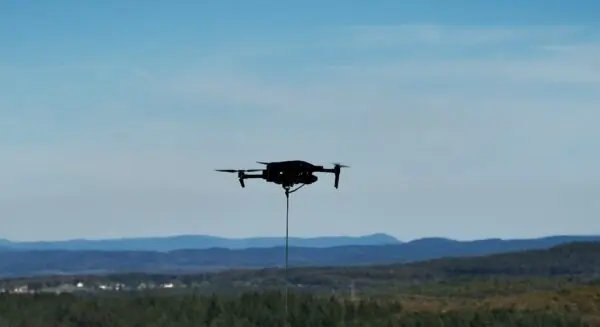
Market adoption has followed a similarly steep trajectory. Lucid Bots now serves a customer base exceeding 400 clients, with active operations spanning more than 40 U.S. states and three continents. Demonstrating its ongoing manufacturing momentum, the company currently produces roughly 25 industrial spraying drones per month. Furthermore, the company recently announced a major expansion of its product ecosystem with the launch of the Power Tether, a specialized hardware addition designed to supply a ground-based source of continuous electricity to unmanned aerial vehicles. Lucid Bots is actively scaling its production capabilities to manufacture an equal number of power tethers every month to meet surging operational demands, according to Ashur.
Brain, Frames, and Tools
At its core, Lucid Bots operates as a specialized manufacturing company providing its commercial customers with the hardware and software tools necessary to replace costly, labor-intensive, and hazardous exterior cleaning programs with efficient, automated UAVs. To conceptualize and communicate the architecture of their offerings, Ashur and his engineering team break down the product ecosystem into three distinct functional layers: the brain, the frames, and the tools.
The first component, the brain layer, represents the company’s proprietary, universal software stack. This software is designed to operate seamlessly across virtually any type of robotic frame, providing the foundational intelligence, flight stabilization, and operational control required for complex autonomous commercial missions.
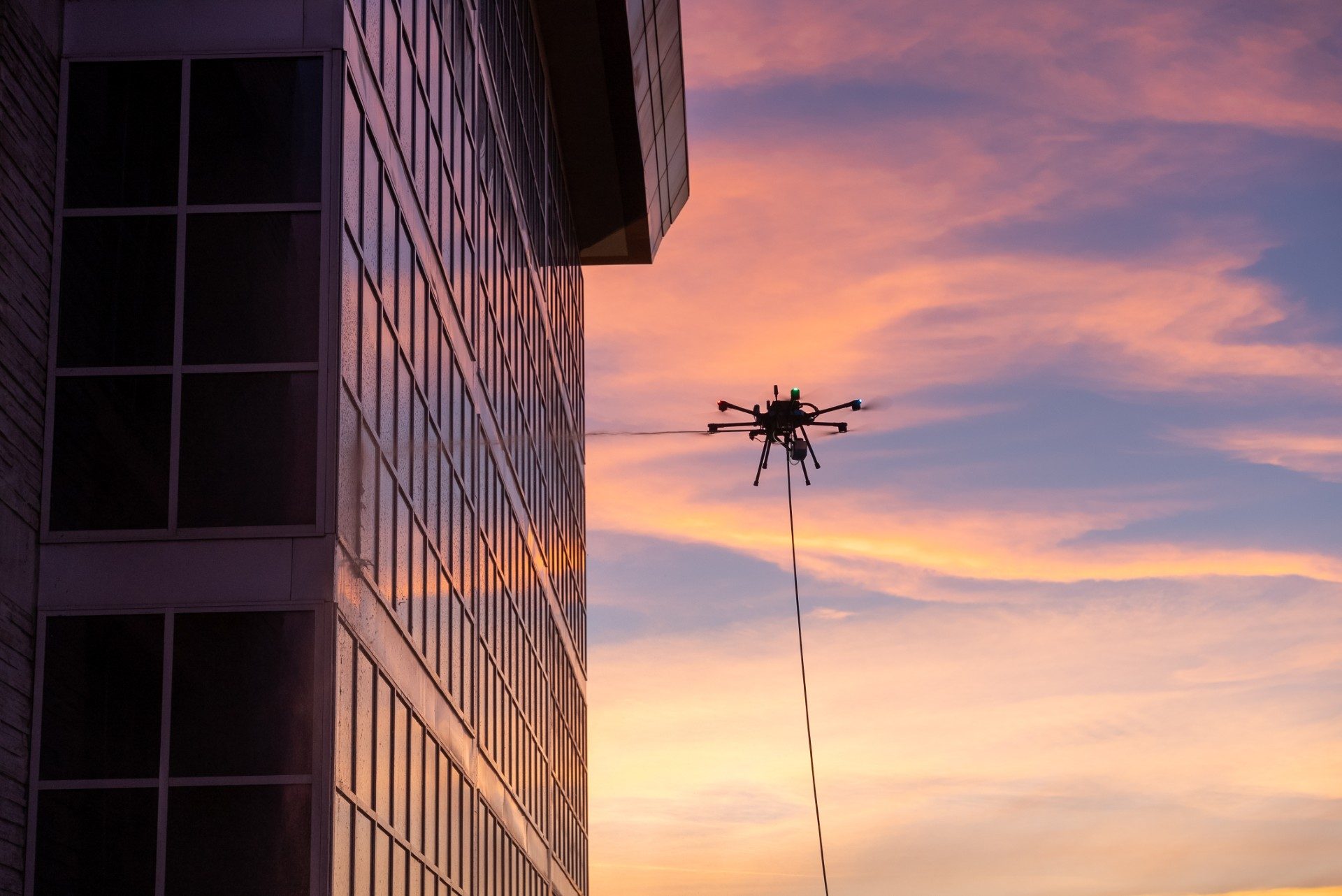
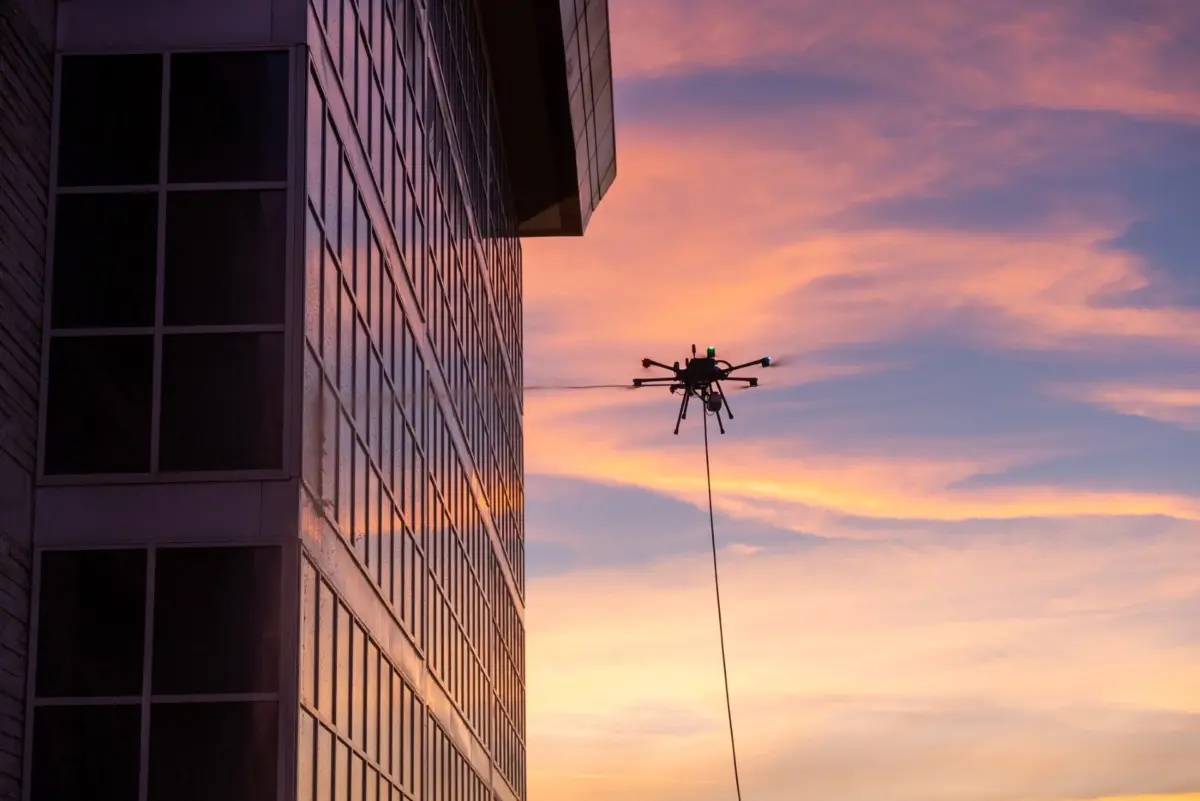
The physical frame layer is anchored by the company’s flagship commercial product: the Sherpa Drone. Purpose-built specifically for the rigorous demands of the commercial cleaning sector, the Sherpa is engineered to wash building exteriors at impressive vertical heights of up to 150 feet. To handle diverse architectural surfaces without causing structural damage, the Sherpa supports three distinct cleaning modalities. It is capable of soft washing for delicate materials such as stucco and sensitive siding, high-pressure washing for rugged concrete and brick facades, and—via an optional specialized payload attachment—traditional window cleaning.
Discussing the design philosophy behind the company’s hardware division, Ashur noted that the primary objective from the outset was to create a highly modular industrial drone. By building flexibility into both the mechanical architecture and the electrical systems of the Sherpa, the engineering team ensured that operators could easily attach a wide variety of functional tools depending on the specific job requirements.
Expanding beyond traditional washing applications, Lucid Bots has steadily broadened its product line on the tool side of the equation to encompass entirely new operational categories. The company recently introduced the Shield Payload, a new tool attachment designed to allow drone operators to spray liquid coating materials directly onto building facades to provide durable waterproofing protection.
Building upon the success of the waterproofing payload, the company has also ventured into automated exterior painting. Ashur noted that Lucid Bots is now in the late stages of development and commercial deployment with a dedicated painting payload. Practical applications are already materializing in the field. Recently, a commercial customer utilized the drone-mounted painting system to coat a massive, newly constructed warehouse facility in a fraction of the time traditional methods would have required. In another notable public sector use case, Lucid Bots has partnered with a local highway infrastructure system in North Carolina, where municipal crews are successfully utilizing the Shield Payload to quickly paint over and obscure graffiti on elevated highway bridges.
The overarching vision for the platform relies on leveraging this modular foundation. By combining the universal software brain with the adaptable frame of the Sherpa drone, the company aims to continually engineer new application tools that allow its customer base to generate expanding streams of economic value and business revenue.
Focus on Supply Chain Dynamics
In the rapidly maturing and highly competitive commercial UAV market, Ashur views his company’s status as a domestic U.S. manufacturer as a significant strategic advantage that continues to fuel its expansion.
As regulatory frameworks surrounding unmanned aviation continue to evolve, the commercial landscape has witnessed a steady tightening of restrictions regarding the importation of foreign-manufactured drones and components. This legislative shift has placed a renewed national emphasis on securing domestic supply chains and establishing robust manufacturing capabilities within the United States.
Reflecting on the early days of the company, Ashur recalled that when Lucid Bots first committed to establishing domestic manufacturing operations, industry observers occasionally viewed the decision as unconventional or overly ambitious. However, as industry conditions and legislative priorities have shifted, it has become abundantly clear that maintaining local manufacturing capacity is essential for any enterprise seeking long-term competitiveness within the North American drone sector.
Like many advanced technology hardware manufacturers operating in the United States today, Lucid Bots places an immense operational focus on building and maintaining a secure, resilient supply chain capable of consistently delivering the specialized parts and components required to sustain production. Internally, the company maintains a lighthearted running joke that supply chain management is treated as their native "love language," with dedicated personnel whose sole professional focus centers on procurement, vendor relations, and inventory oversight.
At the same time, Ashur acknowledges that every hardware supply chain carries inherent risks of disruption. The strategy at Lucid Bots, therefore, is not to eliminate risk entirely—an impossibility in modern manufacturing—but rather to actively minimize exposure compared to competitors in the same industrial space.
The company achieves this risk mitigation through two primary operational pillars. First, Lucid Bots maintains a fully integrated internal engineering team spanning electrical, mechanical, and software disciplines. If a specific component faces sudden market shortages, or if the engineering group needs to adapt to a new part, the internal team possesses the cross-functional expertise required to rapidly redesign and integrate alternative solutions.
Second, the company cultivates a deep, diversified network of qualified vendors rather than relying on a single source. Management ensures that the business maintains zero single-threaded dependencies for any critical hardware components, supported internally by a robust Enterprise Resource Planning (ERP) system that tracks inventory thresholds and maintains strict quality minimum order quantities. Through this careful balancing of domestic manufacturing, modular design, and supply chain resilience, Lucid Bots continues to scale its operations safely as it redefines how infrastructure is maintained from the sky.