Between dwindling water supplies and climbing community demand, long-term water availability has evolved from a distant environmental talking point into a pressing, daily concern across the United States.
Drought conditions are currently affecting nearly half of the country, putting intense pressure on natural resources and municipal budgets alike. As of September, severe drought conditions had worsened significantly across Texas, Oklahoma, and parts of the broader Midwest and Southeast. In Texas alone, approximately 23.5 million residents now live in areas directly impacted by drought. At the same time, rapid population growth and increasingly unpredictable, extreme weather patterns are severely straining aging municipal water systems that were constructed generations ago.
For local municipal leaders and public administrators, tackling this mounting crisis means fundamentally ensuring that communities have reliable access to the water they need, both today and in the decades ahead. Water availability is deeply dependent on three interconnected factors: quantity, quality, and patterns of use. Developing a comprehensive understanding of both available supplies and local demand patterns can help communities spot emerging imbalances early and manage their precious water resources much more effectively. Public agencies are increasingly finding that they must start by looking more closely at how much water their systems actually consume, precisely where water is being lost within the network, and whether their existing infrastructure can reliably meet future demands.
Across the southwestern United States, several local organizations are taking a proactive, highly strategic approach to water efficiency, operational resilience, and modern infrastructure management.
Proactive Water Conservation Efforts Build Resilience Over Time
Rather than waiting for regional water challenges to reach an acute, urgent crisis, forward-thinking public agencies are leveraging utility data, targeted conservation measures, and comprehensive infrastructure modernization to actively reduce demand and improve the day-to-day performance of existing systems.
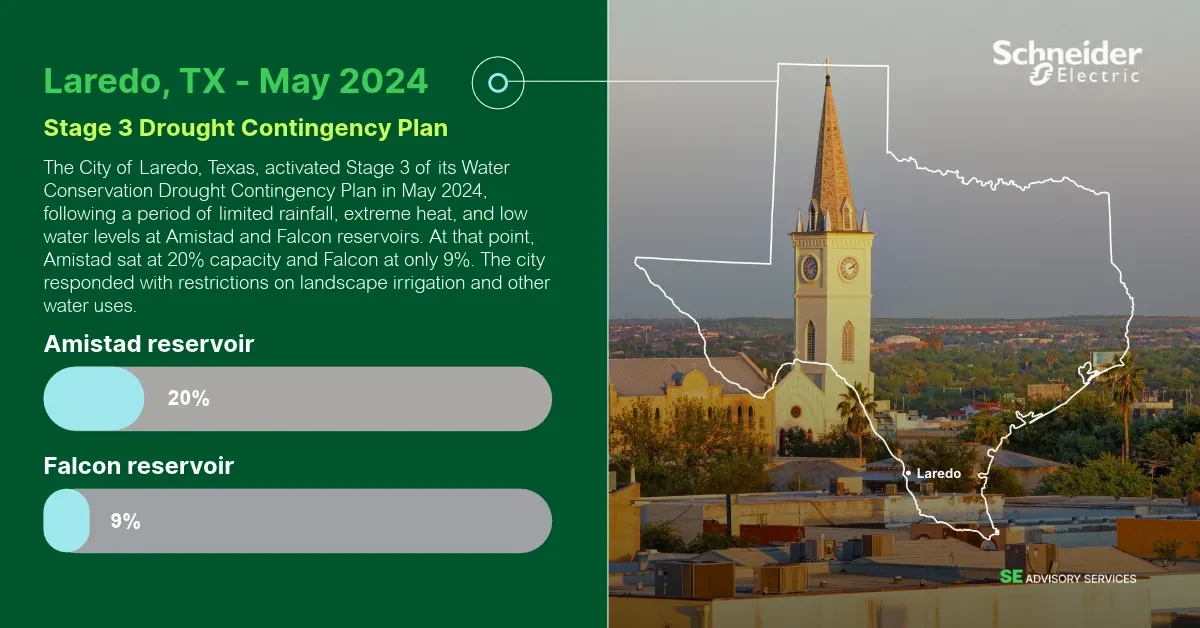
Texas A&M International University (TAMIU) provides a compelling blueprint for how proactive conservation efforts can help public institutions successfully prepare for diminished water supplies. Situated on 300 expansive acres in Laredo, Texas, TAMIU stands as the largest managed green space in its entire county. Because of its massive footprint, the university plays an exceptionally important role in local water stewardship, both within its own campus boundaries and across the broader Laredo community.
To address its resource consumption and upgrade aging campus infrastructure, TAMIU partnered with Schneider Electric in 2017 on a multi-phase sustainability program. As a direct result of these thorough modernization efforts, the university successfully reduced its annual water consumption by approximately 24.8 million gallons. This impressive reduction was achieved through the installation of low-flow plumbing fixtures, the implementation of drought-resistant landscaping, and the deployment of much more efficient irrigation systems. University officials estimate that the volume of water saved is equivalent to filling an Olympic-sized swimming pool roughly 42 times.
The broader significance of the project extends far beyond the sheer volume of water conserved; it vividly demonstrates how early, proactive progress builds lasting organizational resilience over time. TAMIU was steadily reducing its baseline demand well before severe drought conditions forced the implementation of much more restrictive municipal measures in May 2024. By systematically incorporating water efficiency into its broader infrastructure and operational planning years in advance, the university was far better positioned to navigate sudden drought-related challenges because it had already taken decisive steps to lower its water demand.
Reducing Demand To Address Shrinking Water Supply
The acute water supply challenges facing the city of El Paso further demonstrate why aggressively reducing demand must remain a central pillar of any modern water resilience strategy.
The Rio Grande provides nearly half of El Paso’s annual water supply, but the city has not received a full Rio Grande water allocation in about a decade. During the severe drought of 2013, vital river water was available to the municipality for less than two months. Today, following several consecutive years of extreme drought and the earliest recorded snowmelts in regional history, the critical Elephant Butte Reservoir sits at a meager 13 percent capacity.

This stark reality illustrates why regional resilience can no longer depend solely on maintaining or expanding existing water supplies. Actively reducing community demand is a non-negotiable imperative.
El Paso County has tackled this challenge head-on by embedding water efficiency into a comprehensive infrastructure modernization effort spanning 30 different county-owned facilities. Partnering with Schneider Electric, the county implemented a series of deep facility improvements that include extensive upgrades to mechanical systems, advanced building automation controls, and targeted water conservation measures.
The first phase of this ambitious project is projected to slash annual energy consumption by 23 percent while simultaneously saving approximately 48 million gallons of water every year. To put that figure into perspective, the average American uses roughly 82 gallons of water per day, which translates to about 30,000 gallons per year. At that standard consumption rate, 48 million gallons of water is equivalent to the total annual household water use of roughly 400 to 500 single-family households.
Protecting and Maximizing Existing Water Resources
Water scarcity is fundamentally more than just a basic supply and demand imbalance. Communities can significantly improve their overall resilience by understanding precisely where treated water is being lost within their delivery networks and finding innovative ways to eliminate those systemic losses.
Consider the situation in the City of Groves, which produces approximately 879 million gallons of municipal water annually. Despite producing this large volume, the city reports that about 55 percent of its water is unaccounted for—meaning it is either lost to leaks within the distribution system or simply not measured accurately. City assessments have identified subterranean leaks as a major contributor to this massive discrepancy. Systematically reducing those overall losses would yield immediate, substantial water savings for the municipality without requiring new water rights or major supply acquisitions.
To combat this issue, the City of Groves launched a project to replace more than 6,700 aging, inaccurate water meters with Advanced Metering Infrastructure (AMI). The operational mechanics of this technology are relatively straightforward. Instead of relying on infrequent, manual meter readings conducted by personnel, AMI provides utility operators with live, continuous water use information.
This high-resolution data helps utility teams quickly identify unusual consumption patterns that often indicate hidden leaks, broken pipes, or other network anomalies. Better data will also empower the city to identify leaks long before they manifest as unexpectedly high bills for consumers. Furthermore, this transparent approach keeps the community fully informed, helping local residents avoid unpleasant financial surprises and better manage their own household water usage.
Planning Now for Future Water Needs
The onset of the next major water crisis should never be allowed to serve as the starting point for municipal water efficiency planning. Local leaders and public administrators have a window of opportunity to ask critical questions today: Do we truly know where our water is being used and where it is being lost? Have we accurately identified which infrastructure improvements will yield the greatest long-term difference? Do we have a cohesive strategy and a clear investment roadmap designed to meet future community needs?
For public organizations and municipalities that do not yet have definitive answers to these questions, working alongside an experienced partner like Schneider Electric can help identify crucial improvement opportunities. Such partnerships can assist local leaders in turning diagnostic findings into a comprehensive action plan that successfully connects tangible water savings, core infrastructure priorities, and flexible financing options. Taking these proactive steps today will provide communities with significantly more options and greater security as regional water supplies become increasingly constrained.