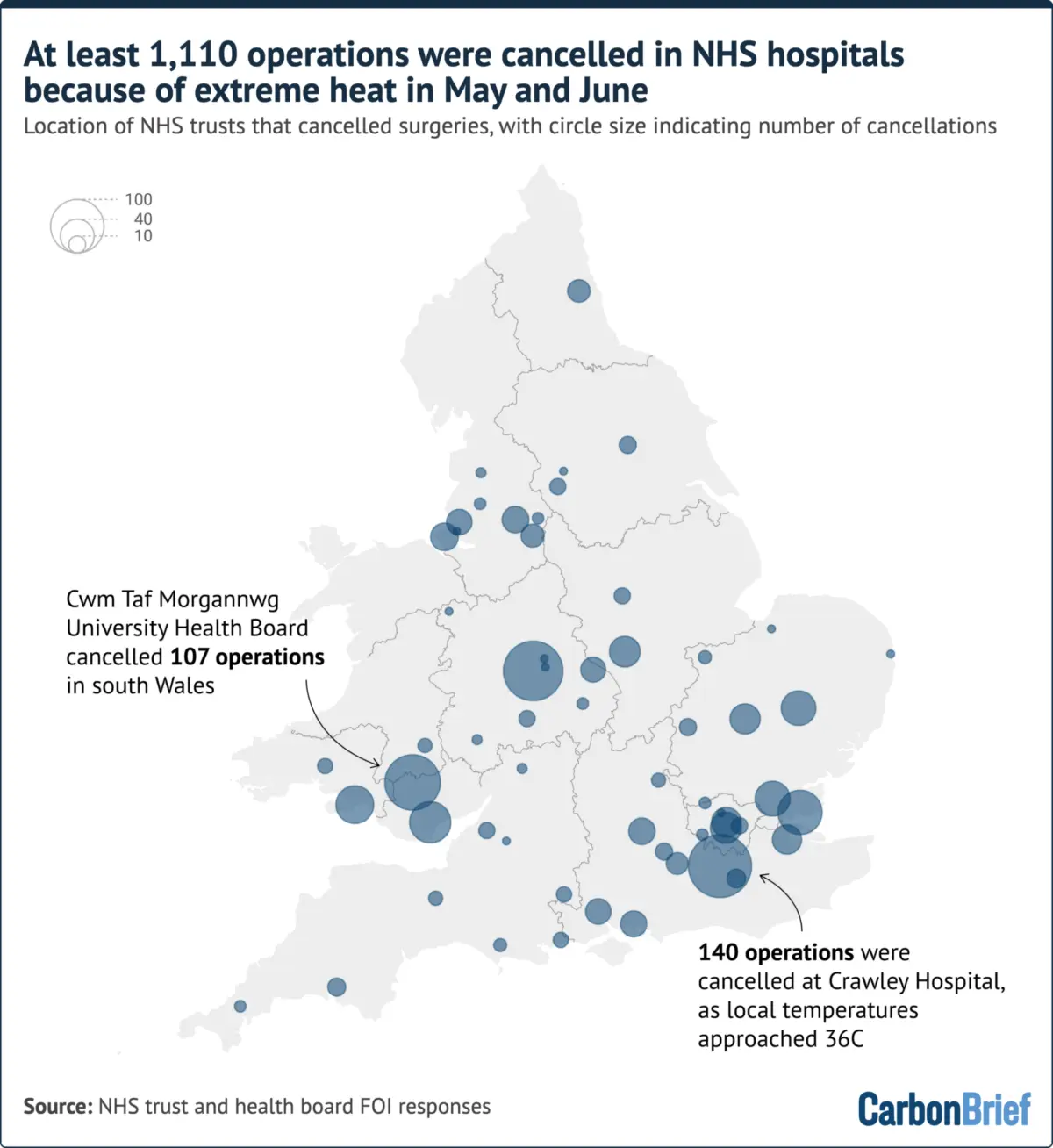
More than 1,000 surgical procedures at NHS hospitals across England and Wales were abruptly cancelled because of extreme heat during the record-breaking heatwaves of May and June, an exclusive investigation reveals.
Data obtained through Freedom of Information (FOI) requests sent to 140 NHS trusts and health boards expose the vulnerability of the UK’s surgical infrastructure during periods of severe weather. The cancellations included 167 orthopaedic surgeries—such as routine knee and hip replacements—alongside critical heart, eye, and skin cancer operations. Most concerningly, the investigation found that at least 10 emergency surgeries addressing life-threatening conditions had to be called off because operating theatres became dangerously hot, while another 18 procedures were abandoned midway through.
The findings offer an unprecedented insight into a surgical system that public health experts describe as "poorly prepared" for the accelerating impacts of climate change. With less than half of the queried NHS trusts providing details on heat-related cancellations—often because hospitals do not routinely track this specific metric—the true national figure is believed to be a significant underestimate.

The investigation highlights regional disparities, with the highest concentrations of heat-related cancellations occurring in areas that suffered the most intense temperatures. Trusts in Surrey and Sussex, south Essex, parts of London, and south Wales reported the most severe disruptions. Notably, the Surrey and Sussex Healthcare NHS Trust logged 140 cancellations alone at Crawley Hospital, where local temperatures approached a scorching 36C in June.
Overheating Operations and Clinical Risks
The severe heatwaves that repeatedly struck the UK in 2026, amplified by long-term climate change, have already been linked to thousands of excess deaths nationwide. High ambient temperatures pose direct health risks by triggering or worsening respiratory, cardiovascular, and kidney diseases. However, the cascading consequences for healthcare institutions have proved equally disruptive.
As record numbers of patients flooded A&E departments and hospital wards reached what researchers and unions described as "dangerously hostile" internal temperatures, critical medical equipment began to fail. In operating theatres, the crisis manifested as intolerable heat and humidity that forced clinical teams to pause or abandon surgical lists entirely.
Out of the 59 trusts and health boards that responded with detailed data, heat-related incidents accounted for roughly 7% of all surgery cancellations during the 17-day period covering amber and red heat-health alerts issued between 22-28 May and 18-27 June.

While the vast majority of the affected procedures were elective surgeries scheduled well in advance, experts emphasize that delays carry a heavy human toll. Dr Dmitri Nepogodiev, a public health researcher focusing on surgery at the University of Birmingham, noted that while hospitals rightfully prioritize time-sensitive, life-threatening interventions, every cancellation causes profound distress.
"Behind all of these statistics are real people who have probably already been waiting a long time," Nepogodiev said, pointing out the human cost of prolonged waiting lists.
Richard Egan, an endocrine surgeon and national clinical director within NHS Wales, highlighted the compounding nature of these delays. For every week that patients are forced to wait for rescheduled operations, their underlying conditions risk deteriorating further, placing additional pressure on an already overstretched National Health Service grappling with persistent staff shortages and bed scarcity.
The Mechanics of Theatre Overheating
When explaining the root causes behind these cancellations, NHS trusts routinely pointed to operating theatres becoming "too hot and humid," creating unacceptable risks of infection and severe discomfort for both patients and medical staff.

Dr Ed Robinson, an NHS anaesthetist, explained that operating theatres are tightly engineered clinical environments dependent on complex ventilation systems. These systems dilute airborne contaminants, clear out chemical fumes from medications and anaesthetic gases, and maintain a directional airflow that pushes pathogens away from the patient and into non-clinical areas.
"When it gets to a certain heat, those systems can fail," Robinson said. "These systems are also responsible for controlling heat and humidity levels inside theatres. When the systems fail, it is not possible to guarantee patient safety, meaning surgeries may need to be cancelled."
Staff responses specifically cited broken or overwhelmed air conditioning and ventilation units in dozens of cases. Furthermore, extreme heat and humidity compromise the safety and efficacy of the environment in multiple ways. Tim Lane, a urological surgeon and president of the Royal College of Surgeons of England, noted that excess humidity can cause moisture to condense on surgical implements, thereby increasing infection transmission risks.
Additionally, surgical teams often wear heavy personal protective equipment (PPE). Orthopaedic surgeons, for instance, frequently wear lead-equivalent aprons to protect against radiation from frequent X-rays. If ventilation systems fail, staff rapidly overheat, severely impairing their concentration and performance. Certain medications and medical equipment are likewise restricted by strict temperature thresholds; specialized bone cement used in hip and knee replacements, for example, can set prematurely if ambient temperatures climb too high.

Addressing Outdated Infrastructure
Following the historic 40C heatwaves of 2022, a published study concluded that UK surgical services were fundamentally unequipped for extreme summer temperatures, finding that ambient temperatures could not be controlled in two-fifths of NHS operating theatres.
As extreme heat events become a recurring feature of the British summer, health secretary Yvette Cooper warned that the NHS must adapt to warm-weather pressures with the same strategic foresight traditionally reserved for winter crises. Yet experts caution that there is no single remedy for a complex, multifactorial challenge that spans infrastructure deficits, workforce shortages, and supply chain vulnerabilities.
Many NHS hospitals occupy aging buildings that were designed decades ago and lack modern climate control architecture. Government advisers at the Climate Change Committee have urged that all healthcare properties must maintain safe indoor temperatures by 2035. While the UK’s national adaptation programme incorporates heat resilience into plans for new healthcare infrastructure, years of underinvestment have left existing sites struggling with deteriorating facilities and outdated technology.
In response to this summer’s disruptions, the government announced £32 million from a broader £1.5 million capital spending program specifically earmarked to reinforce hospital resilience against extreme heat, focusing on upgraded cooling and ventilation systems.

Reflecting on the necessary path forward, RCS England president Tim Lane acknowledged the tireless efforts of NHS staff who constantly reorganize services to keep care moving. However, he warned that frontline resilience can only compensate for structural decay for so long, emphasizing that long-term protection requires sustained investment in modern hospital estates, advanced ventilation engineering, and reliable equipment.
Methodology
Carbon Brief’s investigation targeted 140 NHS trusts and health boards in England and Wales responsible for acute hospitals with surgical capabilities, intentionally excluding mental health, community, and specialist trusts. The data collection focused on the periods of 22-28 May 2026 and 18-27 June 2026, corresponding to official amber and red heat-health alerts issued by the UK Health Security Agency, alongside equivalent warnings in Wales. Scotland and Northern Ireland were excluded due to differing temperature profiles.
Of the 140 queried entities, 59 provided concrete details of heat-related surgery cancellations. Another 63 trusts responded without attributing disruptions specifically to heat, often citing a lack of systematic data collection regarding the weather’s direct impact on surgical lists, while 19 trusts did not respond prior to publication. Where trusts reported low cancellation numbers as a range or withheld exact figures below five for privacy reasons, a conservative baseline estimate was applied.