Extreme heat stands as one of the deadliest climate hazards facing modern society, yet meteorologists and climate scientists emphasize that no two heatwaves are identical. While peak summer temperatures frequently dominate headlines, recent scientific investigations reveal that extreme heat events occurring outside of traditional summer months pose unique and heightened dangers. These shoulder-season anomalies often catch populations entirely off guard, catching communities unready as physical acclimatization has yet to occur and seasonal public cooling infrastructure remains dormant or unavailable.
A new study published in AGU Advances provides the first global measurement of how the timing of extreme heat across the calendar year is shifting. Analyzing data spanning more than four decades, researchers discovered that extreme heat events are spreading unevenly into the spring and autumn shoulder seasons across more than half of the world’s land area. Rather than a uniform global expansion, this creep of dangerous temperatures leans heavily toward autumn in some regions and spring in others, fundamentally altering historical seasonal baselines.
The findings underscore a growing vulnerability in human populations and global ecosystems as climate change accelerates. As global temperatures rise due to greenhouse gas emissions, heatwaves are already well documented to be growing more frequent, more intense, and longer-lasting. This latest research adds a critical temporal dimension to that crisis, demonstrating that the boundaries of traditional heat seasons are actively blurring across vast expanses of the globe.
Defining Heat Seasons
Meteorological summer is traditionally assumed to be the warmest three-month period of the year, simplistically defined as June through August in the Northern Hemisphere and December through February in the Southern Hemisphere. However, actual extreme heat seasons vary dramatically from place to place, frequently failing to align with these neat administrative boxes.
To accurately capture these local realities, the study departed from traditional calendar definitions and instead established the concept of "local heat seasons." Researchers defined these as the three consecutive months when extreme heat events occurred most frequently during the baseline decade of the 1980s. From this foundation, the study investigated how extreme heat has begun encroaching upon the two-month periods immediately preceding and following the primary heat season—windows designated as shoulder seasons.
This flexible methodological framework enabled the research team to measure precise shifts in the timing of extreme heat over time. By calculating the percentage of annual heat days occurring within both the primary heat season and the surrounding shoulder seasons at every coordinate on Earth, scientists mapped relative shifts across a 45-year timeline.
For their primary analysis, the research team utilized comprehensive climate data spanning from 1980 to 2024 from the MERRA-2 reanalysis dataset. To guarantee the absolute robustness of their findings, the entire analytical process was independently replicated using ERA5 global atmospheric reanalysis data. Selecting the 1980s as a baseline decade provided a reliable intersection point between the datasets, allowing researchers to evaluate cumulative climate change impacts by comparing those early decades against the 2015-to-2024 timeframe.
Furthermore, the study maintained a strict distinction between dry heat and humid heat, recognizing that each hazard exerts fundamentally distinct pressures. Dry heat poses severe risks to plant life and ecosystem health by accelerating moisture loss in soils and vegetation, whereas humid heat presents a profound physiological strain on the human body, limiting the body’s natural ability to cool itself through sweat evaporation. To measure these distinct phenomena accurately, the team utilized dry-bulb temperature for dry heat and wet-bulb globe temperature for humid heat. Developed by the United States military in the 1950s, the wet-bulb globe temperature incorporates measurements of ambient temperature, humidity, wind speed, and solar radiation, serving as a trusted international standard for monitoring occupational hazards and outdoor athletic safety.
Changing Heat Seasons
The historical baseline data revealed that during the 1980s, extreme heat across the planet was tightly confined to a single, predictable heat season. Approximately 93% of the world’s land area experienced more than 80% of its extreme dry-heat days squarely within its traditional dry-heat season. Remarkably, this high degree of seasonal confinement held true even across tropical regions, where annual temperature swings are historically much less pronounced.
Moreover, the research demonstrated that extreme dry-heat seasons and extreme humid-heat seasons frequently occupy different temporal spaces, typically offset by roughly one month. This offset is particularly prominent in regions heavily influenced by monsoon systems, such as north-western Mexico and central India, where the extreme dry-heat season reliably precedes the arrival of the extreme humid-heat season.
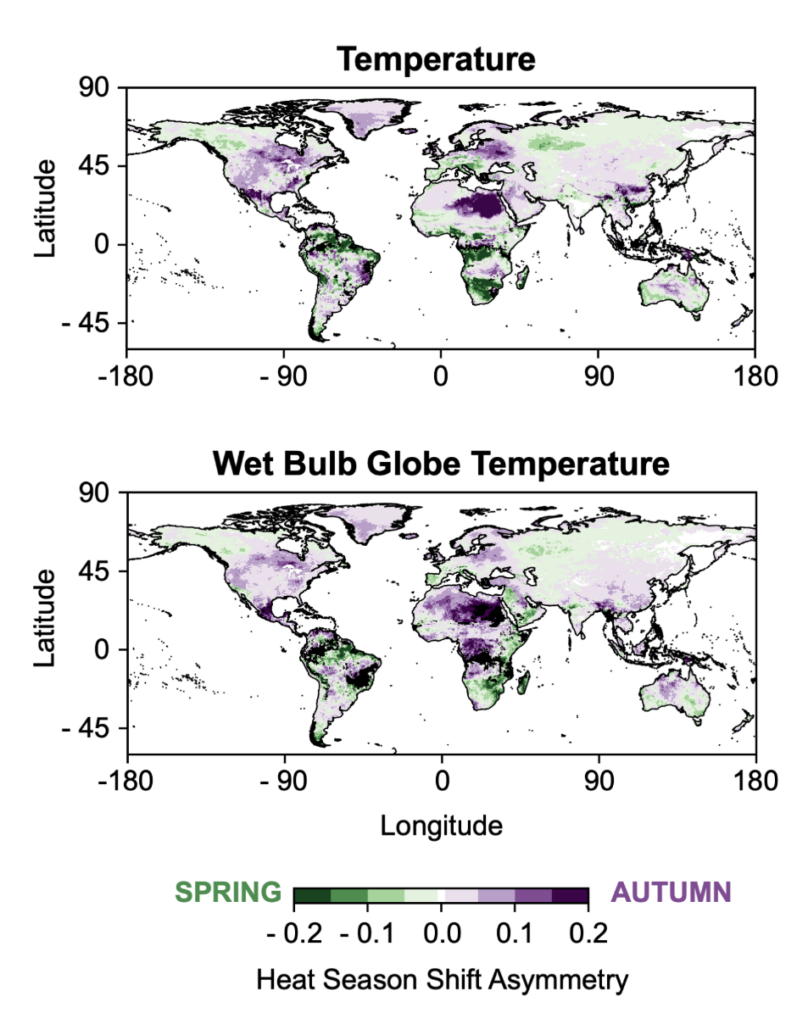
Today, however, those once-reliable boundaries are dissolving. Extreme heat events are spreading significantly across the calendar year in more than a majority of global land areas. This structural stretching of the heat seasons means that dangerous thermal conditions are steadily bleeding into the shoulder seasons, though this expansion is occurring asymmetrically.
Global mapping of these trends reveals stark geographical divides. In regions such as western Europe, southern Africa, and north-western India, a progressively larger fraction of each year’s extreme heat events is occurring during the two months leading up to the historical dry- and humid-heat seasons. Conversely, across much of the United States, eastern China, northern Africa, and eastern Europe, extreme heat events are surging in frequency during the two months after the traditional heat seasons have passed.
Boosting Existing Seasons
The underlying drivers of these shifting thermal patterns initially suggested a straightforward explanation. In many parts of the world, one shoulder season—whether spring or autumn—is naturally warmer than the other. Scientists initially hypothesized that a simple, uniform step-up in daily temperatures across the entire calendar year might naturally tilt the probability framework, making extreme heat days more likely to spill into one shoulder season over the other.
To test this hypothesis, the research team constructed a synthetic timeseries designed to isolate the direct impact of annual average warming. By taking the baseline 1980s timeseries and shifting the data upward by the exact magnitude of average local warming observed between the first and last decades of the study period, the researchers could test whether uniform warming alone accounted for the shift.
The results showed that the reality is considerably more complex. While uniform annual warming successfully explains the intensification of extreme heat within the traditional heat season itself, it cannot account for the uneven and asymmetrical changes occurring in the shoulder seasons.
Consequently, the study concluded that additional physical factors must be actively driving these seasonal shifts. Long-term regional changes in seasonal precipitation and soil moisture—whether trending toward severe drying or increased moistening—likely play a substantial role by altering surface energy budgets. Furthermore, anthropogenic land-use changes, such as agricultural intensification and the widespread expansion of irrigation, can profoundly modify local atmospheric humidity and boundary-layer temperatures. Natural climate variability driven by multi-decadal oscillations, including the Pacific Decadal Oscillation and the Atlantic Multidecadal Oscillation, may also exert powerful modulating influences on regional temperature timing. Pinpointing the precise contribution of each individual driver will require targeted, regionally focused scientific investigations in the future.

Managing Hazards
The confirmed expansion of extreme heat events into the shoulder seasons carries profound implications for public safety and disaster management. Critical protective measures, such as heat early warning systems and the deployment of municipal cooling centers, have historically been restricted to peak summer months. The new findings indicate that these vital interventions must be maintained or adapted for deployment well outside of traditional summer windows.
Additional research is urgently needed to determine whether the temporal overlap between extreme heat and other seasonal hazards is compounding. For instance, the study’s observation that the heat season is expanding more significantly into the autumn than the spring across much of the United States points to compounding risks. In the western United States, extreme heat stretching later into the calendar year threatens to lengthen the window of overlap between dangerous heatwaves and the peak wildfire season.
Meanwhile, a similar autumn extension of extreme heat in the eastern United States increases the probability of hazardous intersections between extreme heat events and the Atlantic hurricane season. Recognizing how these seasonal intersections are evolving is essential for crafting targeted climate adaptation policies, particularly given that compound hazards—multiple climate extremes occurring simultaneously or in rapid succession—pose exponentially greater threats to human life, infrastructure, and ecological stability than events occurring in isolation.