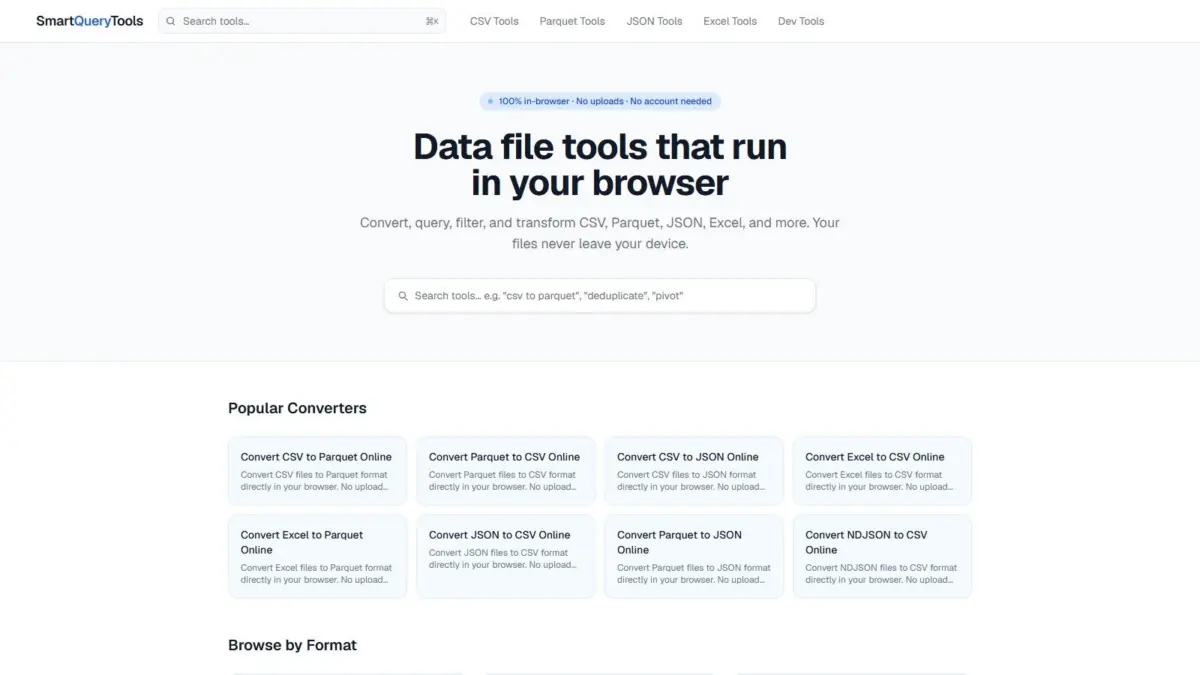
A new collection of web-based data utilities known as SmartQueryTools has been introduced, offering hundreds of free processing applications designed to handle complex data manipulation tasks entirely within a standard browser environment. Developed to address common data preparation and analysis challenges without requiring software installation, account creation, or external server interaction, the platform provides capabilities ranging from high-speed file conversion to interactive SQL querying, data profiling, file joining, and pivot table generation.
At the core of the toolset is the ability to execute Structured Query Language (SQL) queries directly against flat files, such as comma-separated values (CSV) documents, without installing a local database management system, setting up a command-line interface, or configuring a specialized software development environment. The platform supports a broad array of standard and modern data formats, providing seamless conversion pathways between CSV, Apache Parquet, JavaScript Object Notation (JSON), Newline Delimited JSON (NDJSON), Microsoft Excel, Tab-Separated Values (TSV), Apache Arrow, and YAML.
The technical foundation of the entire application suite rests on WebAssembly, a web standard that enables low-level code to run directly inside modern web browsers at near-native execution speed. By leveraging WebAssembly, the platform brings computational capabilities that traditionally required dedicated desktop software or cloud-based server infrastructure directly into the client-side browser runtime environment. This architectural approach allows complex operations—such as parsing massive tabular files, executing relational joins across datasets, and converting binary columnar storage formats like Parquet—to occur locally on the user’s personal device.
A primary design element of the platform is its strict adherence to a zero-server data processing architecture. Under this operational model, data files uploaded or selected for processing are never transmitted across the network to external backend servers. Every computational process, from file ingestion and parsing to query execution and output formatting, occurs entirely within the memory sandbox of the user’s web browser. Because the processing is strictly local, no user accounts are required, no login credentials must be generated, and no usage logs or tracking files are stored on remote infrastructure.
This browser-bound operational model directly addresses long-standing security, privacy, and compliance concerns associated with web-based utility tools. In many enterprise, academic, and governmental environments, organizational privacy policies and strict data governance frameworks strictly prohibit employees from uploading internal spreadsheets, proprietary datasets, or personally identifiable information to third-party online converter websites. Traditional web utilities often process uploaded files on remote web servers, creating potential security vulnerabilities, risk of data exposure, or non-compliance with regulatory standards. By ensuring that user files never leave the local device, the platform offers a secure alternative for handling sensitive spreadsheets and confidential datasets that would otherwise be unsafe to paste or upload into conventional web services.
The platform includes hundreds of distinct utilities designed to solve specific data format interoperability challenges that frequently arise in modern data workflows. Analysts, data engineers, and domain specialists often encounter disparate file formats depending on the systems they interact with. For instance, legacy enterprise applications and business teams frequently rely on traditional tabular formats like Microsoft Excel spreadsheets, CSVs, and TSV files due to their accessibility and human readability. Conversely, modern cloud storage environments, big data frameworks, and analytical engines increasingly utilize optimized columnar formats like Apache Parquet and Apache Arrow to maximize query performance and reduce storage footprints.
Simultaneously, web developers, API engineers, and application programmers frequently exchange information using hierarchical structured formats such as JSON, streamable NDJSON, or human-readable configuration formats like YAML. Bridging the gap between these distinct data representations traditionally required writing custom conversion scripts in languages such as Python or R, maintaining local software dependencies, or installing bulky desktop software packages. By offering client-side conversion tools between all combinations of CSV, Parquet, JSON, NDJSON, Excel, TSV, Arrow, and YAML, the platform simplifies format interoperability into immediate browser-based actions.
Beyond basic format conversion, the platform incorporates advanced analytical functionality that extends the utility of flat files beyond passive storage. The built-in SQL query tool allows users to run complex filtering, aggregation, and transformation statements directly against unstructured or flat datasets. This functionality enables users to inspect and filter data instantly without the friction of provisioning temporary database instances, creating local SQLite or DuckDB files, or writing programmatic data frame code.
In addition to relational SQL querying, the suite features a dedicated data profiler designed to generate immediate structural and statistical insights from ingested files. Data profiling capabilities allow users to assess dataset health, identify data types, evaluate missing or null value distributions, and inspect summary characteristics before performing downstream analysis or migration tasks. The inclusion of multi-file join utilities further enhances relational data exploration, enabling users to combine separate datasets based on shared primary keys or common fields directly inside the browser window. For users requiring dynamic summary views, the platform also includes pivot table generation features, enabling the multidimensional grouping and aggregation of attributes in a format familiar to spreadsheet users.
The creator and voice behind SmartQueryTools is Daniel O’Donohue, a professional geospatial specialist and the founder of The MapScaping Podcast, a prominent media resource for the global geospatial community. Drawing from years of professional experience in geospatial analysis—a field where practitioners routinely work with complex, multi-layered vector and raster attribute datasets—O’Donohue developed the platform to streamline the persistent challenges of data preparation, translation, and analysis.
In geospatial workflows and broader technical disciplines, professionals frequently encounter complex data structures that require immediate cleansing, restructuring, or format conversion before they can be ingested into specialized mapping, analytics, or enterprise software systems. O’Donohue’s background in leveraging spatial data to address multifaceted technical problems highlighted the widespread industry need for accessible, secure, and performant data manipulation utilities that do not impose technical installation barriers or introduce privacy risks.
By combining the accessibility of a standard web application with the security of offline execution, the platform represents a growing movement toward client-side computing in web development. The underlying WebAssembly technology allows the platform to handle substantial data workloads that were previously deemed too resource-intensive for web browsers, demonstrating the evolving capabilities of modern browser environments as self-contained application execution layers.
As data privacy regulations tighten globally and reliance on diverse data formats continues to expand across industries, the demand for local, zero-upload data processing utilities continues to grow. SmartQueryTools meets this requirement by providing a broad, zero-cost suite of utilities that respects user privacy while delivering robust data conversion, profiling, and SQL query capabilities directly on the end user’s hardware.