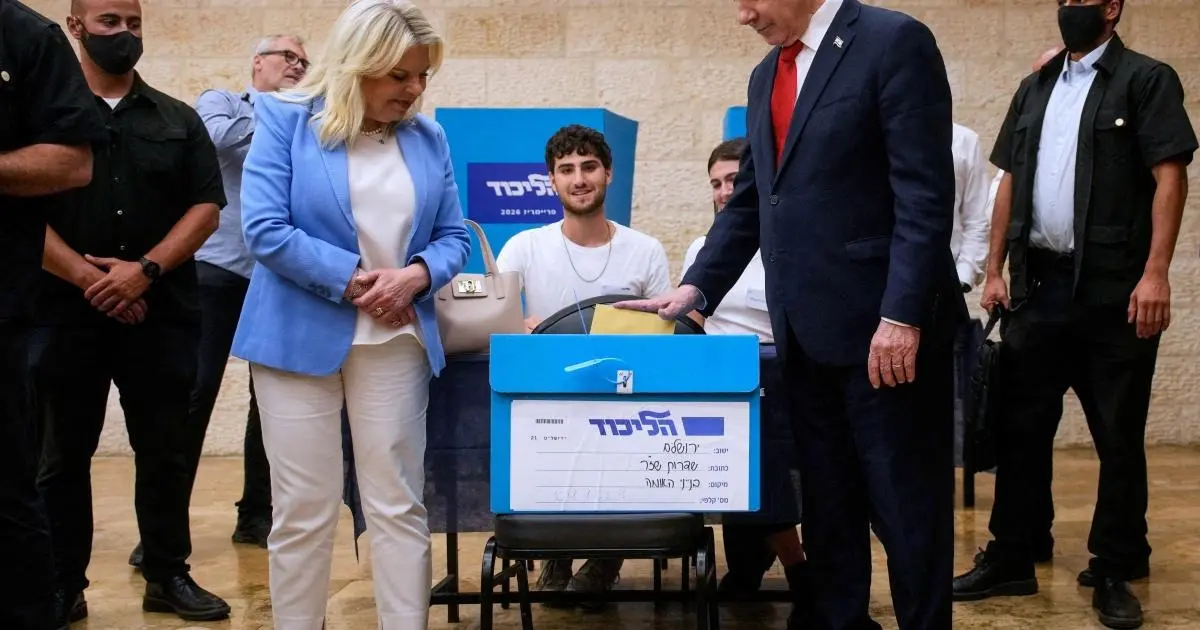
As Israeli Prime Minister Benjamin Netanyahu prepares to face voters next month following three years of incessant war, he has formulated a starkly defensive and uncompromising strategy. Ignoring the astronomical costs in blood and treasure, alongside a steep decline in international support for Israel—particularly within the United States—Netanyahu now publicly and explicitly champions a doctrine of endless war. Drawing what he frames as the definitive lesson from Hamas’s October 7, 2023, massacre, the prime minister asserts that Israel must take preemptive military action against every potential security threat it faces, regardless of the broader geopolitical consequences.
This hard-line posture has forced political observers and international diplomats to question how much of this uncompromising approach might actually change if Gadi Eisenkot, the veteran military official currently leading Netanyahu in national polls, succeeds in defeating him.
Thus far, Eisenkot, a classic centrist, has been blunt and sometimes caustic in his critiques of the prime minister. Yet, apart from broad declarations about bringing an end to the longest war in modern Israeli history, he has generally avoided detailing a fully articulated national security strategy. On certain issues, such as how to handle Hamas in the Gaza Strip, Eisenkot has at times sounded even more hawkish than Netanyahu. When pressed about the future of the conflict with the Palestinians—historically Israel’s most politically volatile issue—he has been exceptionally careful to avoid binding commitments. In a rare public statement regarding the matter in August, Eisenkot stated his opposition to the establishment of a Palestinian state, echoing a consensus position that now spans Israel’s political center, parts of the center-left, and the entirety of the right.
From such statements, it might be tempting to conclude that an Eisenkot-led government would operate little differently from its right-wing predecessor. Indeed, some political analysts argue that there would be no substantive shift on major national security issues. However, that perspective overlooks several critical areas—ranging from the escalating crisis in the West Bank to Israel’s tactical approach toward Syria and the ongoing conflict in Gaza—where fresh strategies could yield meaningful dividends, even if the anticipated changes prove incremental rather than dramatic. Ultimately, the degree to which a new strategic opening emerges will depend heavily on U.S. President Donald Trump and the nature of his relationship with a post-Netanyahu government, should Israeli voters decide to elect one. The most central question facing the region is not whether change is possible, but rather what specific kinds of changes might occur, and what level of active engagement Washington will provide.
Rightward Drift
According to recent Israeli polling, Netanyahu, who serves as the chairman of the right-wing Likud Party, will find it exceedingly difficult to assemble a viable governing coalition following the October 27 elections. For the time being, he appears to be channeling his political energy into engineering a deadlock that would prevent his opponents from uniting the next government. Simultaneously, he continues to heavily promote his narrative of continuous, open-ended conflict.
The revised Netanyahu platform preaches zero concessions and zero compromises. Before domestic audiences, he frequently underscores what he presents as a major strategic achievement: Israel’s seizure and occupation of territory along almost every contested border, including southern Lebanon, Syria, and the Gaza Strip, maintained under the guise of self-styled security zones. Defense Minister Israel Katz has taken this posture a step further, claiming that Israel will occupy these buffer zones for many years as part of the price exacted from its adversaries. Katz and other members of the cabinet actively search for new military adversaries, asserting that Turkish President Recep Tayyip Erdogan—who remains deeply hostile to Israel but difficult to frame as a direct military antagonist—poses a threat equivalent to Hezbollah and Hamas, a talking point that Netanyahu has also embraced. Certain cabinet members have gone even further, maintaining without public evidence that Syria’s president, former jihadist Ahmed al-Shara, is actively preparing to launch an attack on Israel.
This belligerent stance completely sidesteps the punishing domestic costs of Netanyahu’s strategy. With large cohorts of active-duty soldiers deployed on forward fronts for months at a time, the Israel Defense Forces (IDF) has experienced a severe contraction in its training schedules. Meanwhile, military reservists are shouldering an unprecedented burden, serving an average of more than 100 days a year since the outbreak of the 2023 war. The Israeli economy has also absorbed a staggering blow, with recent economic estimates indicating that Israel has spent approximately $142 billion on the war effort—an amount equivalent to more than half of the nation’s total annual budget. This immense financial strain runs parallel to the severe damage inflicted upon Israel’s international reputation and standing in global forums.
Amid these compounding crises and the profound unpopularity of the current right-wing coalition, Eisenkot has established a commanding lead in the polls. As a former IDF chief of staff with an extensive career rooted in the security establishment, he presents a sharp personal and professional contrast to Netanyahu and his nationalist ministers. Eisenkot entered politics relatively recently, stepping into the political arena four years ago. He initially joined Netanyahu’s emergency government as a member of the war cabinet just four days after the October 7 massacre. However, he quickly clashed with the prime minister over the management of the military campaign, particularly concerning Netanyahu’s insistence on slow-walking negotiations with Hamas to secure the release of Israeli hostages. Eisenkot ultimately resigned from the war cabinet the following June.
The personal stakes for Eisenkot were underscored in December 2023, when his youngest son, Gal, a reservist serving in an elite military unit, was killed during an operation in the northern Gaza Strip aimed at locating the remains of Israeli hostages. In an emotional eulogy delivered at his son’s funeral, Eisenkot pledged to dedicate himself to repairing the deep fractures exposed within Israeli society, answering public demands for accountability regarding the intelligence failures of October 7, and pursuing necessary political reforms. His remarks were widely interpreted as a moral and political mission born of profound personal loss.
When Eisenkot signaled last year that he intended to challenge Netanyahu, his campaign steadily gathered momentum, drawing a modest defection of traditional Likud voters to his newly formed party, Yashar!—a Hebrew word meaning honest or upright. In recent tracking polls, Yashar has surpassed Likud, and Eisenkot has opened a substantial margin over Netanyahu on the fundamental question of who is best suited to serve as prime minister. Nevertheless, the candidate and his strategists clearly believe that widening this advantage requires maintaining a cautious political posture.
For one, the diverse opposition coalition that Eisenkot leads—informally referred to as the "Anyone but Bibi" bloc—encompasses four distinct political parties ranging from the center-right to the left. The alliance also includes a right-wing party opposed to Netanyahu whose ability to clear the minimum electoral threshold for Knesset seats remains uncertain, alongside three predominantly Arab parties that could potentially support an anti-Netanyahu government from outside the coalition. Historical precedent exists for this arrangement, mirroring the dynamics of the 2021 government formed by Naftali Bennett and Yair Lapid.
Furthermore, the broader electorate has drifted significantly rightward over the past three years. An overwhelming majority of Israeli Jews harbor deep distrust toward Palestinians and neighboring Arab populations, remain intensely fearful of the prospect of a Palestinian state, and agree that Israel must maintain a highly offensive military posture to neutralize potential threats. Conversely, Arab citizens of Israel, who make up approximately 20 percent of the population, largely reject these premises. For Netanyahu, the core political vulnerability is that a significant segment of the Israeli public no longer believes he is the competent manager of that vision.
At various points, Eisenkot has attempted to outflank Netanyahu from the right, accusing the prime minister of adopting defeatist positions. Other prominent opposition figures positioned to Eisenkot’s right—such as Naftali Bennett, who recently joined centrist leader Yair Lapid in the "Together" alliance, and Avigdor Lieberman—advocate even more hawkish policies. The only prominent opposition figure willing to openly endorse a renewed peace process with the Palestinians is Yair Golan, leader of the Democrats, the leftmost party within the Zionist center-left bloc. Yet even Golan readily acknowledges that realizing a two-state solution remains an exceptionally distant prospect, given the profound mutual trauma inflicted by October 7 and the subsequent war.
Consequently, it is highly improbable that Eisenkot and his political partners would fundamentally overturn Israeli foreign and security policy should they unseat Netanyahu. It would be entirely unrealistic, for example, to expect that a successor government would voluntarily cooperate with ongoing proceedings at international courts in The Hague or initiate a comprehensive, self-directed investigation into allegations of IDF war crimes in Gaza. Nevertheless, substantive opportunities remain for Eisenkot to pivot the nation’s strategic direction—particularly if the incoming U.S. administration under Donald Trump chooses to lean in.
Taming the Settlers
One area of governance characterized by increasingly disastrous policy that an Eisenkot administration would be forced to confront is the West Bank. Over the past four years, the territory has operated largely under the purview of Bezalel Smotrich, leader of the far-right Religious Zionism party, who simultaneously serves as finance minister and holds sweeping administrative authority over the West Bank. Although Smotrich’s official ministerial writ is formally restricted to civilian affairs rather than military policy, Netanyahu granted him an effectively unchecked hand, which Smotrich has utilized to dramatically alter realities on the ground. Since 2023, more than 200 new settlements and outposts have either been established or are under active construction, frequently resulting in the direct displacement of generational Palestinian landowners.
The settler movement’s campaign to assert territorial control now couples an institutional political apparatus with a violent, paramilitary arm. The political wing includes sitting government ministers, members of the Knesset, and regional council leaders, while the enforcement wing consists of roughly 1,000 predominantly young settlers who operate with relative impunity, despite Netanyahu once dismissing them as "about 70 confused youths." This faction has grown increasingly well-armed, catalyzed by National Security Minister Itamar Ben-Gvir’s systematic expansion of civilian gun licenses and weapons distribution since 2023. While political allies of the settlers occasionally distance themselves from or offer token condemnations of the violence, the various factions operate toward a singular objective: land annexation and the localized expulsion of Palestinians, which critics warn constitutes creeping ethnic cleansing.
In recent months, the West Bank has plunged into acute instability, with police and military forces hesitant to confront violent settlers who riot largely unchecked. As this environment of lawlessness has driven the widespread destruction of Palestinian homes, vehicles, and mosques alongside rising casualties, international condemnation has intensified. Documented reporting by outlets such as Haaretz reveals that settler attacks on Palestinians have surged since 2023, resulting in the destruction of dozens of communities and hundreds of injuries. Even Mike Huckabee, Trump’s ambassador to Israel and a self-described proponent of the settlement enterprise, has publicly condemned the violence and urged the Israeli government to rein in extremist elements. In practice, however, Smotrich and his followers dismiss these diplomatic rebukes as temporary noise, confident that domestic political alignments insulate them from genuine pressure.
While domestic media outlets frequently bemoan the public relations damage inflicted by such violence, this critique overlooks the deeper moral crisis and the erosion of centralized military control. If unchecked, the unchecked rise of lawless militias threatens to undermine the IDF’s institutional authority within the territory.
A centrist Israeli government would likely attempt to impose basic restraint on extremist factions. Halting further settlement expansion represents an important and achievable initial step, though it alone cannot resolve the structural crisis. Smotrich and his allies have strategically placed new settlements in locations of vital tactical importance, deliberately severing geographical continuity between Palestinian population centers to preclude the future establishment of a viable Palestinian state. Reversing these facts on the ground will prove exceptionally difficult. Although successive Netanyahu-led governments have occasionally approved limited, court-mandated outposts removals under international pressure, more than two decades have passed since Israel last executed a large-scale evacuation of settlers—specifically, the removal of roughly 9,000 residents from the Gaza Strip in 2005 under Prime Minister Ariel Sharon. Furthermore, given that a growing number of active IDF officers and enlisted personnel now sympathize with the settler movement and religious-right ideology, any government directive to evacuate even a modest number of settlements risks triggering widespread noncompliance within the military ranks.
The more pressing operational challenge lies in the daily administration of the territory. Under the Smotrich era, and with Netanyahu’s explicit consent, settlers have tightened their institutional grip over the military bureaucracy governing the West Bank. Senior figures within the settler leadership routinely shape administrative policy, influence the tactical decisions of local IDF commanders, and exert behind-the-scenes pressure to shield extremist actors involved in harassment and violence against Palestinians from prosecution.
Having spent decades within the upper echelons of the security establishment, Eisenkot undoubtedly views the deteriorating situation in the West Bank as a direct strategic threat to Israel’s long-term viability, even if he has remained publicly reticent on the subject. As prime minister, he could readily deploy administrative detentions against the most violent settler instigators and mandate rigorous police and Shin Bet investigations into major attacks. At the same time, a wholesale purge of the military’s senior leadership or the removal of officers perceived as overly accommodating to settlers remains unlikely. Unlike the political culture in Washington, Israel possesses no established tradition of clearing out senior public servants following a change in political administration. Because Eisenkot previously commanded many of these officers during his tenure as chief of staff, he is more likely to attempt to reassert direct hierarchical authority over them than to replace them outright.
The Trump Factor
A transition in Israeli leadership would similarly unlock new tactical flexibilities across other regional fronts. In Gaza, an administration headed by Eisenkot would operate with fewer ideological constraints regarding national prestige and optics. Eisenkot never promised "total victory" over Hamas, a phrase heavily popularized by Netanyahu, and he has openly criticized the prime minister for fostering unrealistic expectations among the Israeli public. Unburdened by direct personal responsibility for the catastrophic intelligence failures of October 7 and having avoided declaring an all-out war against the Palestinian Authority (PA), Eisenkot would likely possess greater diplomatic latitude to engage with the stabilization frameworks proposed by President Trump and international mediators for post-war Gaza.
It is reasonable to assume that an Eisenkot government would not veto an expanded administrative role for the PA in the Gaza Strip. This shift could eventually clear a path, albeit slowly and cautiously, for the emergence of an alternative Palestinian governance structure. Nevertheless, much like Netanyahu, Eisenkot would find it politically impossible to tolerate an ongoing military presence for Hamas in the enclave, and would accept only a severely restricted political role for the organization, even assuming the monumental hurdle of its total disarmament could be achieved. Moreover, no Israeli leader can easily justify a complete military withdrawal from the strip that leaves border communities entirely vulnerable to future incursions. The most plausible best-case scenario involves a reduced but permanent Israeli security footprint in Gaza, paired with phased plans for internationally supervised PA administration over unoccupied sectors.
Similar diplomatic fluidity could emerge along Israel’s northern borders with Lebanon and Syria. While Eisenkot would enforce stringent, non-negotiable security conditions regarding the disarmament of Hezbollah, he intrinsically recognizes the strategic necessity of concluding military campaigns rather than allowing open-ended conflicts to fester indefinitely. This pragmatic outlook could create valuable openings for diplomatic progress, provided the Trump administration chooses to drive such an initiative.
Syria currently presents a tangible diplomatic opening. Recent reporting indicates that Syrian leader al-Shara is interested in negotiating a security arrangement that would trade an Israeli withdrawal from territory captured in 2024 for a partial normalization of bilateral relations. Eisenkot could view this as a pragmatic, low-risk provisional arrangement. Furthermore, Saudi Crown Prince Mohammed bin Salman might view an Eisenkot-led government as a definitive break from Israel’s polarizing right-wing administration, potentially rendering Riyadh more receptive to reviving stalled normalization talks.
Ultimately, however, the realization of any diplomatic initiatives will hinge heavily on the personal chemistry and strategic alignment established between Israel’s next prime minister and the U.S. president. During his initial term and the early phases of his second, Trump maintained a close alliance with Netanyahu, but relations have since frayed considerably. Prompted largely by Netanyahu’s persistent lobbying, Washington became entangled in a protracted regional confrontation with Iran that spanned nearly six months—a direct contradiction of Trump’s long-standing foreign policy rhetoric. The U.S. president and his inner circle have consistently rebuffed Netanyahu’s appeals to launch an all-out war against Tehran, occasionally placing direct blame on the Israeli leader for the broader strategic fallout.
Amid these lingering tensions, Trump remains eager to secure a definitive diplomatic win in one of the Middle East’s remaining flashpoints, such as Lebanon or Gaza. In both theaters, the White House has applied measured pressure on Netanyahu to constrain offensive operations. While dramatic shifts—such as direct U.S. demands for an IDF withdrawal from parts of southern Lebanon and Gaza without immediate, complete disarmament of Hezbollah and Hamas—cannot be entirely ruled out, such a push currently appears improbable. For Netanyahu, such an ultimatum would constitute a political catastrophe, further exposing his promises of total victory as hollow rhetoric.
For an Eisenkot government, conversely, targeted U.S. pressure could provide a welcome mechanism to wind down active combat fronts, particularly if structured around narrowly defined objectives that allow Trump to claim a diplomatic victory while safeguarding core Israeli security interests. More broadly, it could offer a pathway to reverse Netanyahu’s doctrine of continuous war. Yet, a vast amount depends on whether Eisenkot can establish a functional rapport with the U.S. president. Unlike Netanyahu, who cultivated decades of deep ties within American political and media circles, Eisenkot possesses minimal diplomatic experience and has interacted with very few foreign leaders outside military command structures. Furthermore, he entirely lacks the overt media charisma that traditionally appeals to Trump. Should the U.S. president pivot toward regional disengagement, any significant transformation of Israeli foreign policy risks stalling entirely.
A prospective initial White House meeting between Trump and a new Israeli prime minister could prove socially awkward. The American president might initially miss Netanyahu’s polished English-language media persona and his historical entanglement in U.S. domestic politics—a dynamic that earned Netanyahu the tongue-in-cheek moniker in Washington as "the Republican senator from Jerusalem." Nevertheless, if necessary, Trump would likely adapt to Eisenkot’s more reserved demeanor and straightforward communication style. Fundamentally, Trump respects political victors. For Eisenkot, earning that respect—and the diplomatic leverage that accompanies it—depends entirely on winning the upcoming election.