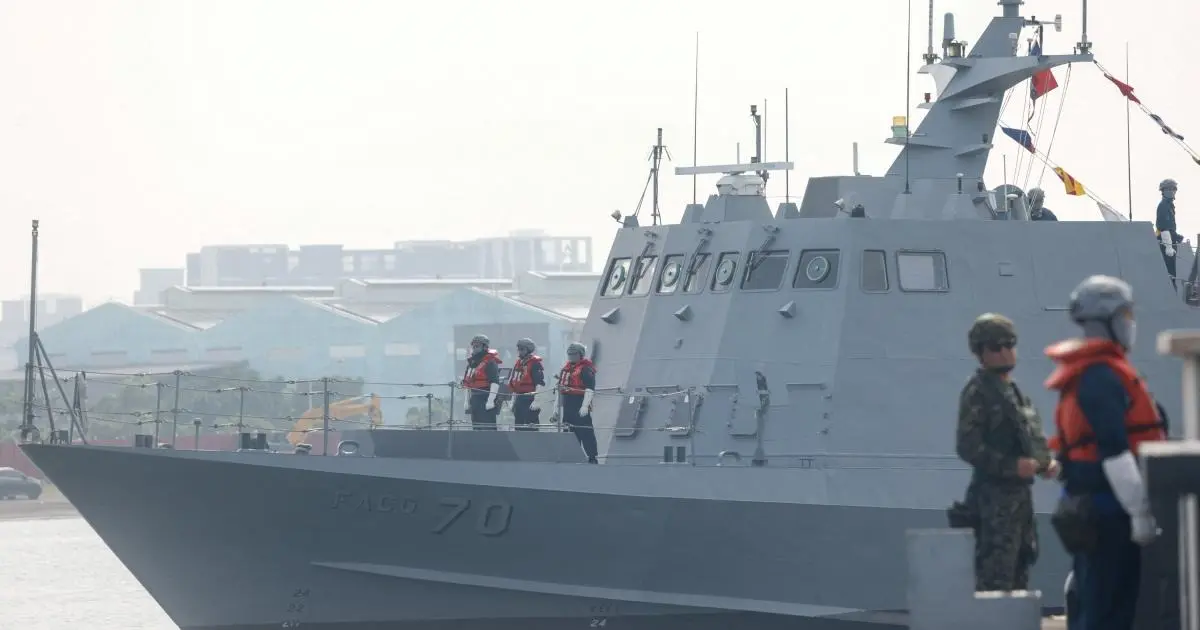
Separated from China by a roughly 100-mile-wide stretch of treacherous water, Taiwan relies fundamentally on its naval forces as the critical first line of defense against any potential cross-strait invasion. To successfully deter or defeat Beijing, Taipei must possess the capability to prevent an amphibious assault carried across the Taiwan Strait by massive Chinese troop-carrying fleets. Historically, however, Taiwan’s naval strategy has favored large surface combatants—such as destroyers and frigates—to form the core of its maritime fleet. These heavy vessels have long served dual purposes: acting as visible symbols of state sovereignty and functioning as diplomatic tools for signaling resolve in the face of continuous Chinese military coercion. Continuing this traditional path, Taiwan’s current long-term shipbuilding plans involve replacing an aging surface fleet with similarly large, highly sophisticated, and immensely expensive new warships.
Yet, military analysts increasingly warn that large surface ships are exceptionally vulnerable in the narrow, constricted waters of the Taiwan Strait. This operational hazard has been dangerously compounded by rapid advancements in modern military technology that make major surface vessels vastly easier to detect, continuously track, and precisely target. Over recent years, China has poured enormous financial and technological resources into developing cutting-edge intelligence, surveillance, and reconnaissance networks—collectively known as ISR—along with advanced electronic warfare systems, loitering munitions, maritime drones, and precision-guided anti-ship missiles. Consequently, Taiwan’s traditional large surface ships risk becoming a severe liability rather than an asset in wartime.
Paradoxically, Taiwan holds a distinct tactical advantage: these very same technological breakthroughs also render China’s massive amphibious invasion ships highly vulnerable when operating in restricted waters. Unlike agile, smaller alternatives, these critical Chinese troop carriers cannot easily be substituted with stealthier designs. Taipei could decisively exploit this strategic mismatch by phasing out its costly destroyers and frigates, replacing them instead with a substantially greater number of smaller surface combatants. These nimble vessels would enjoy a significantly higher statistical probability of surviving an initial wave of devastating Chinese missile strikes while retaining the lethal firepower necessary to systematically dismantle and sink a cross-strait Chinese invasion fleet.
The pressing fiscal and strategic reality is stark. The Taiwanese navy is currently planning to invest heavily in massive surface combatants, including a proposed new 7,000-ton warship alongside as many as 12 light frigates weighing approximately 3,000 tons each. These large vessels act as fundamental impediments to the radical, urgent transformation of the Taiwanese navy that the escalating Chinese threat strictly requires. Constructing warships of this immense scale equipped with the necessary stealth features and layered defense systems to survive an intense, contested battle in the Taiwan Strait would be prohibitively costly. Without such defensive enhancements, they would inevitably prove far too vulnerable to play a meaningful role in the navy’s primary wartime mission: denying an invading Chinese force the unhindered use of the Taiwan Strait.
International precedents underscore these budgetary and operational pitfalls. Efforts elsewhere to construct similarly capable mid-sized and large surface ships have routinely proved remarkably expensive and logistically difficult. The U.S. Navy’s ambitious Constellation-class frigate program, for instance, initially budgeted roughly $1 billion per vessel; the projected cost eventually escalated to about $1.5 billion per ship before the program faced major curtailment. Even at that staggering price point, defense experts noted the resulting ships still lacked many of the specialized capabilities required to fight a technologically advanced adversary within restricted littoral waters. By sharp contrast, Taiwan’s entire projected annual spending budget for its comprehensive naval shipbuilding program sits at approximately $1.5 billion.
Rather than squandering scarce financial resources on large, high-profile hulls, Taipei would be far better served constructing a distributed fleet of stealthy corvettes weighing between 700 and 1,000 tons. Heavily armed with anti-ship missiles and integrated drones, these smaller vessels would be inherently harder for enemy sensors to detect and target, yet they would retain enough destructive firepower to effectively engage and neutralize Chinese invasion craft crossing the strait. Combined with existing defense plans to construct shore-based mobile missile launchers, tactical aircraft armed with advanced anti-ship missiles, and a fleet of eight domestically built submarines, Taiwan could successfully forge a resilient, highly dispersed, and exceedingly difficult-to-destroy defense architecture capable of absorbing heavy initial strikes and ultimately repelling an amphibious invasion.
SITTING DUCKS
While large warships may serve as potent political symbols of national power, they are relatively easy for modern adversaries to target and politically catastrophic to lose. When naval engagements occur within narrow waterways saturated with heavy surveillance and electronic reconnaissance, high visibility quickly transforms from a source of national pride into a deadly operational liability. Furthermore, the catastrophic sinking of a major capital ship carries profound repercussions that extend far beyond an immediate tactical setback on the battlefield. Such a visible and financially devastating loss can easily make political and military leadership far more risk-averse, rendering them hesitant to commit additional surface assets as a conflict drags on.
Historical naval engagements spanning more than the past four decades demonstrate unequivocally that any navy anticipating combat near a powerful enemy’s coast must exercise extreme caution before centering its force structure around expensive, virtually irreplaceable hulls. The 1982 Falklands War fought between Argentina and the United Kingdom offers a classic textbook example of how a single successful tactical strike on a prominent warship can paralyze an entire surface fleet. Argentina entered the Falklands conflict boasting formidable naval assets, including the heavy cruiser General Belgrano and the aircraft carrier Veinticinco de Mayo. However, after a British nuclear-powered submarine successfully torpedoed and sank the Belgrano, the Argentine military command made the cautious decision to keep the remainder of its surface fleet—including the valuable aircraft carrier—sheltered safely in coastal waters or confined to naval ports for the duration of the war.
A similar operational lesson unfolded six years later in the confined waters of the Persian Gulf. During Operation Praying Mantis, the U.S. Navy seamlessly combined real-time surveillance, carrier-based aviation, surface combatants, and precision-guided weaponry to utterly devastate Iranian naval forces in a remarkably short span. In a single day of combat, American forces sank or severely crippled several Iranian surface vessels operating in the restricted waters of the Gulf, including two major frigates.
Whereas the Falklands conflict vividly illustrated the broader political fallout of losing a major warship, Operation Praying Mantis highlighted the mortal danger facing surface fleets that confront an adversary wielding a highly effective "kill chain"—the integrated network of sophisticated sensors, communication relays, and processing tools required to detect, identify, track, target, and attack an opponent’s naval forces with devastating speed. For modern Taiwan, the core takeaway is absolute: the theoretical combat power of large warships is entirely irrelevant if those vessels cannot survive long enough to engage the enemy, and an early catastrophic loss could trigger cascading operational failures across the entire naval command structure.
Conversely, losing a smaller, less conspicuous vessel carries far lower political and military penalties. In 2006, for instance, a Hezbollah anti-ship cruise missile successfully struck the Israeli Navy corvette Hanit while the vessel was operating in contested waters off the coast of Lebanon. The ship had not been formally warned of the incoming threat, leaving the crew with virtually no time to detect and effectively respond to a missile launched from a shore-based battery merely 12 miles away, and several onboard defensive countermeasures were not fully activated at the time of impact. Although the resulting explosion killed four Israeli sailors and heavily damaged sensitive electronic equipment, the well-trained crew managed to contain the fires and structural flooding, allowing the Hanit to limp safely back to port. Crucially, this painful incident did not lead Israel to abandon its reliance on corvettes; rather, it prompted the nation to invest in larger, better-armed, and more technologically resilient corvettes.
Most crucially for Taiwan’s strategic planners, Ukraine’s ongoing Black Sea naval campaign following the Russian invasion in 2022 demonstrated conclusively that a militarily weaker power can effectively constrain a vastly superior adversary in contested waters without ever achieving traditional command of the sea or possessing a comparable conventional fleet. Ukraine’s asymmetric strategy successfully combined land-based anti-ship cruise missiles, coordinated swarms of uncrewed surface vessels, aerial reconnaissance drones, and external intelligence support to impose staggering operational costs on the Russian Navy in the Black Sea.
These sustained asymmetric strikes forced the majority of the Russian fleet to relocate much farther away from Ukrainian shores. The high-profile sinking of the Russian flagship Moskva further underscored that even a heavily armed warship equipped with sophisticated layered air defenses remains dangerously vulnerable to a determined adversary’s modern kill chain. Similarly, ongoing conflicts in the Middle East reinforce this operational pattern: while the United States and Israel severely damaged Iran’s conventional surface navy in early phases of conflict, they have consistently struggled to eliminate dispersed, mobile missile batteries, small armed drones, fast patrol craft, and covert mine-laying boats. Consequently, despite losing the vast majority of its conventional naval power, Iran has retained a persistent ability to threaten international shipping lanes and disrupt commercial access through the vital Strait of Hormuz.
SMALL IS BEAUTIFUL
As these contemporary operational examples clearly demonstrate, a less powerful navy does not need to control its coastal waters outright to successfully deny a stronger adversary the ability to utilize them freely. Within the geopolitical confines of the Taiwan Strait, the primary strategic objective must therefore be "sea denial"—systematically preventing China from utilizing the waterway with the freedom required to mount a successful amphibious invasion.
Achieving effective sea denial does not demand that Taiwan entirely abandon its surface navy. Instead, it must construct a fundamentally different kind of maritime force: one built around a significantly greater number of smaller, highly agile ships capable of operating independently while seamlessly sharing tactical information and coordinating distributed missile attacks. This decentralized posture makes the entire fleet far more resilient against an initial surprise assault and uniquely equipped to repel a massive invasion force.
Looking internationally, Finland and Sweden offer exceptional strategic models for Taiwan to study. Both Nordic nations face the constant requirement to deter and defend against a vastly larger and more powerful military adversary in Russia, while simultaneously contesting sovereignty challenges across controlled maritime areas and preparing for potential amphibious attacks along their extensive coastlines. With naval forces centered squarely around corvette-class vessels, Finland and Sweden have successfully stood up to ongoing Russian political and military pressure, routinely intercepting and harassing Russian submarines that violate their territorial waters, escorting foreign warships away from sensitive zones, and maintaining robust diplomatic stances. Both countries maintain extensive, sophisticated, and steadily modernizing surveillance, communication, and decision-support networks that tie their coastal defenses together.
A comprehensive restructuring of Taiwan’s surface fleet is entirely within practical reach. In July, Taiwanese President Lai Ching-te attended the official commissioning ceremony for the navy’s eighth and newest missile patrol ship—a lightweight yet heavily armed domestic corvette featuring an innovative catamaran hull design that renders the vessel significantly faster, highly stable, and harder to track. Four additional vessels of this advanced class are officially scheduled to be commissioned before the end of the year.
Taiwan’s domestic shipbuilding industry has proven capable of rapidly producing these versatile vessels, and the more hulls it constructs, the greater its manufacturing efficiency will become. Sustained, long-term production runs will progressively drive down unit costs, allowing each successive batch of corvettes to incorporate newly developed weapons systems, advanced sensors, and integrated uncrewed systems. Each of these modern patrol ships has been delivered to the navy at a price tag well under $200 million, contrasting sharply with the estimated $2 billion cost required to build a single 7,000-ton capital warship.
These vital fleet adjustments must be combined with a broader, holistic modernization of Taiwan’s military-wide sensor networks, secure communications tools, aerial drones, and precision missile inventories. Indeed, Taiwan is already making important headway in several of these areas. Its most recent special defense budget and upcoming naval development plans are explicitly designed to strengthen the domestic kill chain by acquiring advanced maritime surveillance drones, upgrading command-and-control networks to better direct and coordinate dispersed military forces, and introducing artificial intelligence-assisted combat decision-support systems.
These technological pillars form the essential building blocks of an effective defense architecture designed to deny China the ability to freely navigate the Taiwan Strait. Yet, defense analysts emphasize a crucial irony: the very same technological innovations that render Taiwan’s kill chain more lethal also make its traditional large surface ships increasingly susceptible to enemy precision strikes. Only through a deliberate, structural overhaul and modernization of its surface fleet can Taiwan truly prepare itself for the realities of a potential cross-strait invasion.
Furthermore, a restructured Taiwanese surface fleet would directly reinforce existing plans to construct eight new domestic submarines, the first of which is already undergoing rigorous sea trials. While submarines are considerably slower than nimble corvettes, they offer unmatched stealth. Anti-ship missiles and drones launched from surface corvettes can critically disable enemy invasion craft by striking them above the waterline, while heavy torpedoes deployed from silent submarines can finish the job by sinking them from below. Shifting the foundational approach toward the surface fleet is therefore a critical catalyst that will make all of Taiwan’s other naval investments significantly more effective.
RIGHTING THE SHIP
Ultimately, the most formidable obstacles standing in the way of a comprehensive transformation of Taiwan’s navy are institutional rather than technical. Because they are exceptionally visible, large capital ships retain an undeniable allure for politicians. They generate lucrative shipyard contracts, high-profile ribbon-cutting ceremonies, a visible sense of national pride, and tangible proof of government commitment to national security.
By contrast, the general public cannot easily witness a secure warehouse filled with hidden anti-ship drones or a mobile missile launcher concealed deep within the mountains. For traditional naval leadership, maintaining the established status quo remains far safer and more comfortable than pushing for radical institutional change. Taiwan’s current inventory of destroyers and frigates—many of which trace their underlying structural designs back half a century to American blueprints—represent well-understood, institutionally safe choices.
Rather than continuing to pour funding into upgrading these obsolescent, if not outright obsolete, platforms, Taiwan’s defense leadership should progressively decommission them and redirect scarce financial resources toward the lighter, distributed surface combatants the nation desperately requires. Moving away from deeply familiar maritime platforms will undoubtedly demand that political and military leaders take calculated risks and weather the inevitable public criticism and political setbacks that accompany major institutional reforms.
The ongoing construction of Taiwan’s first domestically manufactured submarines, for instance, has experienced delays and schedule setbacks. However, such operational and engineering challenges are entirely normal and expected when developing complex, state-of-the-art naval vessels, and they must not be allowed to derail critical defense investments. Government leaders and national security officials must sustain long-term political support for these modernization programs, actively explaining and justifying their strategic importance to the public, even when faced with sharp partisan criticism from political opponents.
After years of historic stagnation and decline, Taiwan’s national defense spending is finally showing upward momentum. The proposed 2027 defense budget is widely expected to comfortably surpass three percent of the island’s Gross Domestic Product, building on the passage of a $25 billion special defense budget in May. While this special allocation represents a significant financial commitment—albeit scaled down from the initial $40 billion proposal originally drafted by the executive branch—Taiwan will not achieve genuine security if these vital resources are misallocated toward outdated defense concepts and a handful of highly vulnerable, oversized warships.
Instead, the nation requires a dispersed, highly agile, and lethal force structure explicitly designed to defeat an invading force within the confines of the Taiwan Strait. Such a modern navy may cut a less impressive figure during traditional fleet reviews and ceremonial displays, but it will serve as a vastly more credible and effective deterrent against a potential Chinese invasion.