Drone delivery pioneer Zipline is seeking federal approval for a sweeping commercial expansion that could ultimately support up to 130,000 package deliveries per day across the Phoenix and Tucson metropolitan areas. The ambitious proposal, which contemplates round-the-clock operations seven days a week, marks a significant escalation in the commercial deployment of autonomous aerial logistics across major American urban centers.
The details of the network’s potential scale emerged from a draft environmental assessment published by the Federal Aviation Administration (FAA) in November. This ongoing federal review is designed to evaluate the potential environmental, noise, and community impacts of integrating Zipline’s high-capacity commercial drone delivery network into the airspace and neighborhoods of Arizona’s two largest population centers.
Federal aviation officials emphasize that the staggering figures outlined in the proposal represent the maximum potential operating capacity of the network rather than expected daily delivery volumes. In practice, daily activity levels would fluctuate based on actual consumer demand, localized weather patterns, and other standard operating conditions. Nevertheless, the sheer scope of the filing underscores how quickly the unmanned aerial vehicle (UAV) sector is maturing from localized pilot programs into infrastructure capable of handling industrial-scale logistics.
A Large-Scale Drone Delivery Network
Under the framework submitted for federal evaluation, Zipline could establish up to 65 charging locations and 1,300 package dropboxes in each targeted metropolitan area, bringing the total regional infrastructure footprint to significant proportions. Each individual charging location is engineered to support as many as 1,000 deliveries per day, feeding a dense web of local distribution points designed to serve dense residential and commercial neighborhoods.
The spatial footprint required for such a network involves strategic placements across commercial real estate. Zipline would anchor its charging and pickup infrastructure at established commercial locations, including retail shopping centers, distribution warehouses, and various partner facilities. To remain compliant with local regulations, the company would be required to site these facilities strictly in accordance with local municipal zoning laws and comprehensive land use requirements.
The sheer frequency of operations required to sustain this volume is similarly pronounced. The FAA environmental assessment identifies up to 390,000 individual flight segments, or transits, per day across the combined Phoenix and Tucson operating regions. To understand the operational flow, each individual delivery is broken down into three distinct flight segments: an initial transit from a charging location to a package pickup point, a second leg flying the payload directly to the customer, and a final return flight back to a charging location.
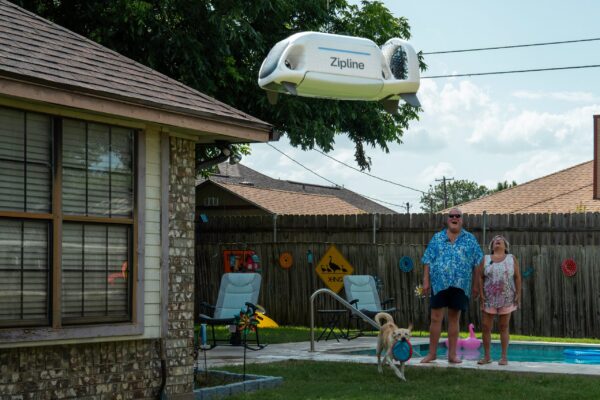
To execute these missions, Zipline plans to deploy its advanced Platform 2 delivery aircraft. This specialized drone features a maximum takeoff weight of approximately 63 pounds and is engineered to carry commercial packages weighing up to eight pounds, a payload capacity sufficient for a vast array of retail goods, meals, and medical supplies.
Round-the-Clock Operations and Environmental Review
While Zipline is formally requesting authorization to operate around the clock, including weekends and holidays, company projections indicate that the vast majority of actual deliveries will naturally concentrate during traditional daytime and evening hours.
According to projections cited in the FAA assessment, approximately 95% of all flight operations would occur between the hours of 7 a.m. and 10 p.m. The remaining 5% of flights would take place overnight between 10 p.m. and 7 a.m., operating strictly on an as-needed basis depending on consumer demand for urgent items such as late-night prescriptions or essential supplies.
The introduction of high-frequency commercial drone traffic, particularly with the possibility of overnight operations, brings complex community considerations to the forefront. The FAA’s environmental assessment carefully examines potential effects on surrounding human and natural environments, including ambient noise levels, local wildlife habitats, land use compatibility, and visual impacts.
These considerations have transitioned from theoretical discussions to pressing local debates as drone delivery operators expand their footprints into populated residential neighborhoods. Similar tensions have surfaced in other parts of the country; for example, Amazon Prime Air’s proposed drone delivery operations in Westborough, Massachusetts, have encountered vocal community opposition, alongside rigorous scrutiny regarding local zoning enforcement and environmental oversight.
The Arizona proposal serves as a prominent indicator of the operational scale that commercial drone networks could eventually achieve across the United States. At the same time, it highlights the growing need for transparent frameworks through which local communities can evaluate the cumulative effects of frequent low-altitude drone flights, particularly regarding acoustic impacts during nighttime hours.
FAA Seeks Public Comment
Zipline is not starting from scratch in the regulatory arena. The company already holds a coveted FAA Part 135 air carrier certificate alongside specific exemptions that permit certain beyond visual line of sight (BVLOS) operations. However, launching the proposed Arizona network requires additional administrative milestones, including targeted amendments to the company’s FAA operating specifications and other final agency approvals.
The publication of the draft environmental assessment represents a mandatory step in the regulatory process dictated by the National Environmental Policy Act (NEPA). Before the FAA can render a final decision on whether to approve Zipline’s proposed expansion, federal law requires a comprehensive evaluation of potential environmental consequences and robust public participation.
To fulfill this mandate, the FAA is actively accepting public comments concerning the draft environmental assessment. Agency documentation lists slightly varying deadlines for submissions, with the draft assessment text pointing toward a December 7 closing date, while the FAA’s dedicated online environmental review webpage lists December 9.
Interested parties, community members, and industry stakeholders may submit formal comments via email to [email protected], ensuring that "Zipline Arizona Draft EA" is clearly noted in the subject line for proper routing and consideration by federal reviewers.