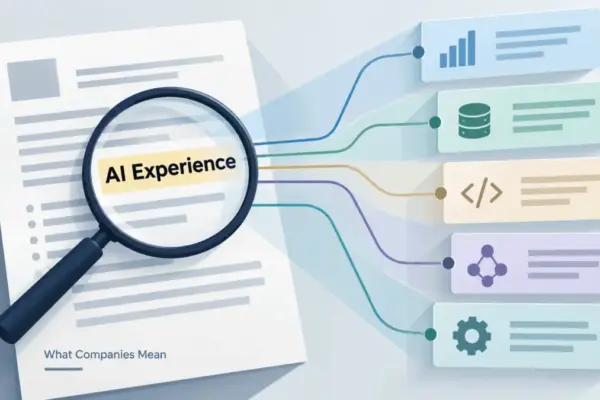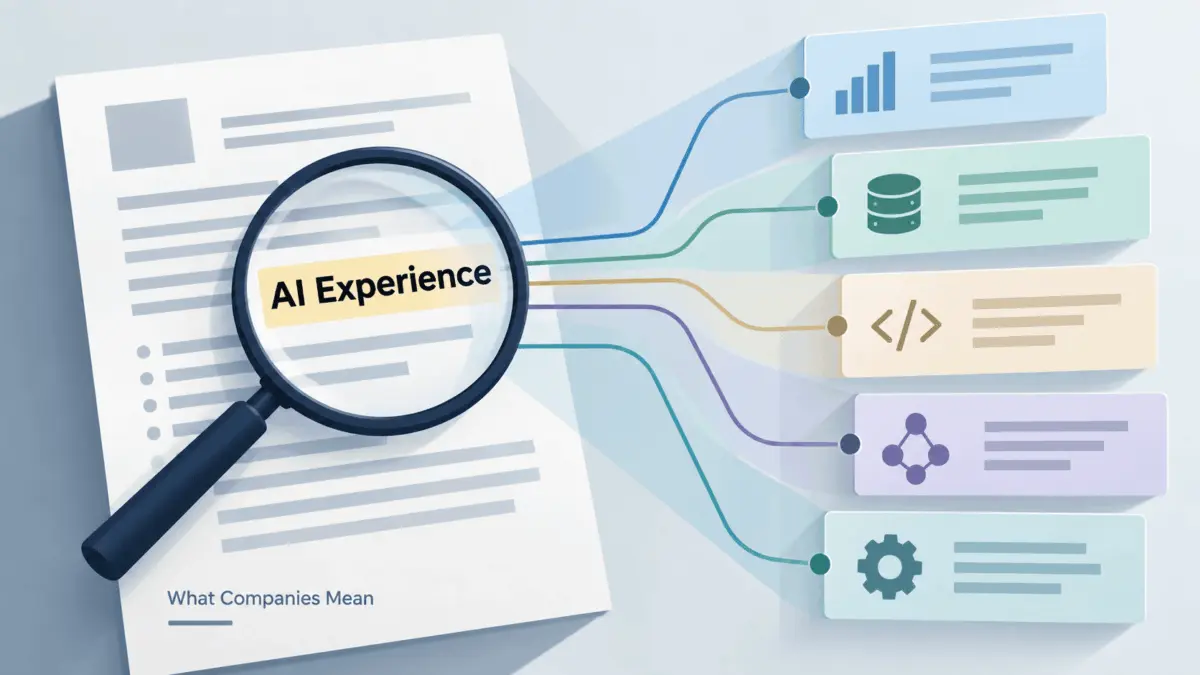
Job postings for data analysts, statisticians, and researchers increasingly list "AI experience" as a strict requirement, creating a common hurdle for job seekers navigating the modern hiring market. However, that single phrase means very different things depending on who wrote the listing, what industry they operate within, and what specific problem they are trying to solve. A hiring manager at a traditional retail company, a cutting-edge biotech startup, and a major financial services firm may all use the exact same two words to describe wildly different day-to-day expectations and technical skill sets.
This industry ambiguity highlights a broader challenge in recruitment: "AI experience" is largely a marketing term rather than a standardized technical benchmark. Unlike traditional qualifications such as five years of regression analysis or demonstrated proficiency in programming languages like R, it carries no shared or universal meaning across organizations. This lack of standardization is rarely accidental. Hiring teams often fail to reach internal consensus on the exact technical competencies they need before opening a requisition. They write "AI experience" into the job description because it signals corporate modernity and successfully filters for candidates who have stayed abreast of recent technological developments, rather than because they have a precise competency profile in mind.
For applicants, the first and most critical task is to decode the listing carefully. The job description itself, the broader industry context, and the seniority level of the position all carry vital clues that reveal what the company actually requires to solve its business problems. Most common uses of the phrase in contemporary job postings fall into distinct operational categories, ranging from basic tool familiarity to advanced algorithmic design. Understanding which category applies to a given role fundamentally changes how candidates should frame their professional background during the application and interview process.
Fortunately, traditional statistical training already serves as the foundational bedrock for almost everything labeled as "AI" in a modern business context. The perceived gap between a classical statistician and an artificial intelligence practitioner is largely one of vocabulary, framing, and tooling rather than underlying mathematical reasoning. Professionals do not need to completely overhaul their resumes to compete for these roles; instead, they need to translate their existing achievements into the prevailing dialect of the employer. Where a traditional resume might note the creation of predictive regression models to forecast quarterly demand, a hiring manager searching for artificial intelligence capabilities sees a professional who fundamentally understands supervised machine learning and rigorous model evaluation. By framing past experience around tangible business outcomes and analytical reasoning processes, the connection becomes immediately visible.
Treating a job posting with the same critical eye applied to a complex dataset helps demystify corporate recruitment demands. Headline requirements in job listings are frequently aspirational, listing every single skill an organization would ideally desire while knowing that no single candidate will check every box. An "AI experience" requirement buried deep within a lengthy list of twelve qualifications carries far less weight than the core responsibilities outlined in the body of the role description. The day-to-day duties and the specific problems the role is intended to solve provide a much more accurate reflection of actual team needs.
Distinguishing between aspirational wishlist items and core functional requirements requires careful reading of the text. The seniority level of a position also changes the interpretation of the phrase substantially. For junior roles, the requirement usually signals adaptability, a comfort level with adopting new software tools, a willingness to learn internal systems, and a lack of hesitation when working with automated outputs. For mid-level positions, the expectation shifts toward informed collaboration, requiring professionals to work alongside engineering teams, contribute meaningfully to model evaluation discussions, and bridge the communication gap between technical data science units and broader business stakeholders. At the senior level, the phrase demands strategic judgment, including knowing when artificial intelligence is or is not the appropriate solution, communicating technical limitations clearly to executive leadership, and helping the organization avoid the substantial operational and reputational costs of deploying technology carelessly.
Several common misconceptions continue to complicate the hiring landscape for applicants trying to position themselves effectively. Many professionals believe they should list every single artificial intelligence tool they have ever touched, but this strategy often backfires during interviews. Hiring managers consistently remember candidates who demonstrated critical judgment and problem-solving abilities rather than those who simply cataloged software tools. Describing the specific business problems solved and the analytical reasoning process used, while mentioning tools merely as supporting context, yields much better results.
Another frequent concern is that candidates are automatically disqualified if they have not built a complex machine learning model entirely from scratch. For the vast majority of roles utilizing this terminology, this is simply not true. What actually disqualifies candidates more frequently is an inability to think critically about underlying data quality, model assumptions, and the interpretation of results. Those are core statistical skills that companies desperately need, even if they sometimes fail to name them correctly in their initial recruitment documents. Similarly, the belief that a specialized certification is mandatory before applying can deter qualified applicants. While credentials can provide helpful validation in certain contexts, most hiring managers evaluating analysts are assessing critical reasoning and domain understanding during the conversation itself. Being able to articulate precisely when an artificial intelligence system might fail, and the underlying reasons why, proves far more persuasive than any completed online training course.
Ultimately, seeing "AI experience" in a job posting should be viewed as a starting point for a professional conversation rather than a rigid technical specification. In most cases, it signals one of several operational needs, ranging from baseline comfort with emerging tools and awareness of machine learning concepts to hands-on modeling or domain-specific applications. Because traditional statistical backgrounds already cover substantial ground across these areas, the primary task for job seekers involves reading the posting with sufficient care to identify the underlying intent, then framing existing professional experience so that the connection to the employer’s needs is unmistakable.
Vinod Chugani, an artificial intelligence and data science educator, focuses on bridging the gap between emerging technologies and practical applications for working professionals. His work spans agentic AI, machine learning deployments, and automated workflows, drawing on analytical expertise originally developed in quantitative finance. Through his ongoing role as a technical mentor and instructor, he supports data professionals through skill development and career transitions, emphasizing actionable strategies and frameworks that can be applied directly in the workplace.