The concept of agentic artificial intelligence has rapidly transitioned from exploratory academic research into core production infrastructure. Across industries of all sizes, systems capable of autonomous planning, dynamic tool utilization, and iterative problem-solving are being deployed to streamline code review pipelines, enhance research assistants, power customer operations platforms, and execute complex internal automation tools.
Yet, as engineering teams rush to implement these advanced capabilities, a stark operational reality has emerged: building agents that function reliably in a production environment is substantially more difficult than creating a convincing demonstration. While a single-turn chatbot relies primarily on the quality of a solitary model response, transitioning to a multi-step autonomous system introduces an entirely different class of engineering challenges. Developers must contend with complex state management, robust failure recovery mechanisms, secure sandboxed execution, and the nuanced evaluation of multi-step execution trajectories rather than isolated outputs.
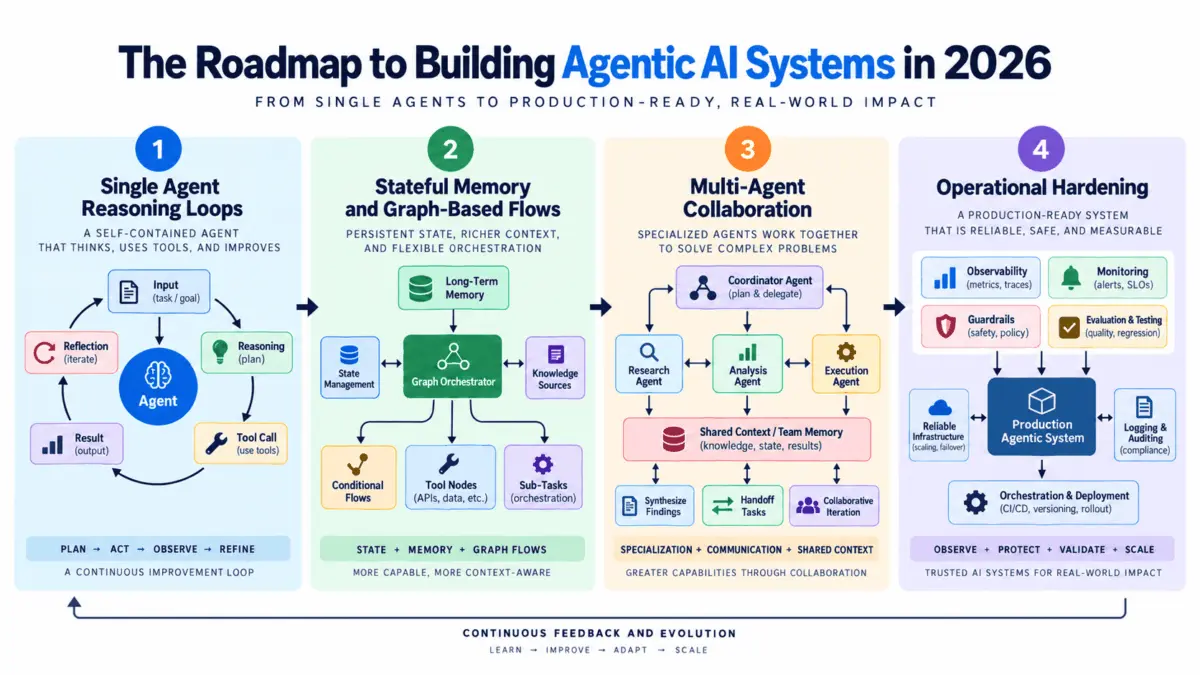
To address these hurdles, a comprehensive four-level roadmap has been outlined to guide practitioners through increasing system complexity. This framework moves from foundational cognitive architectures to the sophisticated design, hardening, and observation of full multi-agent systems, providing a structured approach for engineering scalable AI solutions.
The Anatomy of an Agent and Cognitive Architectures
Before attempting to construct interconnected systems of agents, developers must acquire a precise understanding of the mechanics governing a single agent. Within the artificial intelligence landscape, an agent is defined as a system capable of perceiving its environment, selecting appropriate actions, executing those actions via specialized tools, and utilizing the resulting feedback to inform subsequent decisions. This continuous loop separates an autonomous agent from a standard, linear language model call.
Several distinct reasoning paradigms dictate how these agents structure their operational loops. Chief among them is structured tool interaction, which relies on function-calling protocols. In this setup, the model outputs a structured call directed at a predefined function—such as a web search, code execution environment, or database query—receives the output, and seamlessly incorporates the data into its next reasoning step. To prevent malformed tool calls from cascading into catastrophic downstream failures, strict output validation using frameworks like Pydantic or TypeChat has become an essential safeguard.
Simultaneously, dynamic context assembly presents a critical architectural challenge. Long-running agents inherently consume vast token capacities as they cycle through reasoning loops. Determining precisely what information enters the context window at any given step, what data requires summarization, and what should be offloaded to external memory rather than retained directly is an ongoing practical problem impacting both operational costs and system coherence. Validating these structured interactions prior to execution eliminates a broad spectrum of runtime errors, establishing a firm foundation for more complex agentic designs.
Stateful Memory and Graph-Based Control Flows
A fundamental limitation of early agent designs is their fragility; a single-loop agent that loses critical context between successive tool calls quickly becomes unreliable. Consequently, advancing to the next tier of agent architecture requires equipping systems with persistent memory and replacing rigid, linear execution chains with flexible, graph-based control flows.
In modern agentic systems, memory manifests in multiple forms to support continuity and learning. Similarly, the architectural shift from linear chains to dynamic graphs is vital for handling real-world complexity. While linear execution models follow a strict, predetermined path, authentic operational tasks frequently branch. For instance, a research agent might pursue one path if a reliable source is identified, but pivot entirely if information is missing. Frameworks such as LangGraph model these intricate execution pathways as directed acyclic graphs or cyclical state machines, while alternative platforms like Microsoft’s AutoGen offer comparable capabilities through different ergonomic interfaces.
State persistence ultimately separates production-grade systems from early prototypes. By checkpointing an agent’s state at every step of execution, developers unlock crucial capabilities including the ability to roll back to a prior state when an error occurs, resume paused runs—which is especially critical for long-running tasks or mandatory human approval gates—and thoroughly debug branching execution paths after the fact.
Multi-Agent Collaboration and Protocol Design
When the operational scope of a task exceeds the capacity of a single agent, the natural progression involves orchestrating teams of specialized agents designed to collaborate on complex objectives. Establishing team topology represents the initial strategic decision in this phase, determining how responsibilities are distributed among agents with distinct domain expertise.
Equally important is the design of inter-agent communication protocols. Systems in which agents communicate solely through unstructured text tend to accumulate compounding errors across operational handoffs. Implementing structured message schemas for task assignments, status updates, and formal result reporting—alongside explicit task handoff contracts—drastically reduces coordination failures. Furthermore, robust conflict resolution mechanisms become indispensable when specialized agents generate divergent outputs. Whether a critic agent challenges a coder’s solution or a research agent uncovers evidence contradicting a planner’s core assumptions, the system must possess defined protocols for resolving discrepancies through voting, re-querying with contextual updates, or escalating decisions to human operators. The adoption of emerging standards like the Model Context Protocol further streamlines how these agents securely connect to external tools and enterprise data repositories.
Operational Hardening, Sandboxing, and Observability
A multi-agent system that performs well in a controlled development environment but fails unpredictably in production is inherently incomplete. Ensuring reliability, safety, and debuggability at scale requires rigorous operational hardening.
Runaway loop mitigation stands as an immediate operational priority. Agents that lose sight of their core objective, encounter unexpected tool behaviors, or become trapped in recursive reasoning loops can rapidly exhaust computational resources and token budgets. Implementing circuit breakers, recursion depth caps, and dynamic token expenditure ceilings as first-class infrastructure prevents these runaway scenarios. Additionally, sandboxed code execution is non-negotiable for any agent granted the ability to generate and run code. Permitting an agent to execute arbitrary scripts on a shared server introduces severe security vulnerabilities, making isolated environments like Docker containers, specialized cloud sandboxes, or WebAssembly runtimes essential for secure confinement.
Observability remains a frequent point of failure for early deployments. Evaluating the true quality of a multi-step agent trajectory demands insight beyond merely inspecting the final output. Advanced tracing platforms provide execution graph visualization that records every individual step, tool call, and intermediate state, enabling developers to pinpoint exactly where an agent deviated from its intended path. Embracing trajectory-level evaluation—scoring the efficiency and overall correctness of the entire execution path rather than just the terminal result—represents the emerging benchmark for assessing production-grade agent performance.
As organizations continue to deploy these complex architectures, the success of agentic AI will depend heavily on disciplined engineering practices. By building each layer deliberately—from foundational cognitive loops and persistent memory to structured collaboration and rigorous operational hardening—developers can transform experimental models into reliable, autonomous enterprise systems.
Vinod Chugani serves as an AI and data science educator, focusing on bridging the gap between emerging artificial intelligence technologies and practical implementation for working professionals. His work centers on agentic AI, machine learning applications, and automation workflows, drawing on his analytical background in quantitative finance to inform his hands-on teaching methodologies and mentorship initiatives.