The concept of agentic artificial intelligence has rapidly transitioned from theoretical academic research into live production infrastructure far faster than industry analysts initially anticipated. Systems designed to autonomously plan, leverage tools, and iteratively work toward specific objectives are now actively deployed across diverse enterprise environments. Organizations of every size are integrating these capabilities into code review pipelines, automated research assistants, customer operations platforms, and internal workflow automation tools.
However, developing autonomous agents that operate reliably in a live production environment has proven to be substantially more challenging than building a convincing prototype or a single-turn chatbot. Transitioning from a simple conversational interface to a multi-step autonomous system introduces an entirely new class of complex engineering hurdles. Development teams must navigate intricate challenges including persistent state management, robust failure recovery mechanisms, secure sandboxed execution environments, and sophisticated evaluation frameworks capable of assessing multi-step reasoning trajectories rather than isolated model outputs.
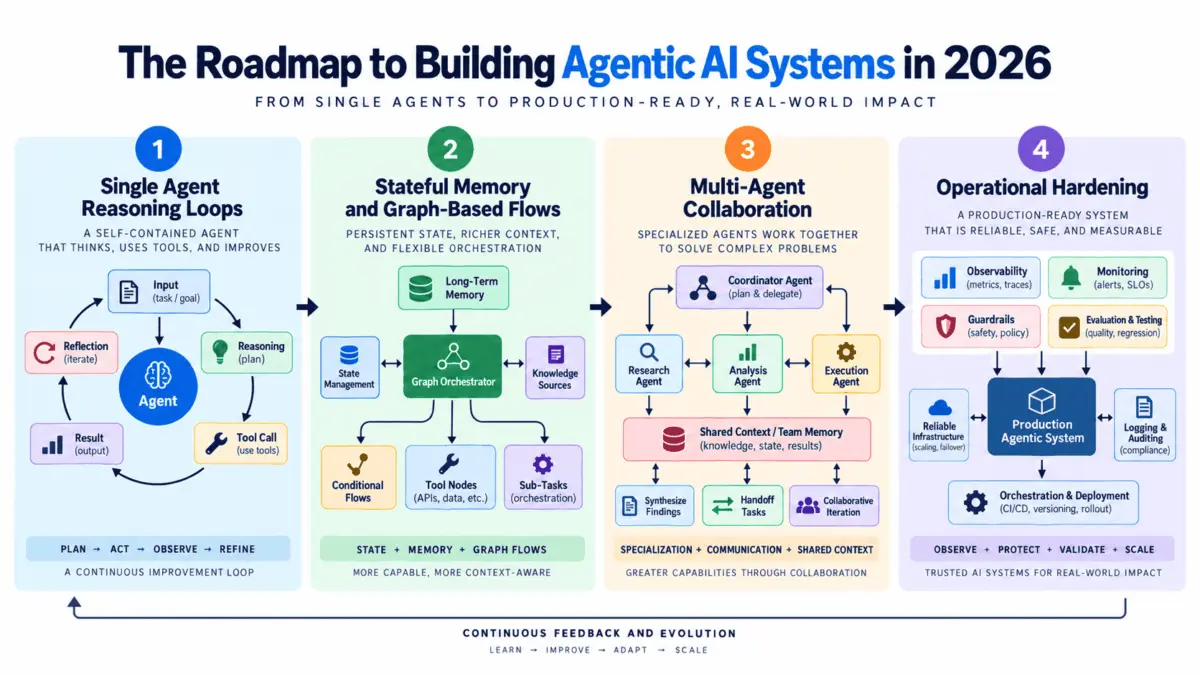
To address these engineering complexities, technical leaders and architects are increasingly turning to structured developmental frameworks. A comprehensive roadmap addressing these challenges moves systematically through ascending levels of system complexity. This progression begins with mastering individual cognitive architectures and advances steadily toward designing, hardening, and observing fully realized multi-layer agentic ecosystems.
The Anatomy of an Agent and Cognitive Architectures
Before engineering complex systems involving teams of interacting agents, developers must first establish a precise understanding of the internal mechanics governing a single agent. Within the modern AI landscape, an agent is formally defined as a system capable of perceiving its operational environment, selecting appropriate actions, executing those actions via external tools, and utilizing the resulting feedback to inform subsequent decisions. This continuous loop separates an autonomous agent from a standard, stateless language model invocation.
Several distinct reasoning paradigms dictate how individual agents structure this execution loop. Structured tool interaction serves as a foundational pillar of this architecture. Modern systems communicate with external utilities through specialized function-calling protocols, where the underlying model generates a structured request for a predefined function—such as a web search, code execution environment, or database query—and subsequently incorporates the returned output into its ongoing reasoning process. Strict output validation mechanisms utilizing libraries like Pydantic or TypeChat are essential to prevent malformed tool requests from triggering catastrophic cascading failures downstream.
Dynamic context assembly represents another critical operational challenge. Long-running autonomous agents consume substantial token counts as they iterate through execution loops. Managing the precise information entering the context window at every individual step, determining what data requires summarization, and deciding what historical context should be retrieved from external memory rather than retained directly are vital systems engineering problems. Effectively balancing these factors directly impacts operational costs, latency, and overall systemic coherence. Validating structured tool outputs before execution fundamentally mitigates a wide range of runtime exceptions during extended agentic operations.
Stateful Memory and Graph-Based Control Flows
A single-loop agent that continuously loses vital contextual awareness between sequential tool calls is inherently brittle. Consequently, the next evolutionary phase of agent design involves equipping these systems with persistent memory architectures capable of surviving across multiple execution steps. Furthermore, this stage requires replacing rigid, linear execution chains with flexible, graph-based control flows.
Memory within sophisticated agentic frameworks generally manifests across distinct operational tiers, each serving specialized retrieval and storage functions. Simultaneously, the architectural shift from linear chains to dynamic graphs is equally paramount. Linear execution pipelines that strictly follow a sequential path from one step to the next quickly reveal their inflexibility when applied to complex scenarios. Real-world tasks frequently branch outward; for instance, a research agent might pursue one specific analytical path if a primary source is successfully identified, but immediately pivot to an alternative trajectory if the search yields insufficient data. Modern orchestration frameworks model these intricate execution pathways as directed acyclic graphs or, where iterative refinement is strictly required, cyclical state machines.
State persistence is the defining characteristic where prototype agentic implementations fundamentally diverge from robust production systems. Checkpointing the internal state of an agent at every granular step unlocks three critical operational capabilities: the ability to execute an immediate rollback to a prior valid state when an error occurs, the capacity to seamlessly resume paused execution runs which is vital for long-running workflows or human-in-the-loop approval gates, and the proficiency to accurately debug branching execution paths after a run has concluded.
Multi-Agent Collaboration and Protocol Design
When the operational scope of a task surpasses the cognitive capacity of a single isolated agent, system designers must implement coordinated teams of specialized agents. Organizing these multi-agent teams requires deliberate choices regarding team topology. Common organizational patterns include hierarchical structures where a supervisory manager agent delegates subtasks to specialized workers, peer-to-peer collaborative networks where agents negotiate directly, and pipeline topologies where outputs are passed sequentially down a specialized assembly line.
The design of inter-agent communication protocols is frequently underestimated yet remains critically important for systemic stability. Agents that attempt to communicate via unstructured natural language accumulate errors exponentially across successive handoffs. Establishing strictly defined message schemas for task assignments, operational status updates, and formal result reporting—alongside explicit task handoff contracts—substantially reduces coordination failures.
Furthermore, robust conflict resolution mechanisms become indispensable when specialized agents produce divergent or contradictory outputs. A designated critic agent might reject a flawed code solution proposed by a developer agent, or a research agent might surface empirical evidence that directly contradicts the core assumptions made by a planner agent. Production systems must incorporate predetermined protocols for reconciling these divergences, whether through consensus voting, iterative re-querying enriched with conflicting contextual data, or systematic escalation to a human supervisor. Emerging interface standards, such as the Model Context Protocol introduced by Anthropic, provide standardized mechanisms for securely connecting agents to disparate external tools and enterprise data sources.
Operational Hardening, Sandboxing, and Observability
An advanced multi-agent system that functions flawlessly in a controlled development environment but fails unpredictably in production is inherently incomplete. Successfully deploying these technologies requires rigorous engineering practices designed to ensure reliability, safety, and comprehensive debuggability at scale.
Runaway loop mitigation stands as a primary operational priority. Agents that lose sight of their primary objective, encounter unexpected tool output formats, or become trapped in self-reinforcing reasoning loops can rapidly consume unbounded computational resources, time, and API tokens. Implementing automated circuit breakers that halt execution after a predetermined number of failed steps, strict recursion depth caps, and dynamic token expenditure ceilings as core infrastructure elements is essential.
Sandboxed code execution is similarly non-negotiable for any agent empowered to write and execute code. Permitting an autonomous agent to execute arbitrary code directly on a shared server introduces severe security vulnerabilities. Isolated execution environments—ranging from secure containerization technologies to specialized cloud sandboxes—provide the necessary containment boundaries to let agents safely develop and test programmatic solutions.
Observability represents the domain where many early agentic deployments experience critical failures. Evaluating the qualitative performance of a multi-step agent trajectory requires far deeper analytical visibility than simply verifying the terminal output. Advanced tracing platforms provide execution graph visualization that exhaustively records every granular agent decision, tool invocation, and intermediate state variable. This granular visibility allows engineering teams to pinpoint precisely where an agent deviated from its intended path. Ultimately, trajectory-level evaluation—scoring the operational efficiency and factual correctness of the entire execution path rather than solely assessing the final delivered answer—has emerged as the definitive standard for production-grade agent quality assessment.
Vinod Chugani is an AI and data science educator who bridges the gap between emerging artificial intelligence technologies and practical application for working professionals. His focus areas include agentic AI systems, machine learning applications, and enterprise automation workflows. Through his work as a technical mentor and instructor, Chugani has actively supported data professionals through skill development and career transitions, bringing analytical expertise derived from quantitative finance to his hands-on teaching methodology. His instructional content consistently emphasizes actionable strategies and scalable frameworks that professionals can apply immediately within their organizations.