A policy booklet recently published by the UK’s opposition Conservative Party features a prominent financial figure regarding the “cost of net-zero” that appears to have been inflated by a simple spreadsheet error.
The “common sense” policy document, titled “The Right Way,” argues that what citizens ultimately want is a government competent enough to solve the problems for which it takes responsibility. Within a section cautioning that sophisticated economic modeling should not serve as a substitute for political judgment, the document disparages various external estimates concerning the financial burden of transitioning the United Kingdom to a net-zero carbon economy.
However, the Conservative publication asserts—incorrectly—that the government’s official climate adviser, the Climate Change Committee (CCC), previously estimated the total cost of reaching net-zero at nearly £1tn. Specifically, the booklet states that in 2020, the CCC estimated its route to net-zero would cost £957bn.

In reality, the CCC’s 2020 estimate was exactly half that amount, standing at £478bn. Furthermore, the committee published a revised figure last year lowering the expected net cost to £108bn, a reduction largely driven by the rapidly falling costs of electric vehicles and advancing green technology.
Spreadsheet Error
The Conservative Party’s erroneous claim appears to trace back to another report that accidentally tallied numbers twice by misinterpreting a data spreadsheet published by the CCC in 2020.
The 2020 spreadsheet features a comprehensive table detailing the additional capital investments required to build a net-zero economy, spanning everything from low-carbon electricity generation infrastructure to residential heat pumps and electric vehicles. These extra capital expenditures, designated as CAPEX, totaled £1.38tn over the thirty-year period between 2020 and 2050. Set against these costs are projected operational savings, designated as OPEX, amounting to £0.90tn over the same timeframe.
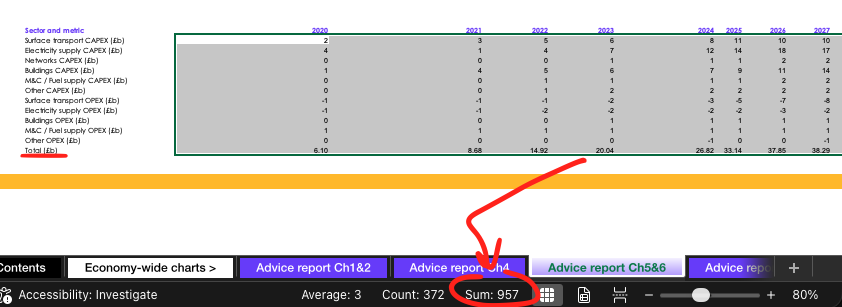
When balanced out over the 2020 to 2050 window, the combined CAPEX and OPEX figures arrive at a net total of £478bn.
Alongside the individual annual sectoral CAPEX and OPEX breakdowns, the CCC’s 2020 spreadsheet also included a summary line providing combined totals for each individual year. Investigation into the origins of the inflated statistic indicates that an analyst inadvertently added all of these annual summary numbers together alongside the primary dataset, resulting in both the operational savings and the capital costs being counted twice.
This double-counted calculation produces a total cost of net-zero amounting to £957bn—the exact figure that subsequently found its way into the Conservative Party’s policy booklet.
When the original figures were published in 2020, the CCC emphasized that the £478bn net cost amounted to less than 1 percent of the UK’s total gross domestic product over the course of three decades. The committee noted at the time that the substantial investments required would not only yield substantial savings through reduced reliance on imported fossil fuels, but would also generate a net boost to overall GDP of approximately 2 percent.
By 2025, the CCC adjusted its calculations, revising projected investment costs to £670bn and operating savings to £562bn. This yielded a revised net total of £108bn for the period spanning 2025 through 2050, representing less than 0.2 percent of GDP. Earlier this year, the committee reiterated that achieving net-zero emissions would ultimately cost less than enduring a single major fossil-fuel price shock, while delivering wider environmental and economic benefits valued at £110bn annually.
Paper Trail
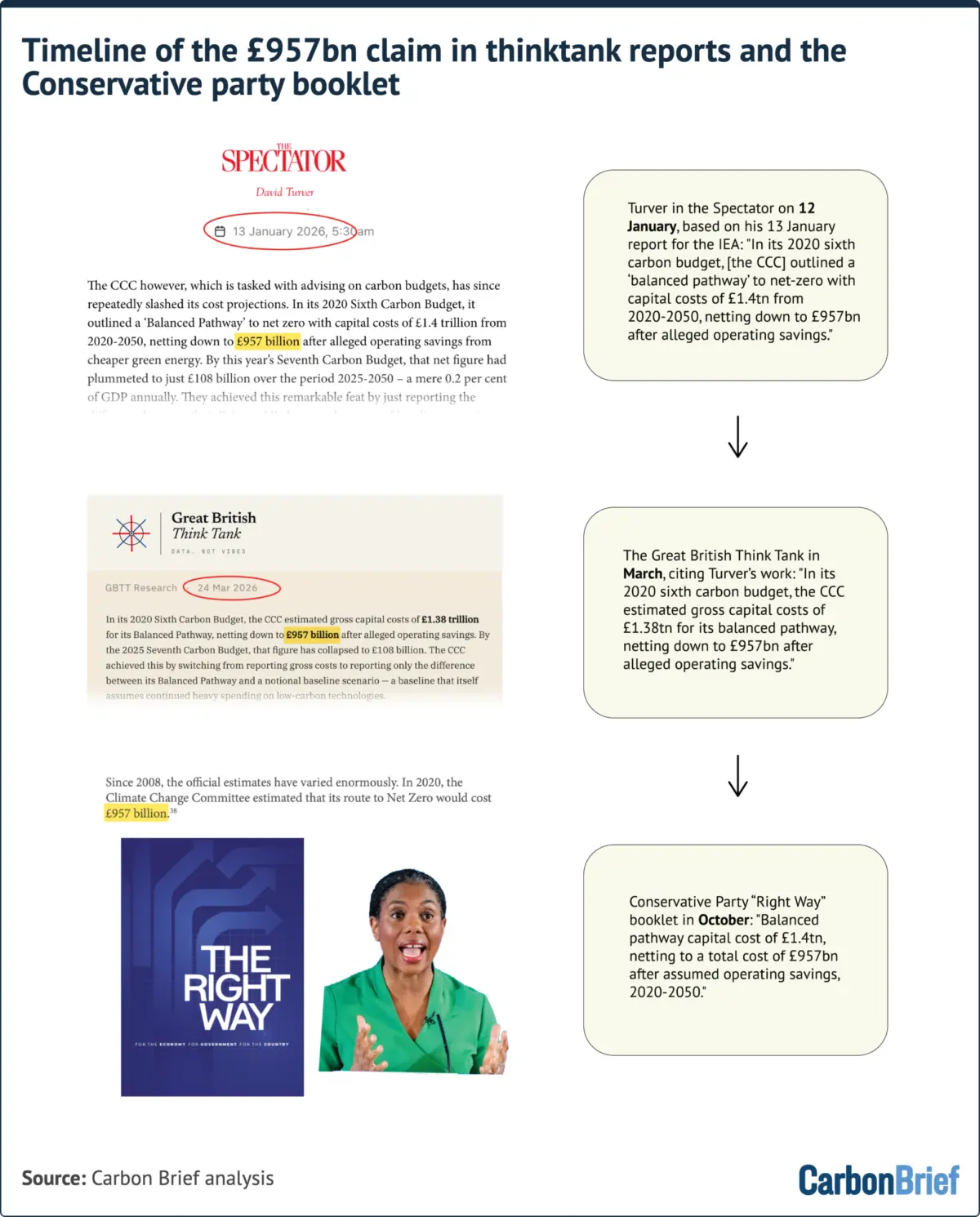
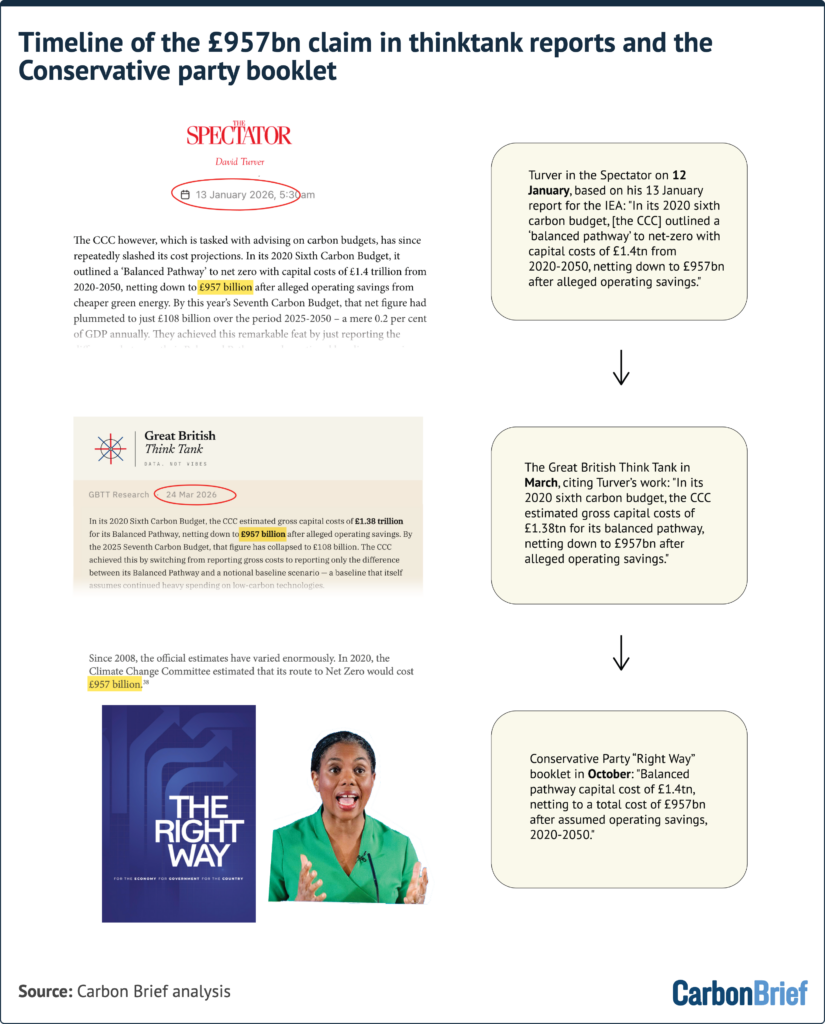
The erroneous £957bn figure included in the Conservative document cites the CCC’s 2020 advice regarding the UK’s sixth carbon budget. However, that official advice contains no such figure.
Tracing the digital paper trail reveals that the earliest online citation of the £957bn figure appeared on January 12, 2026, in an article published by The Spectator, authored by retired engineer and self-described accidental energy analyst David Turver. Just one day later, Turver repeated the mistaken figure within a formal report published by the free-market Institute of Economic Affairs, explicitly referencing figure 5.3 of the CCC’s 2020 supporting advisory documents.
As detailed in the underlying data, the CCC spreadsheet feeding into figure 5.3 totals £478bn—precisely half of Turver’s stated figure. The discrepancy stems from the accidental summation of annual totals already accounted for in the spreadsheet layout, causing the costs to be entirely duplicated.
The same report by Turver also sparked a cascade of inaccurate media headlines across various outlets asserting that net-zero would cost anywhere from £7.6tn to as much as £9tn. Those inflated figures relied on theoretical assumptions that treated fossil fuels, alongside the combustion-engine cars, gas boilers, and power plants that consume them, as having zero economic value or replacement cost.

Following the publication of Turver’s report and article in January 2026, the £957bn figure was repeated in March by the Great British Think Tank, an organization whose tagline promotes data over ideological impressions and insists that its work relies entirely on figures sourced from official public bodies.
Months later, the exact same doubled figure migrated into the mainstream political arena, appearing directly within the text of the Conservative Party’s October policy document.