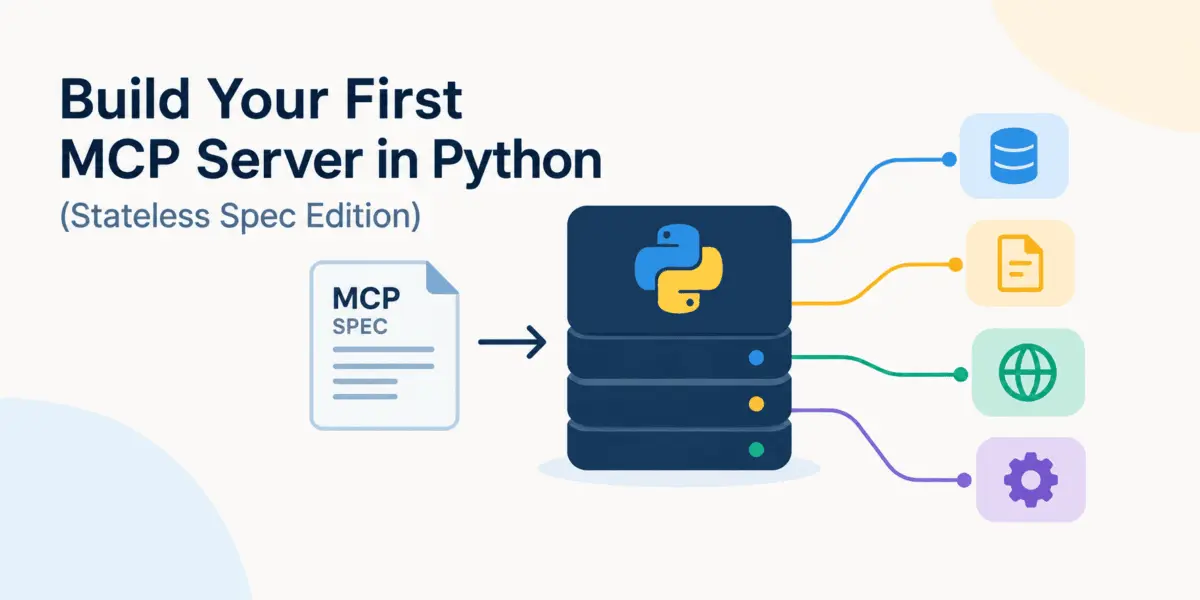
The Model Context Protocol (MCP) has undergone a fundamental architectural evolution, shifting away from stateful sessions toward a fully stateless specification. Introduced with the July 28 specification update, the core protocol no longer requires modern clients to establish a formal protocol session before submitting requests, nor do servers rely on session identifiers for routine operations. This design change significantly simplifies the deployment of MCP servers behind standard HTTP infrastructure and normal load-balancing systems.
Alongside these protocol updates, the official Python SDK has advanced to version 2 as its primary stable release line. The updated SDK introduces a high-level MCPServer application interface designed to let developers define tools, resources, and prompts using standard Python functions and native type hints. Rather than manually writing rigid JSON schemas or explicit tool manifests, developers can rely on the SDK to automatically interpret function signatures, parameter types, and default values to generate the required interface definitions.
To demonstrate this architecture in practice, developers are exploring implementations such as developer knowledge-base servers that expose core MCP primitives. These applications typically feature search tools that accept queries and return filtered dictionary lists, static resource endpoints that expose available documentation via uniform resource identifiers, and reusable prompt templates designed to guide large language model responses. Crucially, these servers operate entirely without persistent user session states, ensuring that every incoming request contains all necessary data for processing.
The transition to a stateless model addresses long-standing scaling challenges associated with bidirectional protocol architectures. Under older protocol iterations, HTTP clients relied on initialization handshakes and session tracking headers to maintain context across requests. This requirement frequently complicated multi-instance deployments, often necessitating sticky routing configurations or shared session state backends to ensure requests reached the correct worker instance.
Under the revised specification, individual requests are entirely self-contained. Load balancers can freely distribute traffic across multiple worker nodes without risking session degradation or context loss. This capability aligns MCP servers with conventional web application architectures, allowing deployment patterns such as multi-worker ASGI server configurations to handle incoming traffic efficiently.
The Python SDK v2 facilitates this integration by offering native support for Streamable HTTP alongside development workflows featuring interactive debugging utilities. Developers can launch applications in a development environment to inspect exposed tools and test interactions through browser-based interfaces, or transition directly to standard ASGI applications compatible with mainstream Python web servers. This compatibility enables organizations to embed MCP endpoints directly within larger web applications or microservices built on established frameworks.
Adopting a stateless protocol core does not preclude applications from managing state when business logic requires it. However, the architectural responsibility shifts from the protocol layer to the application layer. Rather than relying on hidden session identifiers managed by the protocol, developers implement explicit handles—such as transaction identifiers or basket tokens—that are passed transparently by the model during interactions. This explicit-handle pattern allows systems to maintain necessary state while preserving the scalability and simplicity of a stateless request-response transport layer.
The convergence of the stateless MCP specification and the streamlined Python SDK v2 lowers the barrier for integrating large language models with external data sources and operational tools. By removing the overhead of connection handshakes and session management, the updated protocol allows engineering teams to build, scale, and maintain MCP servers using familiar web development paradigms and standard infrastructure tooling.