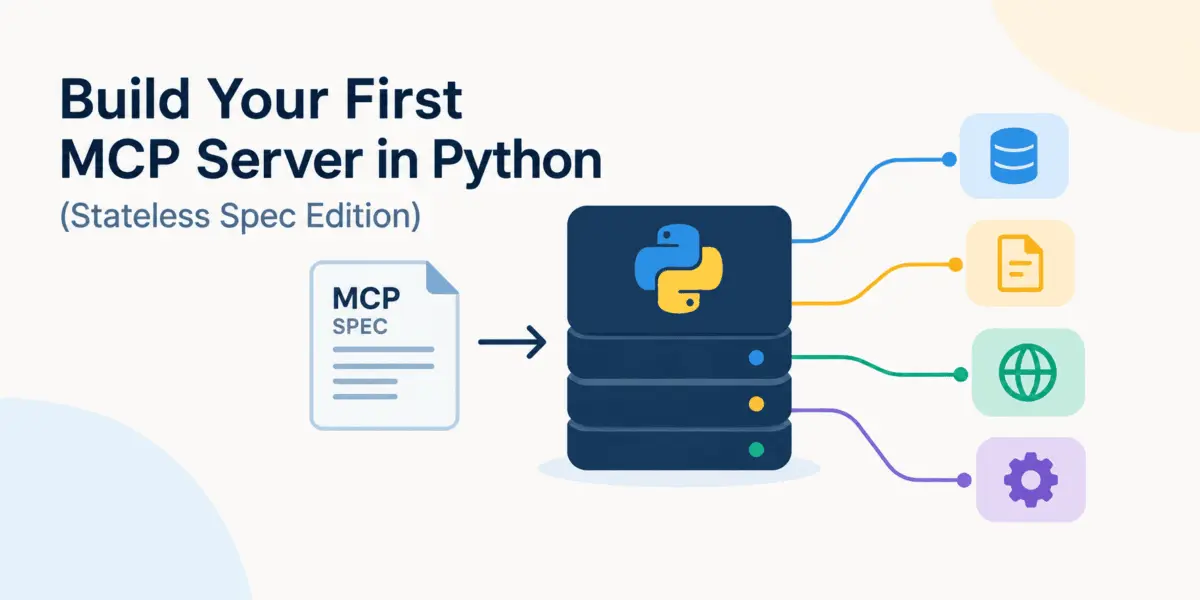
The Model Context Protocol (MCP) has undergone a foundational architectural shift following the introduction of its July 2026 specification update. By transitioning the core protocol to a stateless model, modern clients are no longer required to establish a formal protocol session before issuing requests, while servers have dropped their reliance on session identifiers for standard operations. This evolution significantly simplifies the deployment of MCP servers behind conventional HTTP infrastructure, paving the way for more resilient and scalable AI-driven applications.
Alongside this protocol-level evolution, the official Python SDK has advanced to version 2, establishing it as the current stable line for developers building context-aware applications. The updated SDK introduces a high-level MCPServer application programming interface designed to streamline the exposure of tools, resources, and prompts using standard Python functions. This development allows engineering teams to construct network-accessible MCP applications with minimal boilerplate, bridging the gap between standard backend development and AI orchestration layers.
The practical implications of the stateless update address long-standing scaling challenges associated with bidirectional protocol cores. Under previous iterations, maintaining state through session identifiers often necessitated sticky routing and specialized session infrastructure in multi-instance deployments. The updated specifications remove this requirement by ensuring that modern MCP requests are entirely self-contained. Consequently, workloads can be distributed evenly across multiple server workers without risking session disruption or context loss, reflecting a broader movement toward application-owned state where explicit identifiers travel within the request payload rather than relying on protocol-level persistence.
To demonstrate the capabilities of the v2 Python SDK and the stateless architecture, developers can construct a lightweight knowledge-base server using modern tooling. Utilizing package managers like Astral’s uv, developers can initialize a project and integrate the MCP command-line interface. By defining a high-level server instance, applications can declare specific behavioral instructions for large language models, instructing them to prioritize retrieved knowledge-base documentation over speculative generation when addressing support inquiries.
The integration of tools within the updated framework emphasizes Python’s native type hinting system to automatically generate input schemas without manual JSON configuration. For instance, a function designed to search a support knowledge base utilizes standard type annotations and default parameters to establish its input structure. The framework extracts these parameters, transforming Python function signatures into compliant tool definitions that language models can interpret and invoke dynamically during execution.
In addition to executable tools, the architecture supports resources designed to expose static or dynamic information that host applications can inject directly into context windows. While tools function similarly to action-oriented operations, resources operate more akin to data retrieval endpoints. By defining specific Uniform Resource Identifiers, developers can make supplementary reference materials accessible to clients without requiring explicit tool invocation steps. Furthermore, the framework accommodates reusable prompt templates, allowing developers to standardize interactions and guide model behavior effectively.
Verifying the functionality of a stateless MCP server can be achieved through local development utilities included in the SDK or by implementing custom client scripts. The development command launches the application alongside an inspection interface, providing a visual environment for reviewing registered tools and testing execution payloads. For programmatic verification, developers can implement asynchronous client connections that interact directly with the server over streamable HTTP endpoints, confirming protocol versions and retrieving structured content seamlessly.
Ultimately, the transition to a stateless protocol core and the maturation of the Python v2 SDK reflect a concerted effort to align AI integration frameworks with standard web engineering practices. By eliminating the overhead of session management and handshake negotiations, developers can integrate MCP servers into larger architectures—such as FastAPI or Starlette deployments—with greater architectural flexibility, ensuring that scalable AI infrastructure remains efficient, maintainable, and straightforward to operate.