The developer ecosystem surrounding the Model Context Protocol (MCP) has reached a significant maturity milestone following a major architectural shift implemented in the protocol core. Driven by updates finalized in the July 2026 specification, the core architecture of MCP has transitioned to a fully stateless model. This evolution eliminates the traditional requirement for modern clients to establish a rigid protocol session before issuing requests, while simultaneously freeing servers from managing Mcp-Session-Id parameters for ordinary operations. As a result, deploying and scaling MCP servers behind conventional HTTP infrastructure has become substantially more straightforward for engineering teams.
Concurrently, the official Python SDK has advanced to version 2 as its primary stable release line. This update introduces a higher-level MCPServer application programming interface designed to streamline how developers define tools, resources, and prompts using standard Python functions. Rather than manually constructing complex JSON schemas or maintaining tedious boilerplate manifests, developers can rely on native Python type hints and docstrings to automatically generate the necessary interface definitions. This synergy between the stateless protocol architecture and a streamlined high-level SDK drastically lowers the barrier to entry for building robust, network-accessible artificial intelligence integrations.
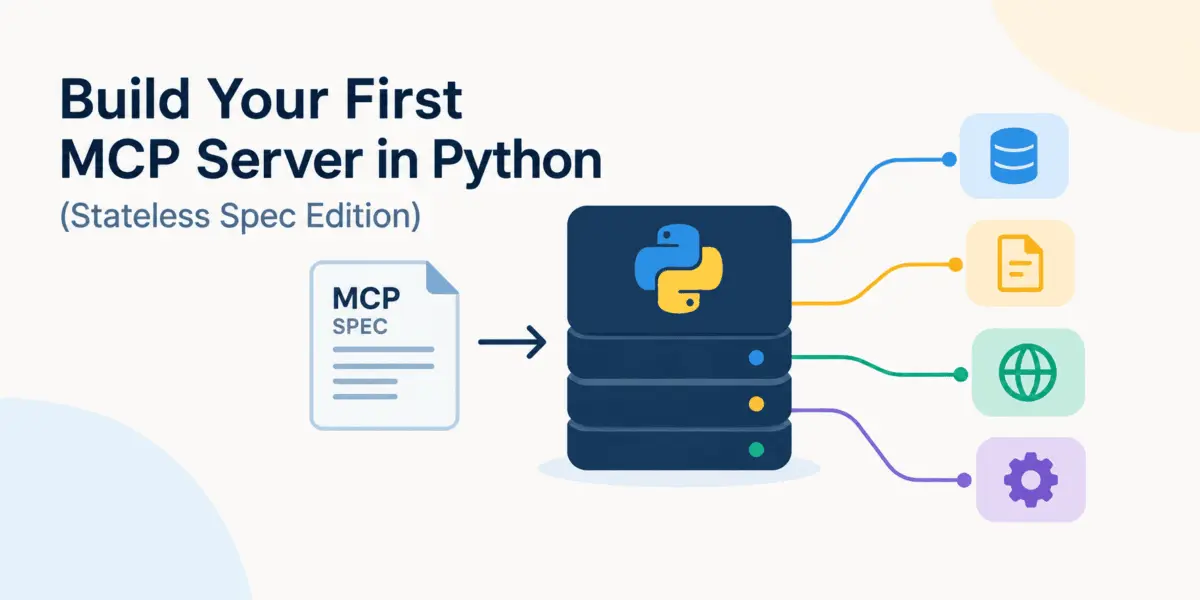
To understand the practical implications of these updates, consider the architecture of a representative developer knowledge-base server. Operating without any user session state, such a server handles incoming requests in a completely self-contained manner, embodying the core design philosophy of the stateless MCP model. An LLM host dispatches an MCP request directly to the Python MCP server, which processes the payload—whether it involves searching a knowledge base, reading an exposed resource, or drafting a support reply—and returns the response without needing to query session memory or maintain sticky routing across distributed workers.
The modern Python SDK, which requires Python 3.10 or newer, integrates smoothly with modern dependency and virtual environment managers like uv as well as standard packaging tools like pip. Creating a project requires minimal setup: developers initialize a workspace and install the core package alongside its command-line interface extras, which supply development utilities and the interactive MCP Inspector workflow. The resulting project structure remains remarkably lean, typically consisting of a server implementation file and a corresponding client verification script, completely bypassing the heavy framework boilerplate often associated with enterprise microservices.
At the heart of the v2 Python SDK is the MCPServer class, which allows developers to instantiate a server instance with a descriptive title and explicit system instructions guiding how the model should utilize the provided capabilities. For standard implementations, this high-level API replaces the lower-level Server class, reserving the latter for advanced edge cases requiring exact control over underlying protocol metadata or custom methods. By supplying sample data structures—such as a collection of support articles covering virtual environments, password resets, and API rate limits—developers can immediately begin exposing functionality to large language models through clean, declarative decorators.
Exposing operational capabilities is handled through distinct MCP primitives, beginning with tools, which represent functions that an autonomous model can decide to execute based on conversational context. By decorating a standard Python function with @mcp.tool(), developers transform a routine lookup procedure into an accessible tool complete with type-safe parameters and documentation. The SDK automatically extracts the input schema directly from the function signature and type annotations, meaning that argument parsers and manual JSON schemas become obsolete. A function parameter with a default value automatically translates to an optional argument in the generated schema, effectively merging standard Python code with the protocol’s interface requirements.
In contrast to tools, which function as dynamic, action-oriented operations comparable to HTTP POST requests, MCP resources provide static or semi-static information that a host application can load directly into context. Resources are addressed via custom Uniform Resource Identifiers, such as a designated knowledge-base URI, and can be read by clients without invoking an autonomous tool call. This behavior mirrors standard GET requests, separating the retrieval of reference data from the execution of active logic. Furthermore, the SDK supports reusable prompt templates through similar decorator patterns, allowing developers to define standardized interaction frameworks that guide the model in generating precise, domain-specific responses, such as drafting technical support replies without hallucinating unsupported product policies.
During the development phase, the SDK’s built-in command-line tools provide an interactive environment for inspecting and testing server functionality. Launching the development workflow spins up a local server instance paired with the MCP Inspector user interface, enabling engineers to view registered tools, examine automatically generated schemas, and execute test queries directly within their browser. Once verified in development mode, the application transitions easily to a production-ready HTTP server using Streamable HTTP. The server exposes its endpoint at a standardized path, and because the underlying framework is built on ASGI standards, it integrates smoothly into larger web applications powered by frameworks like Starlette or FastAPI when utilizing compatible ASGI application factories.
The transition to a stateless protocol core addresses long-standing scaling challenges inherent in older lifecycle models. Previously, protocol interactions relied heavily on persistent sessions tied to specific server instances, frequently necessitating sticky routing configurations or shared session caches to handle multi-round-trip operations. Under the updated specification, each request is entirely self-contained. Load balancers can freely distribute incoming requests across multiple backend workers without concern for session affinity, as no protocol session binds sequential calls together. For applications that genuinely require persistent state—such as shopping baskets or user-specific workflows—the architecture shifts the responsibility of state management entirely to the application layer. By requiring models to pass explicit identifiers, such as a specific basket or session handle, between function calls, developers maintain robust state handling without burdening the underlying communication protocol.
This architectural shift simplifies horizontal scaling across modern containerized environments. Deploying an MCP application across multiple worker processes becomes as simple as scaling a standard web service, as any available worker can successfully process any incoming request. As the artificial intelligence engineering community continues to refine the protocols governing agentic interactions, the combination of a stateless core specification and streamlined SDKs like Python v2 provides a stable, highly scalable foundation for building the next generation of intelligent software systems.