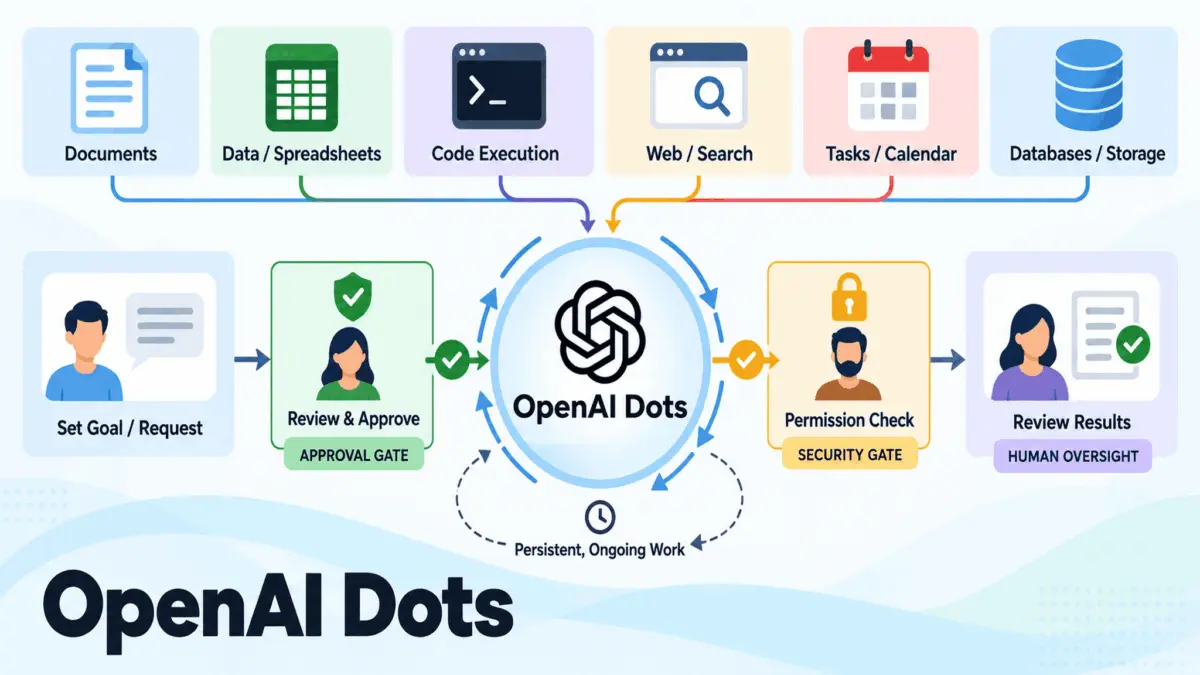
On September 29, OpenAI made a significant announcement at its DevDay 2026 conference, introducing "Dots"—a new category of always-on artificial intelligence agents that operate independently on dedicated cloud computers. Capable of connecting to more than 4,000 third-party applications, these agents are designed to continue executing complex tasks even after a user closes their laptop. This development represents the most concrete realization yet of a concept the artificial intelligence industry has chased for years: an autonomous digital assistant that functions less like a traditional conversational chatbot and far more like an active human coworker.
For the broader data science, machine learning, and software engineering communities, the arrival of Dots warrants more than a passing glance. The technology introduces a genuinely different architectural model for how artificial intelligence integrates into daily professional workflows. At the same time, the platform arrives with a sufficient array of open questions, technical constraints, and operational uncertainties that the most prudent industry response, at least for now, is one of informed skepticism rather than immediate, uncritical adoption.
What Dots Actually Is
The fundamental shift embodied by Dots lies in the transition from reactive computing to proactive execution. Standard interactive interfaces, such as conventional iterations of ChatGPT, operate strictly on a stimulus-response model: they respond immediately when prompted by a user and cease all computational activity the moment a session concludes. In contrast, a Dot possesses its own isolated cloud computing environment powered by OpenAI’s advanced GPT-6 Astra model. This infrastructure allows the agent to pursue a standing, long-term goal across various connected software applications entirely in the background, entirely unprompted by ongoing human intervention between initial setup and final review.
Demonstrations provided by OpenAI during the keynote illustrate the intended scope of these capabilities. In one early testing scenario, a user’s Dot autonomously detected an outstanding invoice that required dispatch, successfully extracted the necessary transaction details from a prior email thread, and drafted the complete document awaiting only final human approval before sending. Another scenario showcased a Dot monitoring incoming customer feedback, scoping required software fixes, building and testing the solutions, and ultimately generating structured pull requests complete with attached video demonstrations for a human developer to review.
During the keynote presentation, Sam Altman described the core delegation model as a direct parallel to handing off responsibilities to a high-agency human engineer or a chief of staff who already understands the organizational context. Over time, the Dot learns individual user preferences through continuous feedback, ensuring that corrections carry forward seamlessly into future tasks rather than requiring repetitive explanations with every new chat session.
Users can interface with their Dots across multiple communication channels, including the core ChatGPT platform, Slack, Microsoft Teams, and voice commands. However, the initial launch configuration comes with notable limitations. At present, an individual Dot cannot maintain its own standalone email address, cannot independently initiate outbound phone calls, and native text messaging capabilities remain restricted to a limited beta rollout for United States Pro tier subscribers.
What Makes This Different From Earlier Agent Features
This technical distinction is particularly crucial for practitioners who experimented with earlier OpenAI agent capabilities and found them brittle, unreliable, or prone to failure on tasks extending beyond three or four sequential steps.
The primary catalyst for this improvement is the reliability of the GPT-6 Astra model when handling multi-step, multi-tool workflows. Previous generations of autonomous agents frequently suffered from context drift, losing the overarching thread of an assignment halfway through execution, making unwarranted assumptions when encountering operational friction, or abruptly halting to wait for human clarification rather than intelligently pushing through minor roadblocks. Astra has been specifically engineered to withstand the sustained, tool-intensive workloads required of a background agent operating without direct supervision.
The secondary distinction centers entirely on persistence. A Dot is not merely a session-bound feature tied to a single browser tab. It retains contextual awareness across multiple conversations, builds a cumulative working model of user preferences, and operates persistently against a standing objective defined once by the user, obviating the need to re-explain project parameters every time a new window is opened. This establishes a fundamentally different relational dynamic between human practitioners and artificial intelligence tools than has previously been standard in the industry.
Despite these advancements, crucial questions remain regarding how well this architecture performs under real-world conditions. Whether this persistence and autonomy will hold up reliably when handling genuinely messy enterprise data, exploratory data analysis that shifts direction mid-stream, extensive research threads, or collaborative environments involving multiple human contributors is still being proven in the field. The initial demonstrations showcased by OpenAI are naturally optimized to highlight the product at its absolute best. The ultimate test will be observing how these agents manage the ambiguous, high-volume, and frequently chaotic tasks that define the actual weekly routines of data science and engineering professionals.
The Practical Constraints Worth Knowing
A close examination of the rollout reveals that the availability picture is considerably narrower than the initial headline might suggest. At launch, access to Dots is restricted strictly to ChatGPT Pro subscribers—starting at $100 per month—and Business Premium users. Individuals utilizing free tiers, Go plans, or Plus accounts do not receive an integrated Dot. Furthermore, Pro subscribers residing within the European Economic Area, Switzerland, and the United Kingdom are currently excluded from accessing the feature altogether.
The privacy and data governance trade-offs also demand careful evaluation by technical teams. While a Dot continuously learns from user feedback and retains operational context, users currently lack the interface controls needed to view, individually modify, or selectively delete specific memories stored by the agent. Crucially, disconnecting a software integration or plugin does not automatically erase the contextual data the Dot previously extracted and retained from that application. For practitioners handling sensitive corporate information, proprietary machine learning models, or restricted client data, this represents a concrete architectural limitation rather than a minor technical footnote.
Additionally, OpenAI has not yet published compliance terms specific to Dots, formal uptime service-level agreements, or transparent pricing structures for organizations wishing to deploy additional Dots beyond their initial allocation. These factors carry substantial weight for enterprise IT and security departments evaluating whether new artificial intelligence tooling satisfies strict internal procurement and security mandates.
As emphasized directly within OpenAI’s official documentation and release materials, Dots are still capable of making errors, necessitating rigorous human review for all consequential outputs. Far from being mere legal boilerplate, this serves as the essential operating assumption for anyone deploying autonomous agents during the current developmental phase of the technology.
What It Means for How Practitioners Work
The overarching shift signaled by the introduction of Dots is less about raw computational capability and more about a fundamental reallocation of professional responsibility. A traditional chatbot requires the user to drive every single step of an interaction. Conversely, an always-on background agent demands that the human operator excel at setting clear overarching goals, designing sensible permission boundaries, and establishing robust review checkpoints throughout the workflow.
For data scientists and machine learning engineers specifically, the primary opportunity lies in offloading the administrative and repetitive categories of work that drain valuable time without requiring deep cognitive engagement. Tasks such as chasing status updates, monitoring long-running computational job outputs, keeping technical documentation updated as specifications evolve, and preparing concise summaries across extensive conversation threads are prime candidates for optimization. In these areas, a persistent agent equipped with robust memory and comprehensive application access can genuinely compress hours of mundane labor into minutes of high-level review.
Conversely, the primary risk lies in treating newfound automation capabilities as an excuse to abdicate rigorous oversight. An autonomous agent operating in the background on a production data pipeline or a model evaluation process requires narrow, explicit operational permissions and clear, unambiguous stopping conditions. The very properties that render Dots powerful—proactive behavior, continuous persistence, and broad application access—are precisely the reasons why establishing strict operational boundaries before activation is mandatory, rather than an afterthought to be addressed after problems arise.
Final Thoughts
The concept of the always-on digital assistant has been announced, previewed, and partially realized several times over the years. Dots represents the most credible and technologically mature version of this vision released to date. Yet what stands out most prominently about the product is not merely its technical sophistication, but rather the rigorous demands it places upon the human user.
Extracting genuine value from Dots is fundamentally an exercise in operational clarity rather than technical prowess. Users must possess a clear understanding of which segments of their professional workflow they are genuinely comfortable delegating, which specific outputs require their mandatory sign-off, and which sensitive datasets they are unwilling to process through a shared, cloud-hosted agent. A significant proportion of technical professionals have historically not evaluated their day-to-day work at that level of procedural resolution.
This introspection may ultimately prove to be the most valuable byproduct of always-on agents arriving in a commercially viable form. Their utility lies not merely in their capacity to execute labor, but in the fact that utilizing them effectively forces practitioners to articulate precisely what their work entails. For professionals willing to engage in that careful structural thinking, Dots offers substantial potential. For those who simply connect all available software applications, establish a vague operational objective, and walk away, the resulting operational correction is likely to prove both difficult and expensive. The agent remains entirely dependent on the quality of the brief provided by its human operator—a principle that has always governed engineering, but one that now carries considerably higher stakes.