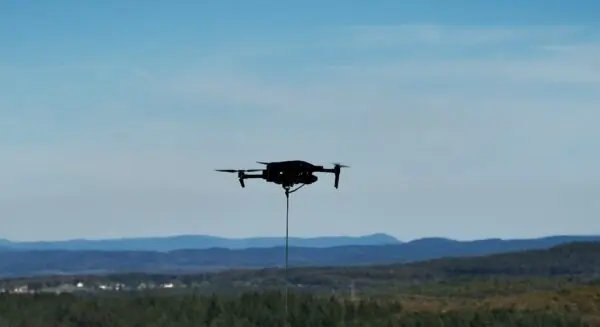
The push to expand unmanned aircraft operations into harsh northern climates has driven a critical advancement in aerospace testing at the University of Alaska Fairbanks. The Alaska Center for Unmanned Aircraft Systems Integration (ACUASI) is tackling one of the most persistent and hazardous challenges in cold-weather aviation through a specialized facility known as the Supercooled Water Experimental Arctic Tower, or SWEAT.
Operating under the umbrella of the UAF Geophysical Institute, the facility opened in early 2025 to give researchers, industry partners, and engineering students a purpose-built environment to study how ice accumulation alters drone performance, control, and lift. While ACUASI continues to push operational boundaries—such as flying human blood samples 1,000 kilometers from its Nenana base for the International Testing Agency—its work on the ground in Fairbanks is laying the technical foundation for reliable winter flight.
Mike Hatfield, associate professor of electrical and computer engineering and associate director for education at ACUASI, emphasized the seamless blending of academic instruction and active research happening at the university.
"We are integrating academics, research and operations so that the students are working in all three of those domains," Hatfield said. "And with ACUASI, it’s pretty natural."
Hatfield led the creation of the UAF aerospace engineering degree program, which is currently entering its fourth academic year. The program offers students four distinct tracks to specialize in: aeronautics, unmanned aircraft systems, space systems and astrodynamics, and a robotics track that launched in 2026. Students enrolled in the aeronautics and unmanned aircraft systems pathways work directly with the ice tower, gaining hands-on exposure to real-world engineering obstacles.
"The ice tower supports aircraft icing, which happens to be an interesting aspect of drone operations," Hatfield noted. "We have to consider icing up here in the Arctic. We’ve got a lot of drone operations, and we’re looking to do advanced air cargo flights."
Why Drone Icing Research Matters
The physical mechanisms of aircraft icing present severe hazards to aviation, but unmanned aerial systems face unique vulnerabilities compared to traditional manned aircraft. Supercooled liquid water droplets—water that remains liquid even at temperatures below freezing—can instantly turn to ice upon contacting the leading edges of wings, rotor blades, or control surfaces.
This rapid ice accretion disrupts smooth airflow across the airframe, drastically reducing lift and complicating stabilization and control. Because drones are significantly smaller than commercial or general aviation aircraft, even a modest layer of ice can fundamentally degrade aerodynamic performance and overwhelm the aircraft’s power margins. By comparison, a conventional airplane cruising at high altitudes like 20,000 feet encounters drier air, making it far less likely for liquid water to freeze instantaneously before being blown clear of the structure.
Federal Aviation Administration icing standards further differentiate between the smaller cloud droplets commonly found in standard winter weather and the larger supercooled drops associated with freezing drizzle and freezing rain. These larger drops present a severe hazard because they can shatter, splash, or spread widely upon impact. This behavior allows liquid water to migrate across aerodynamic surfaces into unheated or unprotected areas before finally freezing, threatening critical components that are difficult to shield.
Eyal Saiet, lead ice tower researcher at ACUASI, pointed out that while cold-weather battery degradation has historically dominated winter drone research, structural icing remains a deeply complex and less understood obstacle.
"Batteries failing in cold temperatures is a well-argued and researched topic, but ice accretion on drones is another challenge that is difficult to test and encompasses drones, airplanes and helicopters," Saiet said. "Icing is a real problem."
Inside the SWEAT Ice Tower
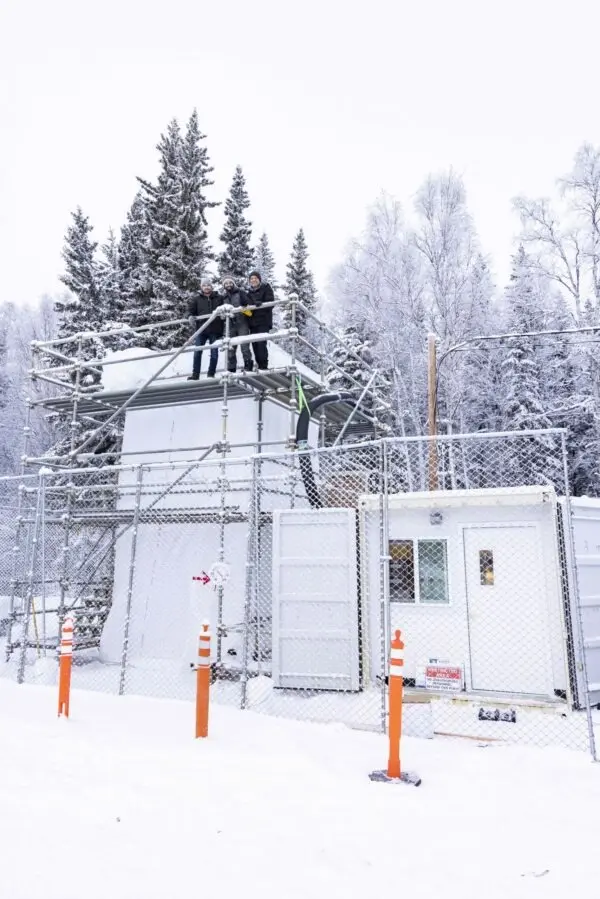
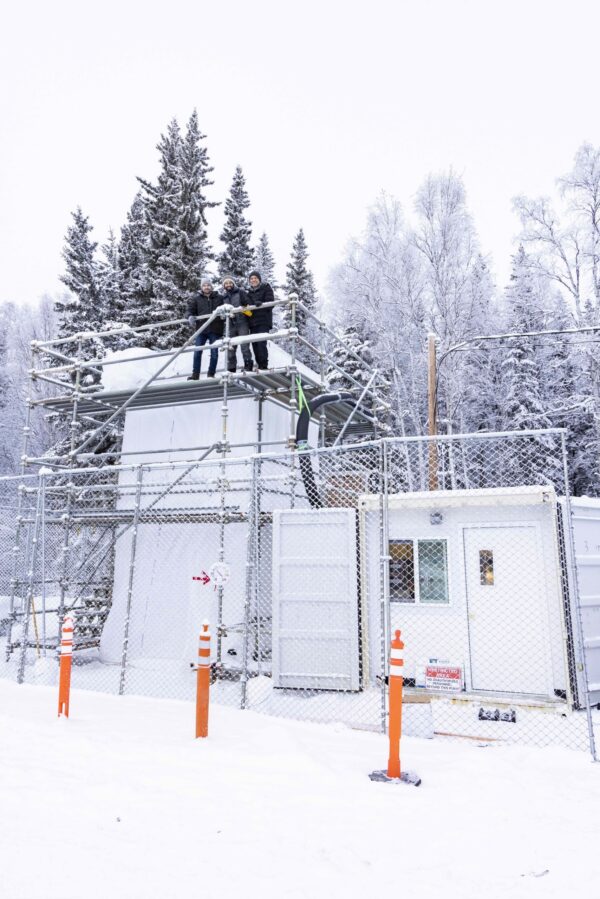
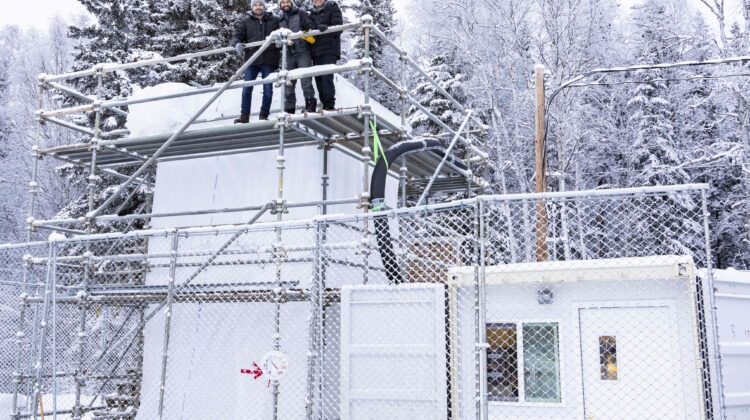
Standing roughly 16 feet, or 4.9 meters, tall within a secure, fenced compound situated directly behind the UAF Reichardt Building, the SWEAT facility operates on principles similar to a vertical wind tunnel. It is engineered to generate precise, calibrated icing conditions, allowing researchers to fly drones in a controlled atmosphere that accurately replicates adverse weather scenarios.
While the tower currently lacks a horizontal wind component to simulate forward flight drafts for fixed-wing aircraft, it provides a stable vertical column for testing rotorcraft and hovering dynamics. Saiet, who spearheaded the development and construction of the tower, envisions a broader future for the installation. He hopes to expand its capabilities to accommodate fixed-wing aircraft testing in the near future.
"I would like to see us become an aerospace icing complex," Saiet said.
This expansion carries significant weight as the state of Alaska accelerates its reliance on unmanned aircraft to serve remote, isolated communities, deliver vital supplies, and execute emergency response missions during severe weather events. Beyond academic and governmental applications, the facility has attracted substantial interest from commercial entities seeking to validate their technology before deploying it in the field.
"We have customers asking about it," Saiet said. "A drone cargo company is investigating icing, because they want their drones to be able to deliver in icing conditions when the roads are bad and nobody wants to drive."
Testing Anti-Icing Coatings
The practical applications of the tower extend deeply into graduate-level research. Doctoral student Morakinyo Labiran focuses his academic work on discovering and refining methods to inhibit ice buildup on both fixed-wing and rotary-wing unmanned systems. In 2025, Labiran led a dedicated research team that utilized the ice tower to conduct both stationary and active flight tests on experimental, laboratory-formulated anti-icing coatings. The team analyzed how these chemical and material solutions affected total freezing time and preserved overall aerodynamic efficiency.
"The ice tower enabled us to make several tests, providing enough data to measure the effectiveness of these solutions," Labiran said. "The tower’s 16-foot height provides space for hovering and observing how its flight dynamics change in real time."
Labiran, who earned his foundational mechanical engineering degrees from the Federal University of Technology, Akure and the University of Ibadan in Nigeria, credits his advisor, UAF associate professor of mechanical engineering Miracle Oyewola, with drawing him into the specialized field of aerospace icing. Like many engineers new to the problem, Labiran initially assumed the solution was straightforward.
"My first thought was that it would be easy—just find a means to heat up the surface," Labiran reflected. "It required more critical thinking due to the drone’s limited power capacity, its material properties and the complexity of the ice adhesion process."
As ACUASI continues to refine its testing methodologies and expand the capabilities of the Supercooled Water Experimental Arctic Tower, the facility remains a critical asset for both the university and the broader aerospace industry. By uniting rigorous academic training with practical, real-world operational challenges, UAF is helping clear the path for safe, reliable drone integration across the Arctic and beyond.