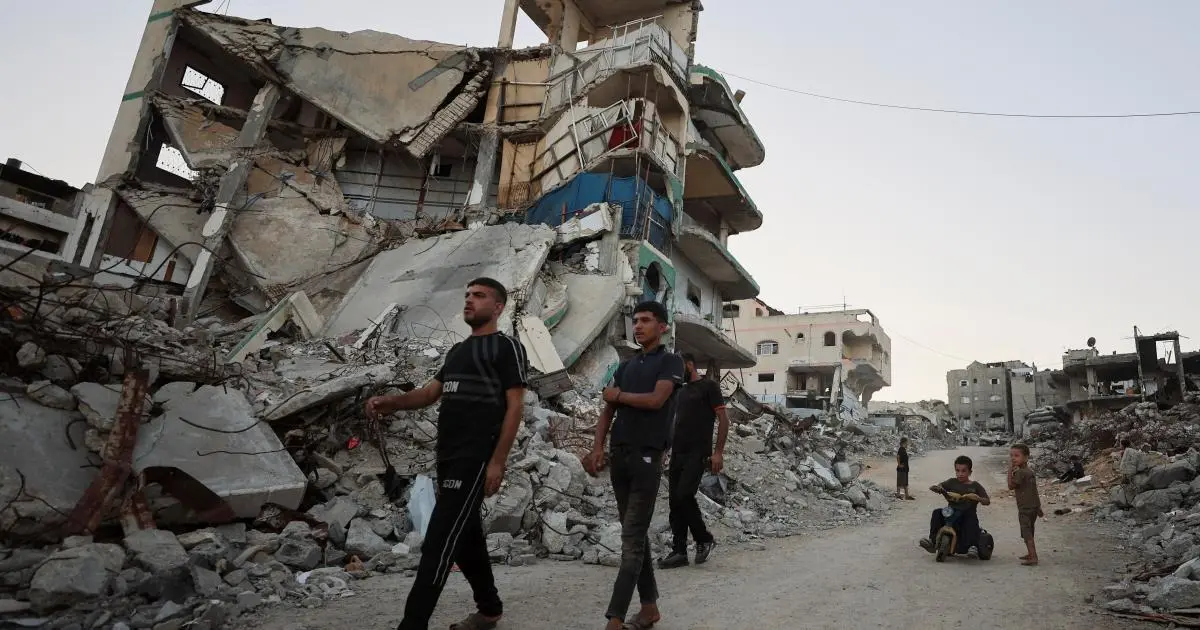
In September 2025, U.S. President Donald Trump unveiled an ambitious peace plan aimed at ending the devastating war in Gaza, vowing that it would not only rebuild the ruined territory but also usher in an era of "eternal peace in the Middle East." Yet, a full year later, that vision has largely stalled. Hamas has not disarmed, and Israeli forces continue to maintain control over more than 60 percent of the Gaza Strip. The promised technocratic government and international security force have failed to materialize, while large-scale reconstruction has barely begun, leaving most Gazans to struggle daily for basic necessities such as food, clean water, and shelter.
As Israel’s upcoming October election approaches, Prime Minister Benjamin Netanyahu has taken an increasingly hard-line stance, explicitly rejecting a U.S.-backed disarmament deal. Although the 25-country Board of Peace—the international mechanism established by the Trump administration to implement the peace framework—announced a more detailed reconstruction program recently, high-level officials have disclosed to the Times of Israel and other media outlets that the group has temporarily halted pressure on Netanyahu to comply with the plan, largely due to the impending domestic vote.
This uncompromising posture strongly appeals to the majority of the Israeli public, who largely believe that Palestinians harbor no genuine interest in negotiations or diplomacy. Consecutive public opinion surveys in Israel have consistently shown that the overwhelming majority of citizens feel Palestinians reject the very idea of peace, leaving Israel without a credible negotiating partner. For instance, a Tel Aviv University poll conducted in July asked Jewish Israelis what they believed Palestinians wanted, with 72 percent responding that Palestinians were moderately or very opposed to any peace negotiations, and over 80 percent stating they believed no peaceful resolution with Israel was achievable.
However, this pervasive perception stands in stark contrast to what most Palestinians actually believe and are prepared to accept. For two decades, Arab Barometer—a comprehensive survey project co-managed by the authors—has tracked public opinion across the West Bank and Gaza. The most recent comprehensive poll, conducted in October 2025, revealed that a majority of Palestinians view diplomatic negotiations, rather than armed resistance, as the most effective path to finally resolving the Israeli-Palestinian conflict. These findings remain consistent with subsequent data gathered in August by the Ramallah-based Palestinian Center for Policy and Survey Research (PCPSR), an Arab Barometer partner.
In truth, a significant share of the Palestinian population holds a clear and pragmatic vision for the future. Support for a two-state solution outpaces any other proposed resolution. Intriguingly, despite bearing the heaviest burden of destruction over the past three years, Gazans tend to be the most pragmatic: an even greater percentage of residents in the strip support a two-state solution compared to Palestinians living in the West Bank. Furthermore, half of all Gazans indicate they would back Arab states normalizing diplomatic ties with Israel, provided the diplomatic process includes tangible, meaningful steps toward Palestinian self-determination. At the same time, public confidence in both Hamas and the Palestinian Authority (PA) has plummeted to historic lows, as citizens feel neither faction has successfully protected their safety or improved their standard of living. Strikingly, despite these grim conditions, the vast majority of Gazans express a deep desire to remain in their homeland to help rebuild rather than emigrate.
The immediate humanitarian and security outlook for Palestinians remains exceptionally dire. Conditions in the West Bank are rapidly deteriorating, and while the regional status quo is clearly unsustainable with no end to the broader conflict in sight, the public’s own perspectives provide critical insights and potential pathways forward. If a newly elected Israeli government and international donors were to embrace a political transition centered on Palestinian statehood and genuine security governance, the polling data suggests that Gazans and West Bank residents alike are ready to compromise and engage in building a new political order.
Palestinian Realism
The depth of the crisis was laid bare in the October 2025 Arab Barometer survey, which captured the severe security, economic, and humanitarian emergencies unfolding across both Gaza and the West Bank. The survey involved face-to-face interviews with 855 individuals across Gaza—conducted inside homes, shelters, and makeshift camps—and 800 individuals in the West Bank. Fieldwork began on the exact day a formal cease-fire was announced in Gaza, offering a crucial baseline regarding the massive hurdles facing reconstruction. Because of the survey’s timing, certain questions concerning domestic politics normally asked across the Middle East were omitted in Gaza to prioritize urgent inquiries into immediate humanitarian survival needs. With limited aid entering the territory and the Board of Peace failing to advance beyond the initial cease-fire phase, the magnitude of the challenge has persisted largely unchanged.
The survey underscored the catastrophic toll of the conflict: 85 percent of Gazans reported being displaced at least once since early October 2023, with 70 percent of those displaced having been uprooted three or more times. Additionally, 61 percent of households stated that at least one family member had lost their job because of the war. Fewer than half reported having eaten every day over the preceding week, and more than one in five had gone without food for all or most of the past seven days. Educational systems have also been severely crippled; among households with school-age children, 31 percent reported that none of their children currently had access to education. Essential infrastructure remains critically damaged, with only nine percent of Gazans enjoying access to electricity and just six percent having access to fuel or cooking gas. The UN Office for the Coordination of Humanitarian Affairs noted a near-total absence of reliable electricity, forcing many residents to burn trash simply to cook basic meals.
In the West Bank, residents experienced less physical destruction of basic services but faced a sharp decline in overall security. Only 58 percent of West Bank Palestinians described their neighborhoods as safe, marking a 16-point drop from October 2023. Two-thirds rated the PA’s security provision as bad or very bad, and nearly a quarter of respondents reported considering emigration. When asked why they wanted to leave, 38 percent cited security concerns, 37 percent cited political factors, and 71 percent pointed to economic despair—contrasting sharply with typical migration patterns in other surveyed countries where economic motivations usually predominate.
Economic hardship in the West Bank has deepened dramatically. Fully 92 percent of respondents described the local economic situation as bad or very bad, a 21-point surge over a two-year period. Hunger has also emerged as a pressing domestic issue: 51 percent of West Bank residents agreed that food they purchased ran out without money to buy more over the prior month, and 41 percent admitted to skipping meals due to a lack of resources during the previous year.
Despite these harrowing circumstances, Gazans have not succumbed to fatalism. A clear majority stated that they would not leave Gaza right now even if they had the opportunity. The 41 percent of Gazans who expressed a willingness to leave if given the chance is comparable to emigration sentiment recorded in far more stable and peaceful societies, such as Jordan and Tunisia, during the same period. Despite living through unimaginable devastation, the vast majority of Gazans remain determined to stay and reconstruct their homeland.
One might naturally assume that the staggering scale of destruction in Gaza and mounting settler violence in the West Bank would erode public support for a negotiated diplomatic settlement. Yet, polling data shows the opposite. When West Bank respondents were asked to choose their preferred solution to the conflict, 56 percent selected a two-state solution—a seven-point increase from 2023. In Gaza, support for two states rose even more dramatically over the two-year war, climbing from 54 percent in October 2023 to 64 percent in October 2025. Simultaneously, support for a confederation grew by ten points in Gaza to reach 20 percent, while backing for a single-state solution dropped to five percent, and support for armed resistance models fell sharply from 20 percent to seven percent.
This renewed commitment to a negotiated settlement was particularly pronounced among younger Palestinians. While individuals aged 18 to 29 were previously less inclined to favor a two-state solution than older demographics, by late 2025 that generational gap had vanished. Among young Palestinians, backing for armed resistance or alternative violent avenues was cut in half, dropping to 14 percent.
Subsequent polling confirms the resilience of these attitudes. An early August survey of 440 Gazans conducted by the PCPSR found that 61 percent preferred a two-state solution based on 1967 borders over other arrangements, while 65 percent agreed that armed resistance had ultimately failed to protect Palestinians and had instead generated catastrophic destruction.
Furthermore, Gazans display notable pragmatism regarding regional diplomacy. While general public opposition to normalization with Israel remains high across the occupied territories, nearly one in five Gazans expressed support for normalization in the October 2025 survey—up from ten percent in 2023. When asked if they would support Arab-Israeli normalization provided it was directly linked to the establishment of an independent Palestinian state, half of all Gazans and over a quarter of West Bank residents answered in the affirmative. The data demonstrates clearly that a majority of Palestinians prioritize national independence and peace over cycles of revenge.
Out With the Old
Palestinians are increasingly unified in the conviction that their traditional political leadership has failed them entirely. For decades, Palestinian politics have been dominated by Fatah, which controls the PA, and Hamas. Observers frequently assumed that a decline in popularity for one faction automatically translated into gains for the other. However, current data indicates that most Palestinians have grown disillusioned with both entities.
In the October 2025 Arab Barometer survey, when West Bank residents were asked which political party they felt closest to, 24 percent named Hamas and 18 percent named Fatah, while a striking 51 percent selected no party, answered that they did not know, or refused to respond. Confidence in the PA’s governance stood at a meager 23 percent, showing virtually no improvement from 2023, while trust in PA President Mahmoud Abbas slumped to just 19 percent.
In Gaza, similar sentiment prevailed, with only about a third of residents expressing confidence in the territory’s remaining Hamas-led governance, mirroring figures from 2023 and confirming that the October 7 attacks and subsequent war did not translate into long-term political backing for the militant group. When presented with a hypothetical legislative ballot featuring the factions that ran in the 2006 elections, 55 percent of Palestinians across both territories stated they would either vote for no established party or abstain entirely. The largest political bloc in Palestinian society is not Fatah or Hamas; it is the politically alienated.
Meanwhile, alternative political figures command significant attention. The August PCPSR survey revealed that nearly 40 percent of Palestinians favor Marwan Barghouti—a prominent leader of the first intifada imprisoned by Israel since 2002—as their preferred presidential candidate, doubling the support of any rival figure, though Israeli authorities have consistently refused to release him in prisoner exchanges amid reports of his deteriorating health.
Regarding governance models, public opinion reflects a complex desire for administrative competence combined with democratic principles. While support for democracy as the best system of governance remained high at 77 percent in the West Bank, backing for a strong leader who bends the rules to achieve results rose by ten points to 51 percent. Two-thirds of respondents agreed that economic stability matters more than the specific form of government, highlighting a deep political exhaustion and vulnerability rather than an outright rejection of democratic values.
The Right Plan
The stated preferences of the Palestinian public offer clear guidelines for any international strategy aiming to end the conflict and rebuild the territories. Simply attempting to insert the corrupt and delegitimized PA back into Gaza without deep structural reform risks repeating past mistakes, particularly given the perception that the PA often functioned as an arm of the occupation rather than an authentic representative body. Similarly, proposals predicated on the mass displacement of Gazans, such as plans floated by hard-line Israeli ministers, ignore the fundamental reality that Gazans wish to remain and rebuild their homeland on their own terms.
Crucially, the future of Gaza cannot be separated from the West Bank. Efforts to stabilize the strip will face insurmountable barriers if settlement expansion and settler violence continue unchecked in the West Bank. Furthermore, Palestinians insist that any near-term diplomatic solution must provide a credible, irreversible pathway toward independent statehood rather than treating statehood as a distant, uncertain reward at the end of a protracted process.
Ultimately, public opinion data challenges the narrative that Palestinian politics are rigidly ideological, driven by revenge, or fundamentally opposed to peaceful coexistence. The primary obstacles to a diplomatic resolution now emanate largely from political dynamics within Israel, where polls indicate that a vast majority of Jewish Israelis reject the creation of a Palestinian state under any circumstances, often underpinned by the belief that Palestinians have no interest in compromise.
With humanitarian crises deepening daily in Gaza and displacement accelerating across the West Bank through military-backed settler actions, time is critically short. The resilience of the Palestinian public’s commitment to a two-state solution, despite enduring immense suffering, highlights the persistent existence of a potential partner for peace. Whether that partnership can be realized depends heavily on upcoming political developments, starting with the trajectory of Israel’s approaching national elections.