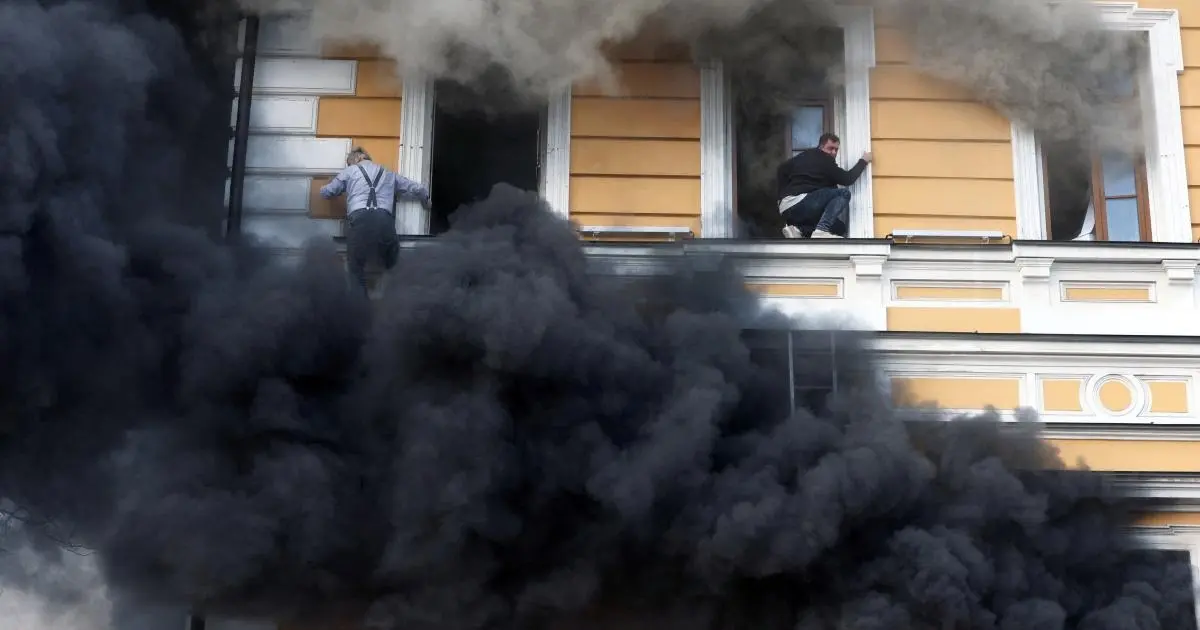
Since the beginning of July, the skies above Kyiv have transformed into a relentless theater of war. Russian drones and missiles have been terrorizing the Ukrainian capital with exceptional intensity, plunging its residents into a continuous cycle of fear and endurance. Air raid sirens blare day and night, warning the population of oncoming fire and sending citizens rushing underground for shelter. While many of the incoming drones are successfully intercepted and shot down, a significant number still bypass defenses. More critically, ballistic missiles have largely managed to penetrate the city’s shield, destroying residential and commercial buildings and taking a steady toll on civilian lives. By late autumn, roughly 100 lives had been claimed by these specific barrages.
The bombardments have become so severe and inescapable that a grim joke has begun circulating among Ukrainians on Instagram and TikTok: “Thank God I live in Kyiv, so I do not have to plan for the future.”
Having endured nearly five years of all-out war, the people of Kyiv are well-accustomed to hardship and deprivation. Yet, this particular brand of fatalistic pessimism is entirely new. For the first half of 2026, observers and analysts had been celebrating what felt like a genuine turning point in the conflict. Following a grueling year of incremental Russian progress, Ukraine successfully adapted its military tactics, mastering precise middle- and long-range strikes. This newfound capability allowed Ukrainian forces to strike Russian military targets deep behind the front lines, effectively halting Moscow’s momentum.
At the time, the Russian military was already suffering unsustainable troop losses, and these deep strikes pushed casualty rates to levels that seemed impossible for the Kremlin to absorb indefinitely. Many military analysts began to speculate that Moscow would soon be forced to seek a negotiated settlement.
However, Ukraine’s technological and tactical advancements ultimately failed to deliver a decisive victory. This summer, Russia dramatically escalated its campaign, sharply increasing its reliance on ballistic missiles and deploying fast, long-range, jet-powered drones at an unprecedented scale. Simultaneously, Moscow widened its targeting strategy. While the Russian military previously concentrated the vast majority of its firepower on cities and towns directly adjacent to the front lines—particularly in Ukraine’s eastern Donbas region—it has now initiated a campaign of mass bombings targeting interior population centers. Kyiv has borne the heaviest brunt of this shift, but the strikes have also reached deep into Ukraine’s western borderlands.
Together, these strategic adjustments signal a fundamental evolution in Russia’s theory of victory. Moscow no longer harbors realistic expectations of winning the war merely by capturing physical cities or by focusing solely on the gradual degradation of Ukraine’s energy grid. Instead, the Kremlin’s objective is to systematically disrupt the entirety of the Ukrainian economy and fracture the morale of the population by terrorizing urban centers nationwide. By making daily life inside major cities intolerable, Moscow hopes to trigger mass exoduses of residents and businesses while severing vital logistical connections between metropolitan hubs. The underlying calculation in the Kremlin is that this relentless pressure will eventually turn ordinary Ukrainians bitterly angry at their own government for failing to protect them, thereby eroding the nation’s globally admired internal cohesion and resolve.
There remains no absolute guarantee that this brutal strategy will succeed. Ukraine is a geographically large, decentralized nation that possesses a degree of societal capability and resilience far exceeding the estimates of even its staunchest international supporters. Nevertheless, the Ukrainian economy is currently navigating severe straits, and the national government is grappling with widening budget shortfalls that urgently require external financial intervention to bridge. Moscow is actively betting that this vital foreign assistance will not arrive in a timely manner. The Kremlin calculates that the financial and political price Washington and European capitals are willing to pay to support Kyiv remains strictly limited, whereas the price Russia is prepared to pay to achieve the conquest of Ukraine is effectively boundless. Consequently, Russia’s primary target is not merely Ukrainian territory or physical infrastructure, but rather the collective will of the Ukrainian people and their international partners.
Holding On for Dear Life
No one in Ukraine has ever been entirely safe from the devastating consequences of Russia’s unprovoked invasion. Citizens from every city, town, and region have stepped forward to fight and die in defense of their state. Commercial stores everywhere suffer from persistent shortages, and the national economy has experienced a profound contraction. Even so, the hardships of the invasion have not affected every corner of the country equally. Residents living in close proximity to the active front lines have long faced constant bombardments and the immediate, terrifying threat of enemy occupation, whereas those situated in the rear areas could, at times, manage to tune out the distant conflict.
That reality is shifting rapidly now that Russia is deliberately targeting locations far removed from the immediate battlefield. In Kyiv, for instance, residents were once accustomed to dealing with a modest handful of drone and missile barrages each week—events that were undeniably disruptive, but rarely enough to stop ordinary urban life from continuing. Today, Russia continuously launches projectiles toward the capital around the clock. On August 27, Kyiv registered a record-breaking 13 separate air raid alerts in a single day. On the night of September 8, a single continuous alert stretched for ten grueling hours, lasting from 7:39 PM until 5:40 AM the following morning. Two weeks later, the pattern remained unchanged, with Kyiv logging 11 alerts on September 23 and another nine-hour alert the very next morning. Where residents once went to sleep expecting a sporadic overnight attack knowing a normal workday would follow, they now exist in a perpetual state of sirens and operational chaos.
While Kyiv has absorbed the brunt of Moscow’s intensified aerial campaign, these terror tactics are increasingly striking other previously protected urban centers as well. On the night of July 30, Russian forces fired more than 20 cruise missiles at Lviv, a historic city located just 45 miles from the Polish border. The strike killed a 35-year-old police officer and injured 38 other people. By mid-September, long-range drones penetrated as far west as Lutsk, setting a passenger railway carriage ablaze. Similar attacks have targeted Ivano-Frankivsk, Ternopil, and Stryi across Ukraine’s interior. Simultaneously, Russian forces are systematically targeting critical economic nodes, destroying commercial warehouses, vital pharmaceutical distribution centers, and data centers responsible for maintaining internet connectivity. Officials warn it is only a matter of time before strikes threaten the infrastructure keeping municipal sewage systems operational.
This relentless terror from the skies has profoundly exhausted Ukrainian society. Ordinary workers are performing daily miracles to keep the national economy functioning amidst increasingly harsh conditions, earning rightful admiration from around the globe. Yet, it is crucial to recognize that Ukrainians remain steadfast primarily because they know that capitulation would make their lives infinitely worse—a reality starkly illustrated by Russia’s brutal conduct in territories it currently occupies. Even so, there is a limit to human endurance, and no one can definitively predict where the breaking point for society might lie.
A Friend in Need
To avert a catastrophic domestic collapse, the Ukrainian government must implement several concrete, decisive measures without delay. First, the national parliament is required to expeditiously pass difficult legislation designed to unlock pledged international funds. These legislative actions typically entail unpopular domestic measures, such as higher tariffs and increased taxation. International lenders, for instance, are demanding that Kyiv eliminate the tax advantages long enjoyed by low-value imports from foreign online marketplaces by applying a standard value-added tax to commercial parcels—primarily originating from China—valued at less than 150 euros, or roughly $170. Imposing such financial burdens on a population that is growing increasingly impoverished under the immense pressure of war is profoundly unpopular, leading lawmakers to frequently delay implementation. Yet the current geopolitical and economic situation is far too perilous to tolerate further hesitation.
Concurrently, the government must enhance public procurement practices, particularly within the sensitive security and defense sectors. While the challenges facing this system—such as prepaid contracts that sit unfulfilled for months—are not systemic failures, Ukraine simply cannot afford costly errors. The state must vigorously root out independent corruption schemes, such as a major kickback scandal uncovered at the state nuclear operator in November 2025. Although unrelated to direct defense spending, such scandals threaten to undermine public and international trust. While the National Anticorruption Bureau and the Specialized Anticorruption Prosecutor’s Office have made commendable progress in pursuing corrupt officials and proving that no one in Ukraine is immune to prosecution, the government must continue taking aggressive steps to curtail graft.
Even with sweeping internal reforms, however, there is a hard ceiling on what Ukraine can achieve entirely on its own. No amount of domestic restructuring can close the yawning financial deficit facing the state. The Ukrainian government estimates that as of September 2026, it will require $52 billion in external financing throughout 2027 to meet its baseline national needs, of which only $20 billion is currently guaranteed by international partners.
Traditionally, the United States and European nations have assisted Kyiv in meeting these budgetary requirements through a combination of grants and loans. However, Washington has signaled that it will no longer provide direct financial support to Kyiv. While the European Union has budgeted roughly $100 billion in assistance for the 2026-2027 period, Brussels remains reluctant to earmark additional funds as its own member states grapple with severe domestic financial and political pressures.
The most obvious, viable solution to this funding crisis would be for the EU to transfer Russia’s frozen sovereign assets—amounting to approximately $300 billion—directly to Kyiv. While EU members generally support empowering Ukraine with these funds, the vast majority of the reserves are locked within Euroclear, a securities depository based in Belgium. Brussels harbors deep legal concerns that handing over the assets could trigger protracted international court battles that eventually force the bloc to reimburse Moscow. Furthermore, the European Central Bank and Belgian authorities worry that confiscating Russian reserves could permanently damage the standing of the euro and undermine Belgium’s hard-earned reputation as a secure financial haven. Meanwhile, Washington prefers that the assets remain frozen to preserve them as future diplomatic leverage against Moscow.
If European states find themselves unable to cover Ukraine’s financial needs independently, they will ultimately need to brush aside U.S. hesitation and reassure Belgium by jointly underwriting any potential legal exposure. Even if European capitals decide to dig deeper into their own pockets, the fundamental choice between financing Ukraine through domestic taxpayer funds or tapping frozen Russian wealth should be straightforward.
Furthermore, the EU must overcome its longstanding institutional taboo against utilizing collective funds to cover the salaries of Ukrainian service members. Although European financial assistance currently allows Kyiv to purchase various military hardware, the continent has historically deemed it unacceptable to subsidize personnel costs. This restriction defies logic from a strategic perspective, as there is no valid moral distinction between paying for the physical ammunition and paying the soldiers who fire it. For Kyiv, however, maintaining military payrolls represents its most essential and expensive obligation, projected to consume roughly $35 billion this year alone. This expenditure creates immense fiscal stress for Ukrainian officials and drains a massive share of domestic tax revenues. If external sources were to underwrite even a portion of these personnel costs, Kyiv would gain crucial budgetary certainty, allowing it to redirect domestic resources toward shoring up the wider national economy.
Europe must also expand its efforts to bolster domestic Ukrainian weapons production, though this aid requires better strategic calibration. Current discussions surrounding military supplies frequently focus narrowly on providing additional missile and drone interceptors. While robust air defense is unquestionably essential, relying solely on interceptors is mathematically unsustainable over the long term. The United States stockpile of Patriot interceptors, for instance, is running critically low, with domestic production capped at approximately 840 units per year—a total that must be carefully divided among the U.S. military and all global allies. In stark contrast, Russia manufactures more than 1,200 new ballistic and quasi-ballistic missiles annually, a domestic output further supplemented by shipments from North Korea.
In time, Ukrainian engineers will likely develop domestic air defense solutions that can be manufactured much more quickly and cheaply than existing Western systems, echoing their successes in pioneering cutting-edge attack drones. Until those capabilities mature, however, Kyiv must be empowered to preemptively stop Moscow’s aerial campaigns at the source. This requires striking Russian manufacturing facilities, launch infrastructure, and logistical supply lines. Western capitals could immediately facilitate this by supplying Kyiv with advanced long-range weapons systems and lifting all political and technical restrictions regarding their operational use. Maintaining these artificial limits does not reflect strategic prudence; instead, it grants Moscow’s interior a protected sanctuary and reinforces Russian President Vladimir Putin’s conviction that he can prosecute the war indefinitely without facing additional consequences.
Mutual Aid
Many Western officials fully understand the specific requirements necessary for Ukraine to prevail. Yet, nearly five years into the conflict, signs of fatigue and frustration regarding the ongoing commitment to Kyiv have surfaced among some political leaders. Certain figures, including U.S. President Donald Trump, have voiced opposition to increasing pressure on Putin, expressing a desire to pursue a negotiated diplomatic arrangement through direct engagement.
Nevertheless, political reality dictates that traditional diplomacy alone cannot halt the conflict. Even if Kyiv were pressured into ceding the remaining portions of the Donbas region currently under its control—a persistent demand from Moscow—the Kremlin’s territorial ambitions would remain unsatisfied. For years, Putin has demonstrated an ideological commitment to the total subjugation of Ukraine, launching repeated assaults aimed at securing total control over the nation. By fundamentally restructuring the Russian economy and political system around the war effort—channeling vast capital investments into weapons manufacturing and elevating prominent hawks to senior government posts—Putin has locked his regime into a state of permanent warfare. Consequently, abruptly ending the conflict poses a far greater political risk to his grip on power than continuing and expanding the hostilities.
Some Western leaders remain tempted to abandon Kyiv, operating under the mistaken assumption that Ukraine’s fate is of marginal importance to their own national security. Such thinking is entirely backward. Helping Ukraine achieve a decisive end to the war is profoundly in the strategic self-interest of NATO and its member states.
Economic analyses underscore this reality. A recent study conducted by the Oslo-based consultancy Corisk and the Norwegian Institute of International Affairs calculated that a definitive Russian victory would cost Europe between $1.3 trillion and $1.8 trillion over a four-year period. By comparison, the cost of adequately supporting Ukraine to secure a stable outcome over the same timeframe is estimated at a considerably lower $570 billion to $910 billion.
Furthermore, the looming threat of direct Russian aggression against NATO territory remains a critical concern. For two decades, state-controlled Russian propaganda has systematically portrayed Washington and Europe as existential enemies. The draft treaties presented by Moscow to the United States in December 2021 explicitly demanded that NATO roll back its military infrastructure to the alliance’s 1997 borders. With Putin engaging in frequent military provocations against NATO states—such as flying drones across alliance airspace—senior Western intelligence and military officials have warned that a direct Russian attack on the European Union is entirely plausible. If Russia were to launch such an operation before achieving its objectives in Ukraine, the resulting conflict would be devastating, particularly given that the battle-hardened Ukrainian army currently serves as the primary conventional counterweight to Russian military power on the European continent.
Offering robust support to Ukraine today provides NATO with a unique opportunity to absorb vital combat knowledge and tactical innovations that have made Kyiv’s forces so remarkably effective. Ukrainian defense firms have pioneered major technological breakthroughs that they are eager to share with international partners. However, these domestic companies suffer from severe capital shortages and a lack of secure geographic locations for industrial expansion, with only about 30 percent of Ukrainian defense production capacity currently funded.
Europe could capitalize on this dynamic by launching joint manufacturing ventures with Ukrainian firms on EU soil, signing long-term procurement contracts to attract private capital, and granting Ukrainian defense companies full access to European financing initiatives, such as the EU’s Security Action for Europe framework. This approach would simultaneously accelerate Ukrainian weapons production and integrate frontline engineering expertise directly into European defense manufacturing, providing NATO militaries with invaluable knowledge on how to deter their primary adversary at a fraction of standard procurement costs.
While the current U.S. administration has made clear its reluctance to directly invest further in Ukraine’s military industrial base, Kyiv continues to provide critical expertise to American armed forces, including tactical advice on modern drone warfare derived from countering Iranian-supplied systems. Top American military leaders, including General Dan Caine, chairman of the Joint Chiefs of Staff, have openly acknowledged that Washington has much to learn from the Ukrainian military experience. Consequently, encouraging private U.S. investment in Ukraine’s defense sector remains a logical step for policymakers in Washington.
The most effective vehicle for integrating Ukrainian defense innovations into Western military structures would, naturally, be formal institutional integration. While NATO membership remains unlikely in the near term due to objections from Washington and Berlin, the European Union maintains a stated commitment to eventual Ukrainian accession, though it has historically remained vague regarding precise timelines and procedural benchmarks. The bloc must provide greater clarity on both fronts. While Ukrainian citizens do not expect to join the European Union overnight, they require regular, tangible evidence that the path toward full membership is steady and irreversible. The enduring sacrifices of the Ukrainian people are sustained by the hope of securing the quiet, dignified life enjoyed elsewhere in Europe, and a clearly defined trajectory toward EU membership will decisively reinforce that national will.
Staying Power
For years, Western leaders have struggled to accurately interpret Moscow’s long-term strategic calculus. As NATO officials debate how to sustain support for Kyiv through the coming months, Putin has made his intentions unmistakably clear: he is reorganizing the Russian state for a prolonged war of attrition, aiming to shatter Ukrainian morale by destroying the national economy and eroding external international support. If the United States and Europe intend to see the Russian president defeated, they must cultivate the political will to outlast him.
Despite facing a bleak winter, Ukrainians remain resolutely committed to defending their sovereignty, possessing the essential grit required to endure the months ahead. Yet it is certain that no sustainable cease-fire will materialize in the spring. It is therefore imperative for Europe and the United States to ensure that Ukrainians are equipped not merely to survive the onslaught, but to return fire effectively. By acting in concert with Kyiv, Western allies can dismantle Russia’s theory of victory—and help transform Kyiv back into a city where its residents can once again plan for the future.