Reform UK, led by Nigel Farage, has established itself as a formidable disruptor in contemporary British politics. By centering its platform on vehement opposition to immigration and aggressive anti-net-zero policies, the hard-right populist party captured significant public attention and led national opinion polls for more than a year. Despite currently grappling with internal funding controversies and maintaining only a modest presence in Parliament, the party’s ideological stance against climate science mirrors the playbooks of similar populist movements across Europe and beyond.

At the heart of this outlook is the party’s energy spokesperson and deputy leader, Richard Tice. A vocal critic of what he dismissively terms "net stupid zero," Tice has repeatedly rejected established climate science, incorrectly blaming natural phenomena such as the sun and volcanic eruptions for human-induced global warming. Tice has made it clear that if Reform UK were ever to form a national government, it would immediately scrap the UK’s net-zero target, tear up existing contracts for renewable energy, and aggressively expand fossil-fuel extraction. While party leader Nigel Farage tends to use slightly more measured public language, he has consistently echoed climate-sceptic viewpoints, falsely blaming green policies for what he describes as the "deindustrialisation of Britain."

These talking points draw heavily on long-standing, inaccurate delay narratives designed to stall environmental action. They have manifested clearly in Reform UK’s election manifestos, its actions within local councils, and the broader beliefs of its voter base. To address the proliferation of these narratives, analysts and researchers have compiled and factchecked 45 false or misleading claims made by the party’s leadership regarding climate change, energy costs, renewables, and the net-zero transition.

Climate Science
A central pillar of Reform UK’s rhetoric involves outright dismissal of anthropogenic global warming. Tice has frequently claimed there is no evidence that human-produced carbon dioxide alters the climate, occasionally citing fringe reports such as a discussion paper produced by Statistics Norway. However, the Intergovernmental Panel on Climate Change (IPCC)—the global authority on climate science—maintains that human influence on the climate system is unequivocal. Statistics Norway explicitly clarified that the discussion paper did not represent the official stance of the bureau and had not been peer-reviewed, with independent academic reviews noting that it relied on standard climate-denial tropes.

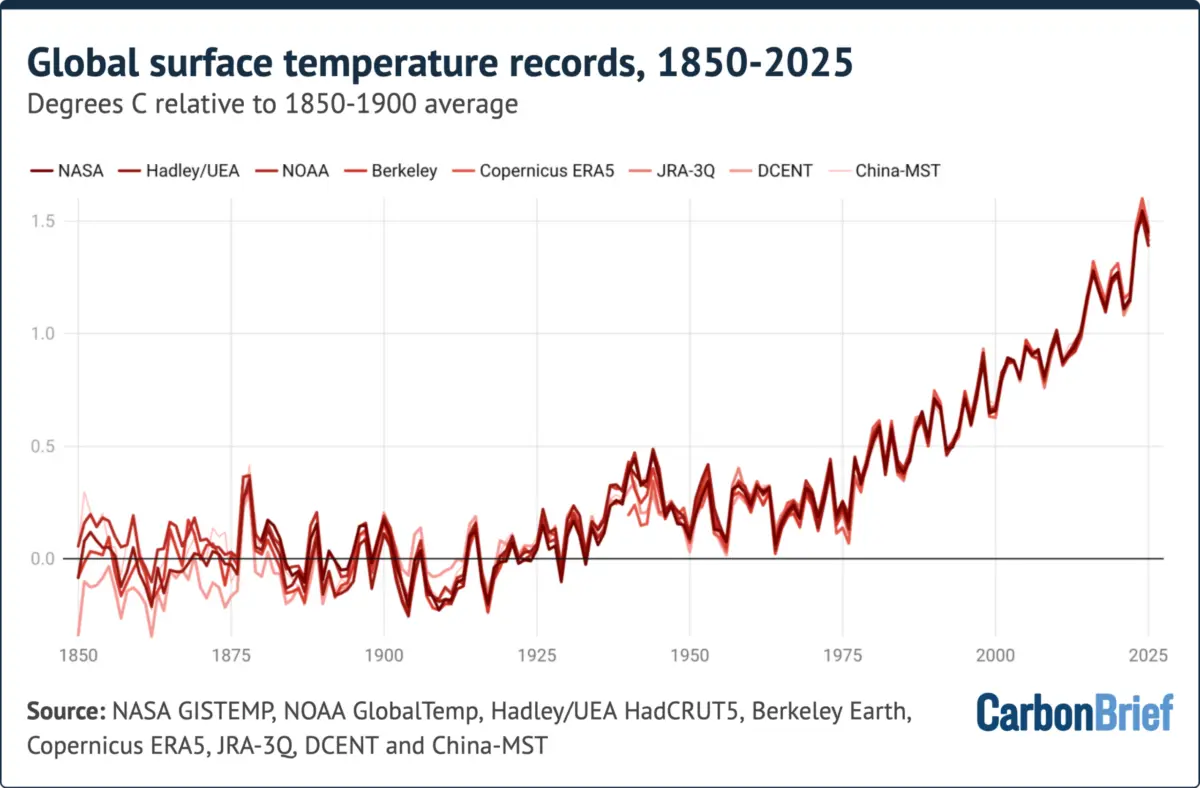
Similarly, claims by Tice that global temperature shifts are merely part of natural, multi-millennial cycles ignore the unprecedented scale of modern warming. While Earth’s climate has experienced ice ages and warm periods driven by orbital variations over tens of thousands of years, current global temperatures are roughly 1.4C higher than pre-industrial levels, a pace of warming that scientists overwhelmingly attribute 100% to human greenhouse gas emissions. Tice’s assertions that the sun or volcanoes are responsible for recent warming have been repeatedly debunked by comprehensive scientific analysis, which demonstrates that natural factors play only a marginal role in long-term temperature trends.

Farage has also leaned into misleading statistical framing, arguing that because human activity accounts for only a small percentage of global annual CO2 emissions, carbon dioxide cannot be considered harmful. While land and ocean ecosystems naturally exchange hundreds of billions of tonnes of CO2 annually in a balanced global carbon cycle, human industrial activities have continuously added net emissions without a natural sink to absorb them, driving atmospheric concentrations to levels unseen in at least two million years.

Furthermore, Tice’s assertions that thousands of scientists dispute the consensus on net-zero rely on heavily scrutinized petitions, such as a 2022 declaration where fewer than 1% of signatories identified as actual climate scientists. Scientific bodies worldwide maintain that achieving global net-zero emissions is the only viable path to halting climate change and stabilizing global temperatures in alignment with the Paris Agreement.

Net-Zero Target
Reform UK’s opposition to the UK’s legally binding climate targets is underpinned by arguments regarding economic self-harm and international isolation. Tice has asserted that it is foolish for the UK to pursue net-zero unilaterally when other nations do not follow suit. In reality, approximately 140 countries representing roughly 74% of global emissions have established net-zero targets. If the UK were to abandon its goals, it would join a shrinking group of major emitters without formal targets, alongside the United States and Iran.

Claims that net-zero policies are "killing the economy" or costing the British public trillions of pounds similarly conflict with official economic assessments. The Climate Change Committee estimates that reaching net-zero by 2050 will require manageable net investments amounting to a fraction of national GDP, significantly outweighed by the operational savings of clean technologies and the avoided costs of severe climate damages. Historical data shows that the UK economy has nearly doubled in size since 1990 while domestic emissions have fallen by more than half, demonstrating a clear decoupling of economic growth from carbon output.

Party leadership has also frequently blamed net-zero policies for industrial job losses and deindustrialisation. However, historical employment data indicates that major contractions in sectors like coal mining, steelmaking, and oil and gas extraction occurred decades before national climate legislation was introduced, driven by global market forces and resource depletion. Far from destroying jobs, the expanding green economy currently supports hundreds of thousands of high-value positions across the UK.

Energy Costs
Energy affordability is a cornerstone of Reform UK’s political messaging, with leadership frequently blaming green subsidies and renewable energy expansion for soaring consumer bills. Tice and Farage have argued that a renewables-dominated grid is inherently expensive and requires prohibitively costly backup systems.

Economic analyses from institutions such as the UK Energy Research Centre and independent energy experts demonstrate that wholesale electricity prices in the UK have been driven primarily by high and volatile international gas prices, particularly in the wake of successive global geopolitical crises. Because the UK’s electricity market design often ties power prices to the marginal cost of gas generation, fossil fuels have remained the primary driver of high bills. Conversely, renewable energy generation has acted as a crucial buffer, helping to suppress wholesale electricity prices during periods of extreme fossil-fuel market stress.

Claims regarding infrastructure costs—such as Tice’s assertion that burying transmission cables is equally or more cost-effective than overhead pylons—are directly contradicted by engineering studies from institutions like the Institution of Engineering and Technology and independent consultancies. These studies consistently show that undergrounding transmission lines is several times more expensive than overhead alternatives, and widespread implementation would impose tens of billions of pounds in additional costs onto billpayers.

Oil and Gas
Reform UK frequently advocates for a reversal of the UK’s declining fossil-fuel production, arguing that new North Sea drilling licenses and the introduction of hydraulic fracturing would replicate the low energy prices seen in the United States.

Geological reality prevents this comparison. The UK has already extracted approximately 90% of the economically recoverable oil and gas within its share of the North Sea basin, leading to a long-term production decline that spans multiple decades and administrations. Independent regulatory authorities confirm that new licensing rounds cannot reverse this depletion. Furthermore, because the UK operates within an internationally traded commodity market, domestic extraction levels exert minimal influence on global energy prices.

Similarly, proposals to introduce fracking in the UK overlook the country’s constrained shale geology, which studies indicate is far less extensive and significantly more difficult to extract than North American reserves. High population density, strict regulatory hurdles, and widespread public opposition present further barriers that make a large-scale domestic shale industry economically unviable.
Impacts and Adaptation
Rather than pursuing emissions reductions, Reform UK leadership frequently suggests that the UK should focus solely on adapting to a changing climate, framing mitigation and adaptation as mutually exclusive strategies.

Climate scientists and the Climate Change Committee emphasize that adaptation and mitigation must proceed in tandem. While adaptation measures such as flood defenses and heat resilience are essential, there are hard limits to how much societies can adapt as global temperatures rise. Unmitigated climate change threatens to impose catastrophic economic damages on the UK, with costs running into billions of pounds annually from extreme weather events, agricultural disruption, and infrastructure strain. Investing in emissions reductions remains the most effective way to prevent these risks from exceeding manageable thresholds.

Despite these scientific and economic assessments, Reform UK continues to challenge the foundational frameworks of modern energy and environmental policy, maintaining a combative stance that resonates with a segment of the electorate concerned about the immediate cost of living and regional economic transitions.