Global fossil-fuel emissions are on track to decline by approximately 0.5% this year, driven by the profound economic and geopolitical fallout stemming from the ongoing crisis in the Strait of Hormuz, according to a comprehensive new analysis by Carbon Brief.
The military conflict involving the United States and Iran has severely disrupted critical maritime trade routes through the Strait of Hormuz, triggering a massive spike in international oil and gas prices. These surging energy costs continue to ripple across the global economy, fundamentally altering consumption patterns, shifting industrial demand, and forcing a rapid re-evaluation of energy security strategies worldwide.
With each month that the disruption persists—compounded by related geopolitical flashpoints, such as renewed violence in Yemen—the financial and strategic incentives for governments and corporations to transition away from volatile hydrocarbons are intensifying.

Amid these sweeping market changes, fossil fuels continue to account for roughly two-thirds of all global greenhouse gas emissions. However, the precise mix of energy sources consumed globally is undergoing a dramatic short-term and potentially long-term restructuring.
The latest energy market forecasts from the International Energy Agency (IEA), which form the basis of the emissions estimates, paint a complex picture of shifting demand across coal, oil, and natural gas in the wake of the global energy crisis.
The Coal Market Paradox and Competing Pressures
The disruption in traditional energy supplies has fueled intense media discussion regarding an apparent "return to coal," as skyrocketing natural gas prices force some power generators to seek cheaper or more readily available alternatives. Latest forecasts indicate that global coal demand is set to rise by roughly 1.2% this year, defying earlier expectations of a downward trajectory.
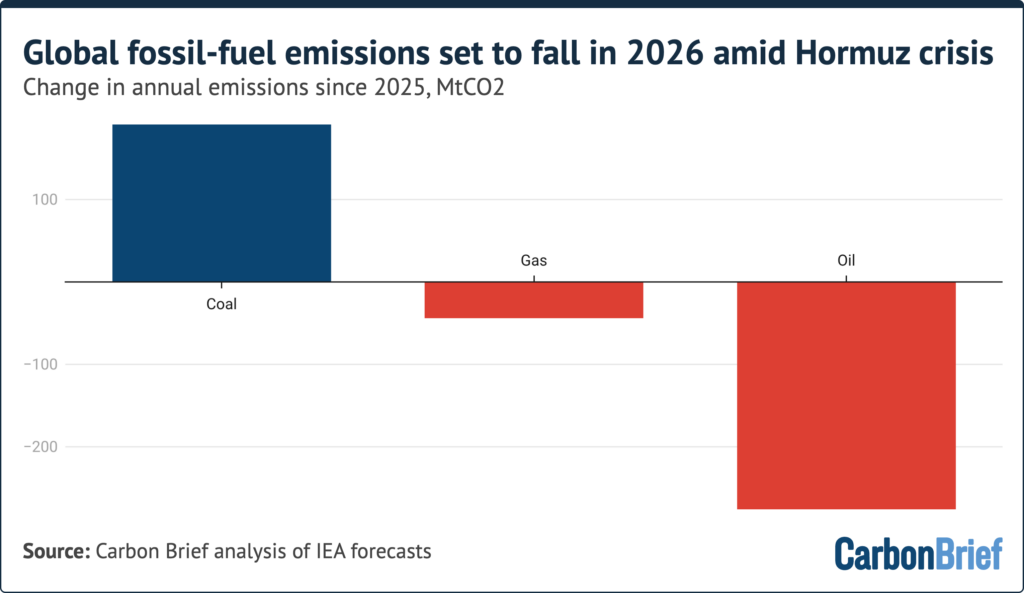
However, Carbon Brief’s analysis reveals a crucial nuance: the incremental rise in emissions associated with this increased coal use—much of which is driven by factors entirely unrelated to the Hormuz crisis—will be more than offset by steep and unprecedented declines in the consumption of oil and gas.
To understand this shift, it is helpful to examine how global forecasts have evolved over the course of the year. Initially, the IEA anticipated that global coal demand would decline through 2026. In its late-2025 coal report published in mid-December, the agency noted that structural declines in coal demand within China would successfully outweigh the impact of pro-coal policy agendas promoted under U.S. President Donald Trump.
By September 2026, however, the IEA’s mid-year update reversed course, projecting a 1.2% global demand increase for the year. The report highlighted the clear boost to coal consumption resulting from prohibitively high gas prices following the closure and militarization of the Hormuz corridor.
Even so, analysts emphasize that there are strict technical and economic limits to this trend. Only a limited number of countries possess the infrastructure required to switch large-scale power generation from gas to coal on short notice.
Furthermore, the IEA’s latest reporting points to several other short-term factors influencing coal markets this year. A notably strong El Niño climate pattern has simultaneously driven up electricity demand for cooling systems while depressing hydropower generation across key regional markets. Additionally, expanding volumes of curtailed or "wasted" wind and solar generation in major renewable markets like China have complicated the overall energy balance.
Oil and Gas Demand Plummets Under Economic Strain
While coal has experienced a modest, localized bounce, the picture for natural gas and oil tells an entirely different story of contraction and demand destruction.
For natural gas, the IEA initially projected a robust 2.0% increase in global demand for 2026, based on forecasts published in January. By July, however, that outlook had shifted downward to a 0.6% contraction. Since then, intense economic pressure from sustained high prices has continued to suppress gas consumption across industrial and residential sectors alike.

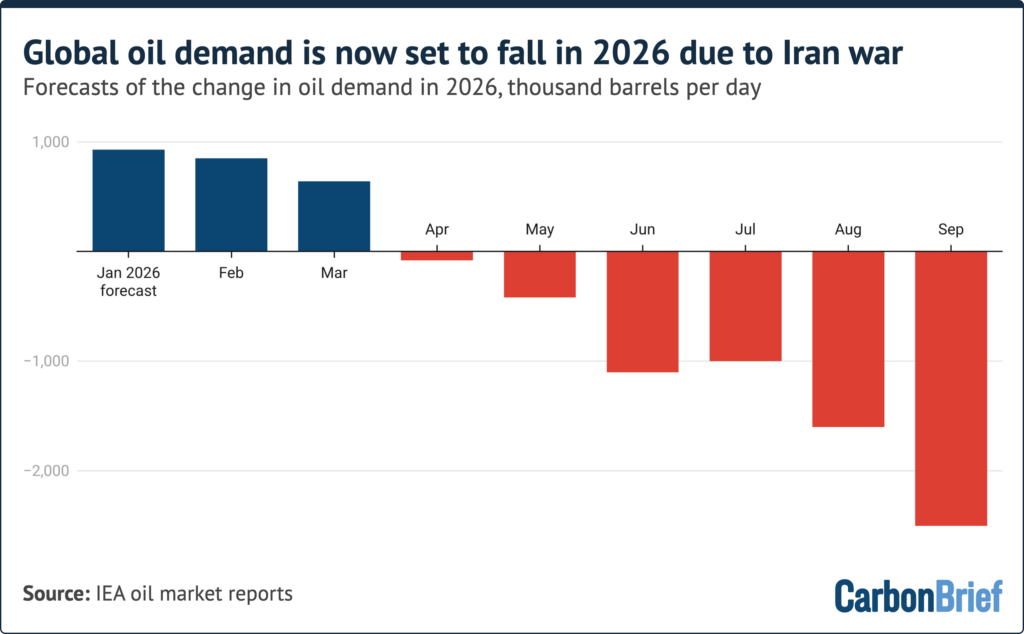
The shift in the global oil market has been even more dramatic and far-reaching. At the start of 2026, the IEA’s January oil market report anticipated modest growth, forecasting an increase in demand of approximately 930,000 barrels per day (bpd). As the Hormuz crisis ignited, escalated, and subsequently dragged on, those projections were steadily and aggressively revised downward month after month.
By September, the IEA’s forecasts estimated a staggering 2,500,000 bpd drop in global oil demand for 2026, representing a 2.4% reduction compared to 2025 levels. Independent financial institutions have echoed these findings; a mid-September research note from Morgan Stanley placed the consensus forecast among major analysts at a reduction of 2,415,000 bpd for the year.
Permanent Demand Destruction and the Accelerating Energy Transition
While numerous short-term economic and meteorological variables have influenced energy forecasts throughout 2026, energy analysts increasingly agree that the severity of the current crisis will leave a permanent mark on fossil-fuel demand well beyond the current year.

Initially, the IEA projected that global oil demand would experience a swift economic rebound in 2027, pushing consumption comfortably above 2025 levels. Today, the agency expects oil use to remain essentially flat for two consecutive years. This stagnation directly challenges previous baseline assumptions—such as those published in late 2025—which suggested that global oil demand would not reach its ultimate peak until approximately 2030.
Industry experts argue that prolonged geopolitical instability acts as an irreversible catalyst for structural change. Sverre Alvik, vice president at energy consultancy DNV, noted in a late-August analysis that every month the conflict continues significantly increases the probability of permanent oil demand destruction.
As international fuel prices have remained stubbornly high, electric vehicles have captured record-shattering market shares across major global automotive hubs, including Australia, China, Europe, Indonesia, and Thailand. In July alone, EV sales nearly doubled year-on-year across emerging markets outside the traditional powerhouses of China, Europe, and North America.
Meanwhile, the 2027 outlook for coal and gas remains heavily interdependent. Coal demand could experience renewed upward pressure if international gas prices remain elevated, or it could retreat if LNG markets stabilize.

Governments in developing economies that had previously planned to anchor their near-term energy security on imported liquefied natural gas are now signaling strategic shifts. Facing prohibitive import bills, many nations are reassessing their reliance on imported fossil fuels, choosing instead to accelerate investments in domestic clean energy generation or extend the operational lifespan of existing coal infrastructure.
Ultimately, the confluence of geopolitical conflict, skyrocketing commodity prices, and accelerating clean technology adoption has created a pivotal moment for global energy markets. The current crisis carries the clear potential to drive down fossil-fuel consumption and greenhouse gas emissions not merely as a temporary shock, but on a more permanent and transformative basis.