Most data practitioners arrive at Polars after experiencing a very specific, highly relatable kind of professional frustration. They encounter a scenario where they are working with a dataset that comfortably fits on their local hard drive or disk storage, yet steadfastly refuses to fit into their system memory during manipulation. Alternatively, they watch helplessly as a complex data transformation script runs entirely on a single processing core while the other fifteen cores on their modern multi-core workstation sit completely idle, contributing nothing to the task. It is this exact performance bottleneck that has fueled the rapid rise of Polars, a modern DataFrame library written from the ground up in Rust and built directly on top of the Apache Arrow memory format.
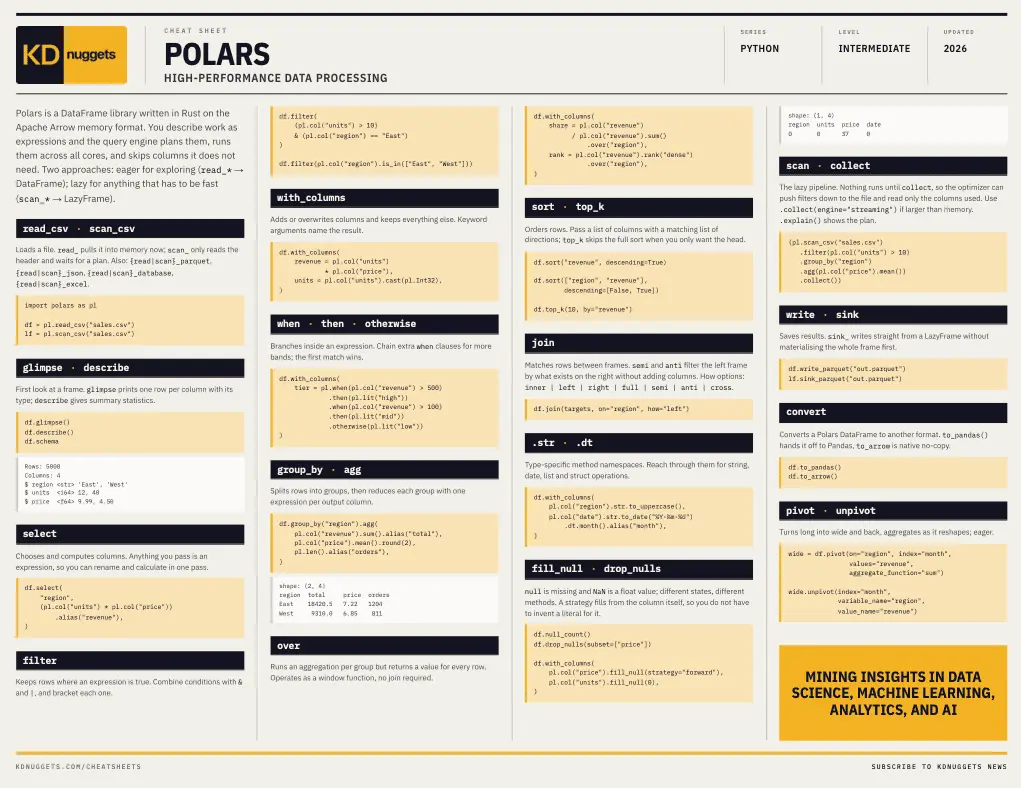
However, industry experts note that the exceptional processing speed of Polars stems less from the inherent performance characteristics of the Rust programming language itself and much more from its underlying execution model. This architectural model shifts the traditional data processing paradigm: instead of commanding the computer to execute operations step-by-step immediately, users describe their intended data manipulations as a series of abstract expressions. The sophisticated Polars query engine then reviews these expressions, plans out an optimized execution strategy, decides how to distribute the workload across all available hardware cores, and aggressively prunes away unnecessary columns before a single byte of heavy computation takes place. To help data scientists and engineers harness this advanced architecture effectively, KDnuggets has officially released a comprehensive new cheat sheet covering all the foundational functionality needed to make Polars work at peak performance.
The mechanics of this execution model become clearest when examining the fundamental difference between eager and lazy evaluation methods, specifically through functions like read_csv versus scan_csv paired with collect. In a traditional eager execution framework, a command like read_csv instructs the system to ingest an entire data file into computer memory immediately. In contrast, scan_csv reads merely the file header and then pauses, waiting for further instructions. Everything chained to a scanned data source is simply a description of user intent rather than an immediate command; nothing actually executes until the user invokes the collect method. This delayed execution gives the query optimizer ample room to maneuver, allowing it to push data filters directly down to the file parser level so that the system reads exclusively the rows and columns that the analytical pipeline actually requires. Furthermore, for datasets that genuinely exceed the physical limits of the host machine’s RAM, invoking collect(engine="streaming") allows Polars to process the data in manageable chunks rather than throwing an out-of-memory error and giving up entirely.
Another critical architectural concept highlighted in the new resource is the over expression, a powerful feature that addresses common grouping challenges without requiring convoluted code. Traditional data workflows often necessitate complex groupby operations followed by structural joins to calculate group-level metrics alongside original row data. The over syntax, by contrast, executes a specific aggregation per group while gracefully returning a corresponding calculated value for every individual row in the dataset. This capability means that tasks such as calculating a specific geographical region’s percentage share of its own total metric, or establishing rankings within discrete categories, can be accomplished smoothly without resorting to cumbersome groupby-and-join individual treatments. It functions essentially as a sophisticated window operation that reads as naturally as any standard column expression within a broader data pipeline.
Navigating the library also requires understanding subtle data type distinctions that frequently trip up practitioners during their initial transition from other ecosystems. One particular nuance that causes outsized confusion among early users involves the distinct treatment of missing values versus undefined numerical states. In the Polars environment, a null value strictly signifies a missing data point, whereas a NaN represents an actual floating-point value indicating an undefined or unrepresentable numerical result. These two states are treated as fundamentally different conditions backed by entirely separate handling methods, and expecting them to behave as a single interchangeable concept is a common stumble for developers migrating from alternative data analysis tools.
Beyond these foundational mechanics, the new KDnuggets cheat sheet spans the entire working surface of the library, ensuring developers have quick access to essential syntax and operations. It covers the core verb set required for everyday data manipulation, including select, filter, and with_columns, which together allow for precise subsetting and feature engineering. It details grouping and reshaping capabilities through group_by, agg, pivot, and unpivot, enabling analysts to effortlessly transform wide data into long formats and vice versa. Conditional logic is also thoroughly addressed via the intuitive when, then, and otherwise construct, which provides a clean, expression-based alternative to complex nested conditional statements.
Data integration and relational operations are equally well-represented, featuring comprehensive coverage of standard joins alongside specialized variants like semi and anti joins. These filtering joins allow analysts to check for the presence or absence of records in a secondary dataset without inadvertently widening the primary data frame or duplicating rows. Additionally, the reference guide highlights the dedicated .str and .dt namespaces, which provide specialized, highly optimized methods for handling text strings and temporal data types respectively. On the output side of the pipeline, the guide emphasizes features like sink_parquet, which enables developers to write transformed data straight from a lazy frame directly to disk without ever materializing the entire dataset into memory first. For organizations that have already built extensive data infrastructures around older tooling, the cheat sheet also documents essential interoperability functions like to_pandas and to_arrow, recognizing that adopting Polars is rarely an all-or-nothing proposition that requires abandoning existing codebases.
Data professionals looking to eliminate performance bottlenecks, optimize memory consumption, and accelerate their daily analytical workflows can download the Polars High-Performance Data Processing cheat sheet directly from KDnuggets to begin applying these advanced techniques immediately.