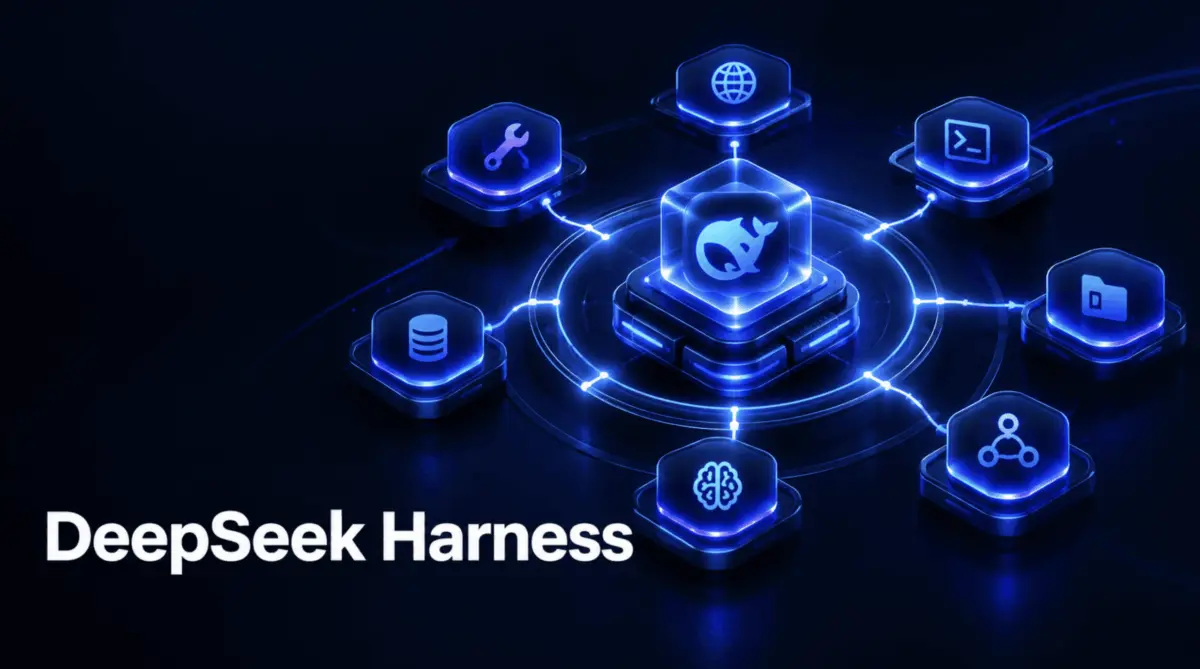
On August 13, 2026, artificial intelligence research organization DeepSeek quietly open-sourced an agent runtime designated as DeepSeek Harness, operating under the command-line interface name dsh. Despite the understated rollout, the reaction from the global developer community was immediate and overwhelming. The GitHub repository captured roughly 50,000 stars within its first twelve hours, crossed approximately 92,000 stars by hour twenty-eight, and surged past 186,000 stars alongside more than 20,000 forks in ten days. Such velocity is exceptionally rare even within the fast-paced ecosystem of modern AI tooling, prompting industry analysts and software engineers to examine what exactly drove the viral adoption, which points far beyond the simple proposition of a standard coding agent.
What’s the Buzz About DeepSeek Harness?
The central architectural claim defining the project, emphasized across DeepSeek’s technical documentation, is that virtually every layer of an autonomous agent is implemented as an independent plugin. This modular design encompasses the model adapter, the tool registry, the session log, the execution sandbox, the user interface, and even the core agent execution loop itself. The foundation rests upon Cordis, an established plugin framework boasting a robust production track record. Rather than being invented specifically for this launch, Cordis spent four years running inside the Koishi chatbot project before DeepSeek adopted it for this new infrastructure. Furthermore, the underlying design is detailed in an academic paper titled A Programming Paradigm for Spatiotemporal Composability, providing a level of rigorous theoretical grounding that most agent tooling releases rarely publish.
Industry observers note that this architectural philosophy means DeepSeek Harness is not an out-of-the-box coding agent designed to be immediately pointed at a software repository for day-to-day development work. Instead, it serves as the foundational machinery and structural framework from which customizable coding agents can be assembled.
This release also highlights a consistent strategic preference by DeepSeek for open infrastructure over proprietary walled gardens. In January 2025, the organization introduced DeepSeek-R1 as the first open, MIT-licensed frontier-class reasoning model originating from outside traditional Western artificial intelligence laboratories. Trained at a fraction of the cost required for comparable models, DeepSeek-R1 fundamentally disrupted prevailing assumptions regarding accessibility and openness in frontier AI development. The introduction of Harness appears to apply this exact philosophy one layer higher in the software stack, offering open agent infrastructure published simultaneously with the public announcement rather than through prolonged teasers or closed beta cycles.
What I Found When I Ran It
As the runtime is distributed as a standard npm package, developers can install and inspect it directly via command-line utilities. Executing the version check command returns a specific release candidate number matching the official GitHub releases page, confirming the authenticity and currency of the package. Examining the help output reveals multiple operational profiles designed for different deployment scenarios, including a web profile to boot a browser-based user interface, a headless profile for single-task execution, alongside terminal user interface and rescue profiles. Each profile represents a distinct stack of mounted plugins configured beneath a unified launcher, while package management commands treat the installation of new agent capabilities as standard package additions rather than proprietary mechanisms.
A particularly revealing diagnostic capability within the tool is a configuration dump flag, which prints the entire composed plugin tree for a given profile prior to execution. When run against the default web profile, the utility outlines more than 150 separately named, independently swappable plugins. These components range from sidebar navigation and chat interfaces down to approval prompts, sub-agent panels, and scheduling modules that remain integrated yet disabled by default. Each individual user interface panel and backend service functions as a standalone installable package possessing a unique identifier. This confirms that the framework achieves a remarkably fine-grained plugin architecture, reaching down to individual interface elements that traditional developer tools typically bundle into monolithic frontends.
Testing the one-shot headless execution path without a pre-configured model API key similarly demonstrates thoughtful system design. The runtime immediately returns a clean, specific credential error identifying the missing environment variable or configuration path required for the provider route. This structured error handling reflects a deliberate focus on developer experience, ensuring clear diagnostics rather than opaque system stack traces.
My Take
The most distinctive architectural bet underlying DeepSeek Harness is the treatment of the core agent loop itself as a modular plugin. In conventional developer utilities, modifying the execution behavior of the primary reasoning loop typically requires editing compiled binaries or deep source code. Within the dsh runtime, however, the execution loop resides within an ordinary package that can be swapped out via configuration settings just as easily as changing a user interface panel. This represents a fundamental architectural difference rather than a superficial rebranding of extensibility, explaining why developers specializing in agent infrastructure have focused heavily on the release.
Despite the intense initial interest, the framework is not yet positioned as a general recommendation for everyday software engineering workflows. The project documentation explicitly and repeatedly identifies the software as a developer preview within an ecosystem that is still actively taking shape. Independent community directories have begun cataloging dozens of specialized plugins spanning various utility categories, illustrating an active but nascent developer community.
Who Should Actually Care Right Now
For software engineers who build agent infrastructure or developers seeking the flexibility to swap session stores and sandboxing backends without managing complex forks, DeepSeek Harness warrants immediate evaluation. The underlying architecture is sound, and the software functions as a tangible, running reality rather than speculative vaporware. Conversely, developers searching for a polished, ready-to-use coding assistant to immediately replace existing daily-driver tools in production workflows will find that the framework is not yet built for that purpose, a limitation the project itself openly acknowledges.
Shittu Olumide is a software engineer and technical writer passionate about leveraging cutting-edge technologies to craft compelling narratives, with a keen eye for detail and a knack for simplifying complex concepts.