As much of North America continued to endure a summer of remarkable and prolonged heat well into September 2026, the traditional markers of autumn—crisp air, falling temperatures, and vibrant foliage—still felt like distant, foreign concepts across the majority of the continent. Yet, in the far northern reaches of Canada, the tundra and subarctic ecosystems operate on an entirely different seasonal clock. Fall does not wait for the southern latitudes; it arrives swiftly and decisively across the vast landscapes of Nunavut.
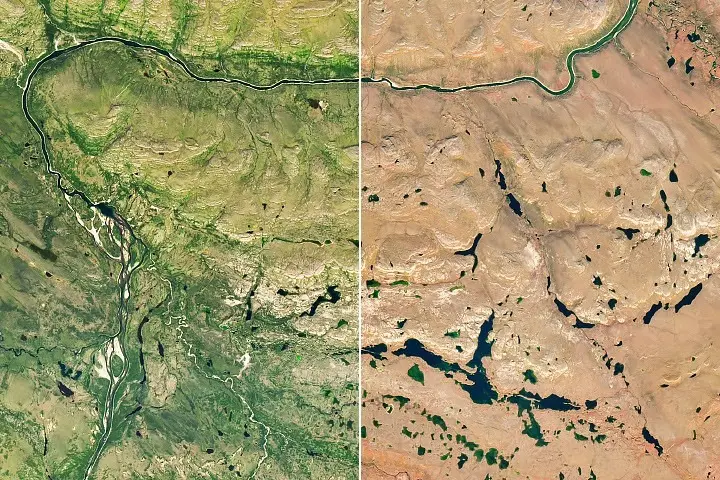
Vivid signs of this dramatic seasonal transition were already sweeping across the northern terrain on September 6, 2026. On that day, the Operational Land Imager (OLI) aboard the Landsat 9 satellite captured a striking natural-color image illustrating the transformation. The satellite view highlights the Coppermine River as it winds its way through low-growing shrubs and hardy tundra vegetation just upriver from Kugluktuk, a remote community situated at the mouth of the river.
For comparison, imagery captured of the exact same region a few weeks earlier on July 27, 2026, reveals a landscape dominated by deep, uninterrupted summer greens. By early September, however, the transformation was well underway, painting the remote river valley in brilliant shades of red, orange, and yellow.
The Unique Ecology of Northern Autumns
The affected region is famously characterized by resilient flora adapted to extreme cold, including willow and birch shrubs, wild blueberries, bearberries, and various other low-growing tundra plants. As autumn takes hold, these plants undergo a rapid chemical and visual transformation, blanketing the rolling terrain in fiery hues.
Scientific analysis of satellite data underscores just how unique this northern phenomenon is. A comprehensive seven-year study conducted jointly by researchers from NASA and South Dakota State University examined the timing and duration of autumn color changes across high-latitude environments. The analysis revealed that foliage in this specific part of Nunavut typically begins to shift in color during the very first days of September, reaching its absolute peak by the middle of the month. This makes the Canadian tundra one of the earliest places on the entire North American continent to display autumn colors.
However, observers must act quickly if they hope to witness the spectacle. The same NASA and South Dakota State University analysis highlighted a distinct characteristic of far northerly regions: they tend to experience much shorter periods of peak foliage color compared to lower-latitude areas. In many cases, the window of peak vibrancy lasts for a week or even less before the leaves drop and the barren winter landscape begins to take over.
The Science Behind the Seasonal Palette
The transition from vibrant summer greens to the warm tones of autumn is governed by fundamental biological and chemical processes within the leaves. Throughout the spring and summer growing seasons, leaves manufacture and maintain high concentrations of chlorophyll, the vital molecule that plants use to synthesize food through photosynthesis.
Chlorophyll absorbs red and blue light from sunlight striking the leaf surface while reflecting green light, which is why healthy summer foliage appears green to the human eye. However, chlorophyll is an inherently unstable compound. To maintain their green color, plants must continuously synthesize new chlorophyll, a demanding biological process that requires both ample sunlight and consistently warm temperatures.
As autumn approaches, days grow progressively shorter and ambient temperatures drop sharply. In response to these environmental cues, plants begin to shut down their food-making machinery, and the production of chlorophyll slows down and eventually stops altogether.
As concentrations of chlorophyll steadily decline, the dominant green pigment fades from the leaves. This reduction clears the stage for other pigments—specifically carotenoids and anthocyanins—which have been present in the leaves all along but masked by the abundant green chlorophyll.
Carotenoids are responsible for absorbing blue-green and blue light. With the chlorophyll gone, these pigments cause leaves to appear a bright, luminous yellow. Meanwhile, anthocyanins absorb blue, blue-green, and green light, creating wavelengths that reflect back to the human eye as vivid reds and purples. Together, these underlying chemical compounds combine to produce the sweeping tapestries of red, orange, and gold captured by Earth-orbiting satellites.
Tracking Environmental Change from Space and Ground
Monitoring these shifts is not merely an exercise in appreciating natural beauty; it provides critical data for scientists studying global environmental change and plant phenology—the study of periodic biological events in the plant and animal worlds as influenced by climate.
To expand the scope of this research, citizen scientists around the globe have opportunities to contribute directly to long-term environmental databases. Programs like the GLOBE North American Phenology Campaign invite public participants to observe and systematically record leaf color changes during both the spring and autumn transitions. By reporting these local observations, volunteers help professional scientists better understand how northern and temperate plant ecosystems respond to ongoing shifts in climate and regional environmental conditions.
The detailed observations of the Coppermine River region were compiled into the NASA Earth Observatory image archive by designer and data visualizer Michala Garrison, utilizing raw Landsat data provided by the U.S. Geological Survey. The ongoing documentation of these rapid seasonal shifts along the Arctic frontier continues to offer researchers vital insights into how Earth’s northernmost ecosystems react to a changing climate, capturing a fleeting moment of natural color before the long, cold winter locks the landscape in ice and snow.