Home appliance and consumer electronics giant LG Electronics USA has announced plans to suspend any applications built for its smart TVs that function as always-on residential proxy nodes. The decisive move by the manufacturer comes less than a month after independent cybersecurity researchers revealed that an alarming percentage of games, utilities, and other software available for download on LG’s webOS store allowed unknown third parties to silently route their external internet traffic directly through an unsuspecting user’s television set.
The controversy first gained widespread attention following a detailed security report published by the security firm Spur. The researchers examined the prevalence and mechanics of residential proxy software development kits embedded within smart television applications across major manufacturer ecosystems. According to Spur’s findings, more than 42 percent of applications available for download within LG’s webOS app store included hidden software development kits capable of transforming a household television into an indefinite, active proxy node. Furthermore, the researchers discovered that more than a quarter of all applications designed for Samsung’s competing Tizen operating system contained remarkably similar residential proxy components.
When formally presented with the findings and inquiries regarding Spur’s eye-opening research, LG Senior Vice President John Taylor confirmed to security journalists that the corporation was actively coordinating with application developers to completely purge the residential proxy option from their respective offerings on the webOS platform. Taylor issued a stern warning that software creators who fail to comply with these platform safety mandates will face immediate suspension and removal of their applications from the store.
A residential proxy network is not an intended use for LG smart TVs, Taylor explained, emphasizing that LG Electronics is aggressively working alongside developers to eradicate the residential proxy option from their webOS applications. He added that if this specific capability is not completely excised, the offending apps will be swiftly suspended.
Taylor reiterated that LG remains deeply committed to keeping commercial residential proxy networks entirely out of its smart TV application ecosystem moving forward. He noted that the company’s comprehensive security review of all available webOS applications is already well underway. As part of ongoing corporate efforts to enhance platform quality and elevate the overall user experience, Taylor stated that LG will continue to significantly strengthen its evaluation processes for developer-submitted applications, particularly scrutinizing software that attempts to incorporate residential proxy software development kits.
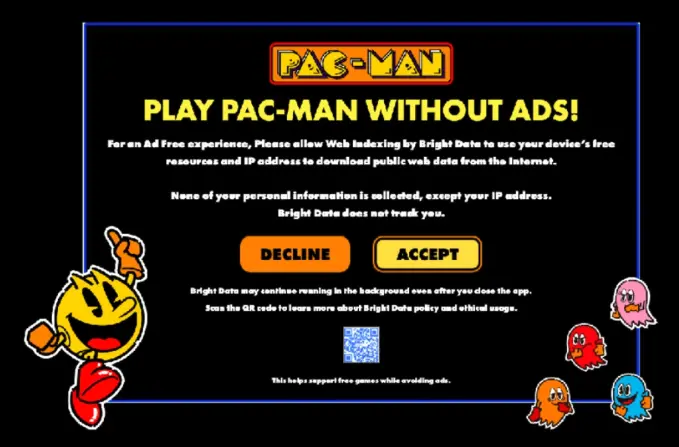
The underlying economic motivation for this trend stems from app monetization challenges. Application creators seeking alternative revenue streams frequently turn to residential proxy providers. These third-party companies routinely pay developers to integrate specialized software development kits into their products. Once installed, these kits silently convert the everyday consumer device into a residential proxy node that is then rented out to paying external customers for various data-gathering tasks. In the specific case of LG and Samsung smart televisions, Spur’s investigation uncovered that these proxy kits were bundled indiscriminately with everything from casual games like Pac-Man to visual screensavers and basic file utilities.

Spur’s comprehensive threat report identified that the residential proxy network operated by Bright Data accounted for the vast majority of proxy software development kits discovered across both Samsung and LG smart television platforms. In a formal statement provided to researchers, representatives for Bright Data defended their business model, maintaining that their entire network is built upon principles of explicit user consent and operational responsibility, operating fully within the terms of service established by both LG and Samsung.
Every peer opts in through a dedicated screen and receives value in return, the statement from Bright Data read, adding that every commercial customer undergoes strict vetting. The company noted that its operational practices have recently undergone a second independent security audit by PwC, and reaffirmed its ongoing commitment to maintaining an open, transparent internet where legitimate businesses, academic researchers, and established institutions can responsibly access information living within the public domain.
Bright Data and other commercial proxy providers highlighted in Spur’s research consistently maintain that they enforce rigorous know-your-customer verification procedures to validate the legitimacy of how their network services are utilized. These activities are frequently tied to authorized web scraping and public market research. Furthermore, the proxy companies argue that they incorporate robust technological countermeasures designed specifically to prevent proxy service customers from interacting with, scanning, or otherwise controlling other sensitive devices operating on the local home network of the proxy user.
Despite these assurances from commercial providers, security analysts like Spur argue that the core issue is not the legal existence of residential proxy networks themselves. Instead, the fundamental problem is that these commercial monetization tools are being stealthily embedded at massive scale into everyday household electronics—devices that the average consumer fundamentally views as media appliances rather than computers, and which they are entirely unequipped to monitor or audit.
A one-time consent prompt hastily buried deep inside a television application menu is never an adequate substitute for meaningful transparency, ongoing user control, and rigorous platform oversight, wrote Trevor Sutter of Spur. He pointed out that the inherent risk is dangerously amplified when consent is inadvertently granted by vulnerable individuals within a shared household who regularly use the device but lack the judgment required to provide valid consent, such as minor children.
While LG’s swift announcement that it is aggressively culling residential proxy software development kits from its application store has been widely welcomed by the cybersecurity community, the manufacturer simultaneously found itself facing separate public criticism regarding another questionable software partnership involving high-end hardware. Earlier in the week, technology analysis reports and video content highlighted by the prominent hardware YouTube channel Gamers Nexus revealed that certain models of LG LCD monitors automatically install an application designed to aggressively promote paid McAfee antivirus subscriptions. According to the findings, this promotional software arrives quietly on user systems via standard Windows Update procedures without requiring any explicit user approval prompt or prior notification.