In the modern corporate environment, the standard slide deck remains a primary vehicle for communication, yet it frequently serves as a barrier to understanding rather than a conduit for clarity. Communications experts and presentation strategists are increasingly taking a critical look at how business information is packaged, particularly when dense data is forced into single-slide formats meant to serve multiple conflicting purposes.
At the center of this ongoing evaluation is a common workplace scenario: a standalone slide that attempts to function both as an advance reading material for busy executives and as a visual backdrop for a live presentation. According to recent analyses of corporate presentation habits, this dual-purpose approach nearly always compromises the effectiveness of the message.
When viewed as a standalone document, commentary provided alongside dense data can offer helpful context, but the core message frequently gets lost in the layout. Readers are forced to do the heavy lifting themselves, spending valuable time trying to identify what actually matters and why the information is significant. A strong pre-read document is supposed to help leaders arrive at a meeting fully informed and ready for substantive discussion. Instead, traditional, overloaded slides often leave executives scanning through chaotic tables and dense text blocks right up until the meeting begins, undermining the very purpose of advance preparation.
The situation becomes even more problematic in a live setting, where a busy slide creates immediate friction for both the speaker and the audience. When a display is crowded with complex tables and bulleted text, attendees are forced to split their attention between reading the screen and listening to the presenter speak. Even in scenarios where the audience has diligently read the material in advance, they still find themselves hunting for specific details during the live delivery rather than engaging meaningfully with the overarching message.
Communication professionals emphasize that a live delivery is significantly more effective when audience attention is deliberately guided. Rather than showing an entire database of information all at once, revealing ideas sequentially allows the speaker to maintain control of the room and keep the focus exactly where it needs to be.
Start with the purpose
To fix these common communication breakdowns, experts suggest that being specific about the operational situation helps dramatically to improve design. Before a single chart is built or a bullet point is drafted, creators must ask fundamental questions about what the slide actually needs to achieve, who will be using it, and in what kind of setting it will be displayed. Once those core parameters are clearly determined, it becomes much easier to shape the narrative arc and choose the right structural format for the information at hand.
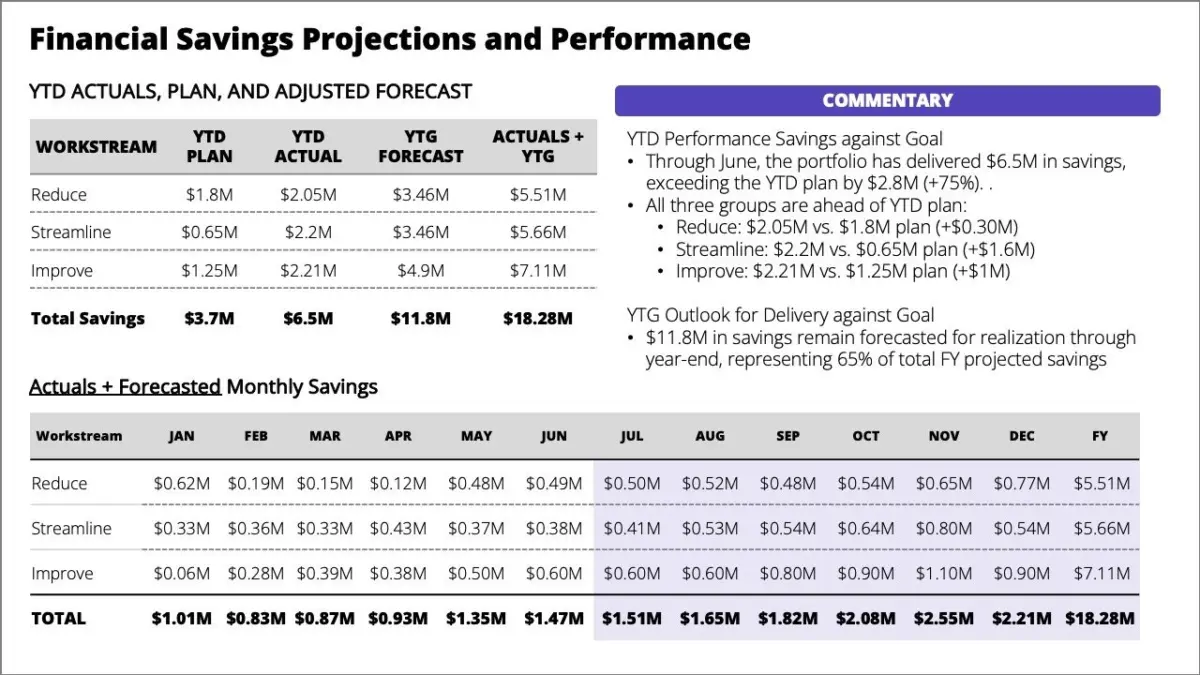
Consider a recent real-world client example that illustrates this exact challenge. The overall message the client originally wanted to communicate in a single slide was that, despite year-to-date performance running ahead of plan, a significant amount of work still remained to achieve the final forecast. The primary call to action was to reiterate organizational priorities to ensure the team stayed thoroughly focused on three critical workstreams, while also establishing a mechanism to quickly escalate any blockers standing in the way of projected savings.
Attempting to cram all of this vital strategic nuance—financial performance, workload warnings, operational workstreams, and escalation protocols—into one visual view inevitably dilutes the impact. Articulating the primary goal at the outset helps presenters determine what stays, what gets cut entirely, and how to structure the narrative to fit each unique communication situation.
When looking at how to restructure information effectively, communication strategists advise considering the live delivery context first. When presenting in person, a speaker does not need to cram every detail onto a single view because they control the pacing of the conversation. Instead of showing everything at once, the content can be broken down into a deliberate sequence where each individual slide supports one specific, digestible point.
Adopting this phased approach shifts the dynamic of corporate meetings away from passive reading and toward active engagement. As organizations continue to reevaluate their internal communication tools, the push for clarity over clutter highlights a broader shift in corporate culture—one that values the time and attention of leadership teams by ensuring that every presentation is built with a clear purpose, a focused narrative, and a structure designed for genuine comprehension.