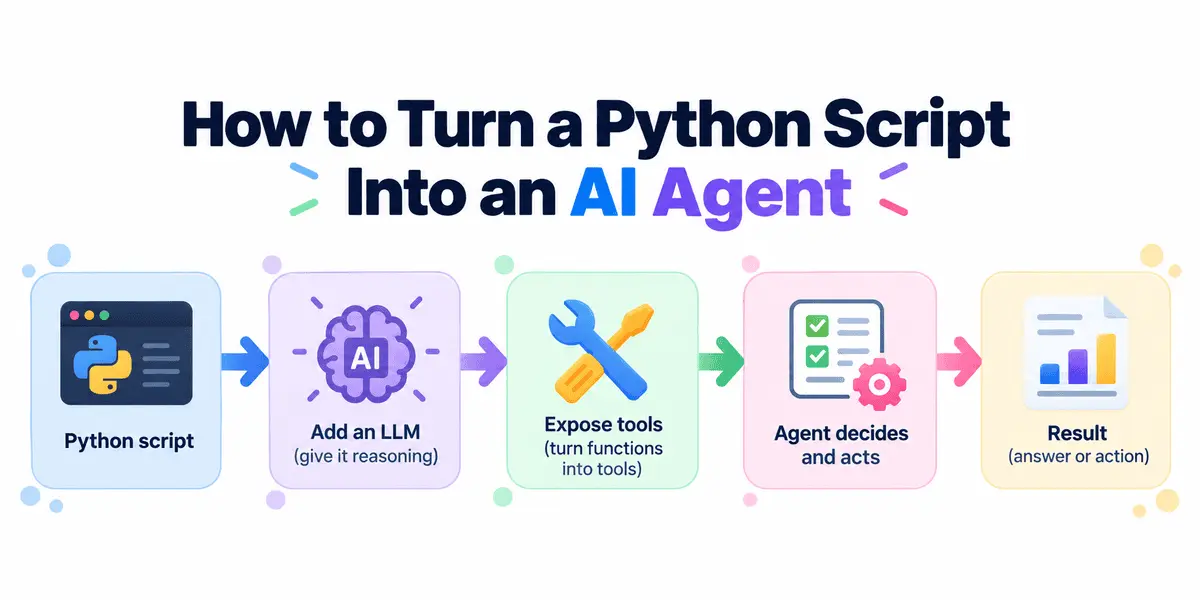
The boundary between traditional software automation and artificial intelligence continues to blur as developers gain access to tools that bridge standard application code with large language models. Rather than undertaking costly and complex rewrites of existing Python codebases, software engineers can now expose their functional scripts directly to large language models as dynamic tools, allowing an autonomous agent to determine when to call specific functions, how to assign arguments, and how to process the resulting data.
This architectural shift highlights a growing trend in software engineering: shifting away from rigid, hardcoded control flows and toward intent-driven automation. By utilizing frameworks like the OpenAI Agents SDK, developers can take familiar automation scripts—such as a routine website-monitoring utility—and elevate them into sophisticated AI agents capable of multi-step reasoning, comparative analysis, and adaptive decision-making.
Moving Beyond Fixed Execution Logic in Traditional Python Scripts
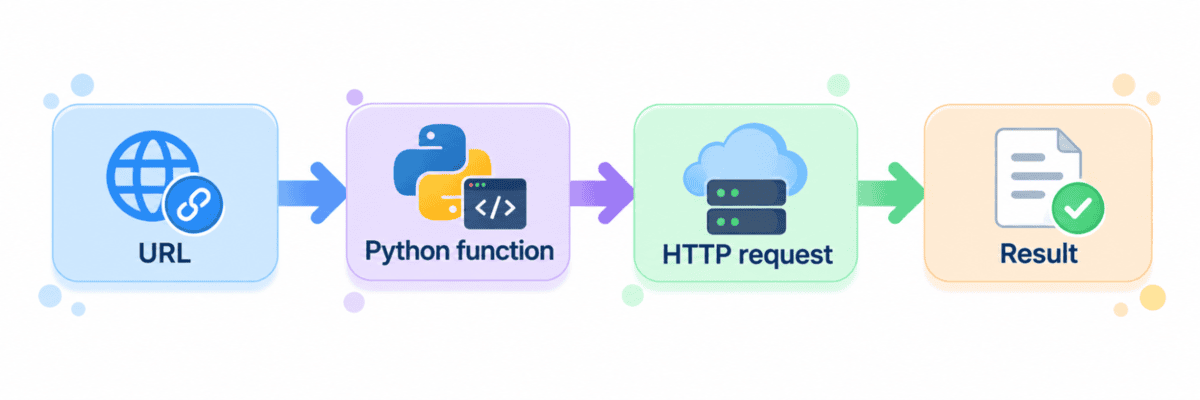
To understand the impact of this architectural evolution, it is helpful to examine how standard automation scripts typically operate. Consider a basic Python program designed to monitor website availability and measure response latencies using standard HTTP requests and performance counters. In a conventional setup, a developer writes a function to dispatch an HTTP GET request to a specified uniform resource locator, capture the response code, calculate the elapsed time down to the fractional second, and return a formatted string indicating the health and speed of the target endpoint.
While such a script executes reliably for a single target, its operational workflow is entirely fixed. If a developer wishes to evaluate five distinct websites, compare their respective latencies side by side, or dynamically identify which server is experiencing performance degradation, they are required to write the underlying iteration and comparison logic manually within the application code. Every conditional branch, loop, and exception-handling routine must be meticulously mapped out by the programmer in advance.
This rigid paradigm changes fundamentally when an artificial intelligence model is introduced into the loop. Instead of hardcoding every decision point in Python, developers can expose functional blocks—such as a website-checking utility—as accessible tools and provide an AI model with a high-level objective. Armed with these capabilities, the model gains the autonomy to decide when a tool should be invoked, which parameters to pass, how many times the operation needs to be repeated to gather sufficient evidence, and how to synthesize the raw outputs into a coherent, natural-language response.
Integrating the OpenAI Agents SDK Into Modern Workflows
Implementing this capability relies on lightweight runtimes designed specifically to manage agent interactions, tool execution, session states, and execution tracing. Developers typically initialize a dedicated project environment, install the requisite packages—including the OpenAI Agents SDK alongside standard HTTP request libraries—and configure their environment variables with the necessary API credentials.
The core innovation of the Agents SDK lies in its ability to abstract away the boilerplate code traditionally required to interface application logic with language models. When a standard Python function is decorated with specific tool-definition markers, the runtime automatically inspects the function signature, parses its parameters, and constructs the JSON schema demanded by the underlying model. Furthermore, it leverages the function name and embedded documentation strings to generate semantic descriptions, allowing the artificial intelligence to understand the utility of the function without requiring the developer to manually write complex interface schemas.
Once the function is properly exposed as a tool, developers instantiate an agent entity, define its operational persona or system instructions, and supply the tool within the agent configuration. When a user issues a natural-language request—such as asking the agent to evaluate multiple prominent web portals and identify the slowest responder—the agent takes over the execution flow.
Understanding the Autonomous Decision-Making Loop
Behind the scenes, the interaction between the language model and the application code is governed by a continuous runtime loop managed by an execution runner. When a user submits a prompt, the language model evaluates the request against the available tools and determines whether external data or action is required. If tool execution is deemed necessary, the model formulates the appropriate function arguments and triggers the execution of the local Python code.
Once the Python function executes and returns its output, the resulting data is fed back into the model context. If the initial findings provide enough information to satisfy the user request, the model generates a final synthesized response. However, if the model determines that further investigation is required—such as checking additional endpoints or verifying anomalous findings—it can invoke the tool repeatedly until it has gathered sufficient evidence to formulate a complete answer.
This iterative feedback loop represents the defining characteristic of agentic workflows. Rather than executing a pre-determined sequence of instructions written entirely in procedural code, the software application relies on the model’s semantic understanding to orchestrate the workflow dynamically based on real-time feedback and changing conditions.
Expanding Agentic Automation Across Diverse Python Scripts
The architectural pattern of wrapping existing functions into discoverable tools extends far beyond simple website monitoring. Virtually any standard Python automation script—ranging from data processing pipelines and file management utilities to database querying scripts and API integrations—can be adapted using this methodology.
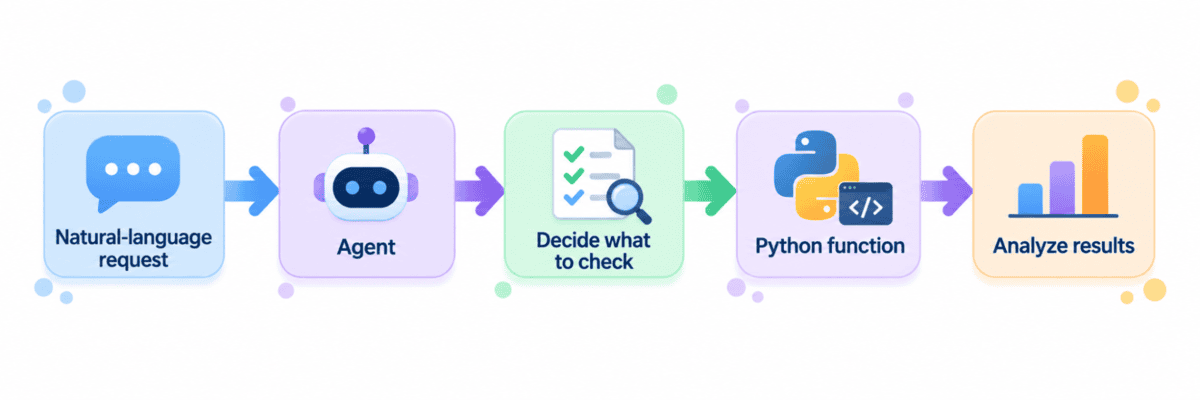
By retaining the underlying procedural code that performs the heavy lifting while layering an agentic orchestration framework on top, developers can preserve tried-and-tested automation routines while supercharging them with natural-language comprehension, intelligent tool selection, and flexible multi-step execution. The Python code continues to execute the actual computational work, while the artificial intelligence model assumes responsibility for planning, reasoning, and combining disparate outputs into meaningful insights.
As the software industry continues to embrace agentic architectures, the practical applications for multi-step automation are expanding rapidly. Driven by the availability of more efficient and cost-effective language models capable of running complex tool-using systems at scale, organizations are increasingly turning to agents to handle intricate, multi-layered tasks that previously required extensive custom scripting. By granting models a clear objective and a robust set of well-defined functional tools, developers are redefining how software applications interpret user intent and execute complex operational workflows.