The ongoing debate surrounding data communication reached a fresh flashpoint yesterday when a participant in a professional data presentation workshop raised a fundamental question about the boundaries of objectivity. Working closely with academic researchers and rigorous statisticians, the workshop attendee voiced a common discomfort: the very idea of “telling a story” with data can feel counterintuitive, if not outright dangerous, to those trained in empirical sciences.
The core anxiety centers on the mechanics of narrative. Doesn’t telling a story inherently mean choosing a specific perspective? And doesn’t choosing a perspective inevitably introduce bias? For many scientists, analysts, and quantitative experts, the most objective approach appears to be stepping back entirely—simply displaying the raw numbers, charts, or regression outputs and letting the audience draw their own independent conclusions.
It is an instinct rooted in a commitment to scientific integrity, but experts suggest it misunderstands both the nature of storytelling and the illusion of absolute neutrality.
The resistance often begins with terminology. The word "story" frequently triggers mental associations with embellishment, manufactured dramatic arcs, or the cherry-picking of evidence to fit a predetermined narrative. In research contexts, where precision and reproducibility are paramount, the idea of "storytelling" can sound uncomfortably close to spin.
Yet dismissing the concept entirely risks treating it as a rigid formula rather than a flexible communication tool. The appropriate narrative approach for a corporate sales team looks vastly different from the one required by a clinical researcher or a public policy analyst. The challenge facing professionals is not whether storytelling applies to their specific discipline, but rather what form ethical and effective communication takes within their unique context.
Disentangling Bias from Perspective
At the heart of the debate lies a critical distinction: the difference between a harmful bias and an unavoidable perspective.
Rigorous analysis demands that researchers actively work to minimize cognitive, methodological, and systemic biases that distort findings. But eliminating bias is entirely different from pretending that perspective can be engineered out of the human analytical process.
Long before a single data visualization is placed before an audience, a cascade of subjective choices has already occurred. Analysts must decide what phenomenon to study, what variables to measure, and what instruments to use. They formulate specific research questions, collect targeted datasets, decide which anomalies to investigate, and choose which baseline comparisons to highlight. Even the final act of displaying one specific graph while leaving dozens of alternative cuts of the data in a folder is an intentional choice.
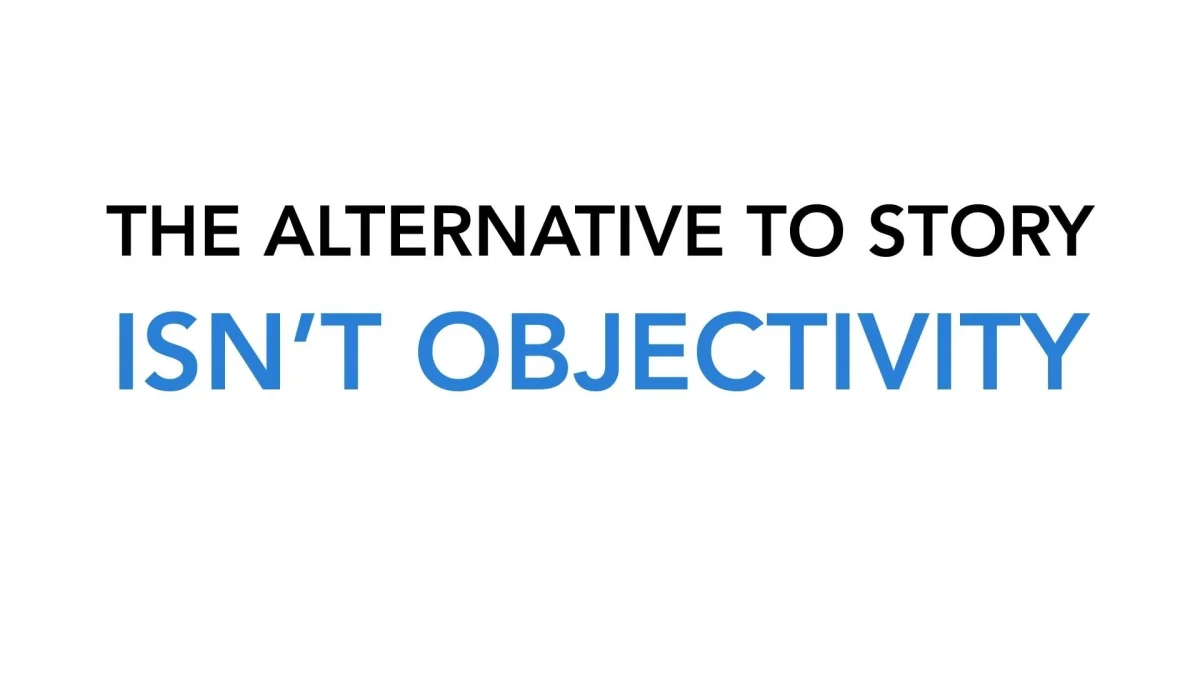
There is no magical threshold where an analyst can simply "show the data" without having heavily influenced what an audience perceives. The true alternative to a deliberate story is not pure objectivity; it is unguided, unstructured interpretation.
Having a reasoned perspective on data is not a professional failing. Given the depth of time researchers invest in their work, it is an inevitable asset.
You Know the Data Better Than Your Audience
Professionals who conduct quantitative research spend considerably more time with their data than anyone else in the room. They have explored its contours, tested its limits, investigated unexpected anomalies, and weighed its contextual constraints. They possess a comprehensive understanding of what the numbers can—and cannot—reveal.
Discarding that hard-earned institutional and contextual knowledge at the exact moment of communication makes little sense.
Effective communication requires bridging the gap between the analyst and the listener. When researchers withhold their interpretation, they do not eliminate bias or ambiguity; they merely outsource it. Audiences left to decode complex datasets on their own will inevitably make sense of the information somehow. While some may arrive at the intended conclusion, others may misinterpret critical nuances, miss vital trends, or inadvertently extract misleading takeaways. In the worst-case scenarios, a complete lack of guidance leaves raw data vulnerable to being selectively weaponized by third parties to advance unsupported agendas.
Just showing the data provides no inherent shield against misinterpretation, selective bias, or manipulation. In many cases, professional silence makes those negative outcomes significantly more likely.
Starting with Perspective When "Story" Feels Uncomfortable
For professionals who remain uneasy with the vocabulary of storytelling, experts advise starting with something more tangible: bringing an active, reasoned perspective.
Grounded in a deep familiarity with the dataset, analysts can ask straightforward questions before presenting their work. What stands out as genuinely important? What deserves the audience’s immediate attention? What are the most reasonable conclusions a stakeholder might draw, and what practical decisions or strategic conversations should this information inform?
This approach does not require manufacturing a singular, forced certainty where the data remains ambiguous. In exploratory research or preliminary studies, effective communication frequently involves mapping out multiple plausible interpretations. Analysts can outline several ways to read the findings while highlighting the specific questions those results raise. This method provides non-expert audiences with a reliable intellectual anchor without overstating what the underlying evidence can support.
Bringing a distinct perspective also means actively communicating uncertainty, methodological limitations, and alternative explanations. Responsible communicators do not want their work to wield more influence than the underlying evidence warrants. At the same time, however, a fear of exerting too much influence is rarely a valid justification for aiming for zero impact.
Rejecting Passivity Disguised as Rigor
The deep-seated discomfort with narrative structures often leads analysts to retreat behind the shield of passive neutrality. Declaring that a professional role is "simply to inform" sounds admirably objective on the surface. In practice, however, it can occasionally serve as an intellectual shortcut—a way to avoid the demanding work of synthesizing complex information and helping stakeholders make actionable sense of it.
True communication rigor is not mutually exclusive with having a clear point of view. Professionals can maintain rigorous standards while holding a distinct perspective; they can tell a clear story while fully acknowledging data uncertainty; and they can direct an audience’s attention toward critical findings while simultaneously providing the underlying evidence needed to challenge that very interpretation.
These elements are not contradictory. They represent the core components of responsible professional communication.
When faced with complex data and the reflexive urge to declare that storytelling has no place in a given field, researchers and analysts are encouraged to reframe the challenge. Rather than asking whether storytelling works in their specific situation, the more productive inquiry is to ask what form effective storytelling should take.
Whether that manifests as a decisive strategic recommendation, a cleanly articulated empirical finding, a balanced set of alternative interpretations, or a focused effort to direct attention where it matters most, the underlying imperative remains the same. Professionals must bring their expertise, context, and perspective to the data, and then give their audience the tools required to question, challenge, build upon, or act on those findings.
Refusing to tell a story does not eliminate perspective. It simply leaves the narrative to someone else.